It seems like ancient history today, but just a few months ago, Colorado's political class was embroiled in a major controversy over proposed "local control" ballot initiatives to give communities greater say in regulating oil and gas drilling. Several residential cities along the northern Front Range have voted to suspend or even ban the practice of hydraulic fracturing within their boundaries, in the interest of protecting residents from drilling's harmful effects but conflicting with the mineral rights owned by energy companies.
Out of a number of proposals that circulated among environmentalist and civic groups this year, two proposals supported by Rep. Jared Polis (D-Boulder) gained traction: an initiative to increase drilling setbacks from other development, and another putting an 'environmental Bill of Rights' into the state's consitution. Environmental protection has long been part of Polis' agenda, but it took on a greater importance for him after a driller violated the rules adjacent to property owned by the Congressman, later resulting in tens of thousands of dollars in fines.
At the same time, Polis was subjected to over-the-top criticism from everyone in Colorado with any connection to the oil gas industry, which if you haven't been paying attention includes a lot of Democrats. All kinds of speculation about the destruction Polis' initiatives would mean for Democrats up and down the ticket was traded at water coolers and spread among chattering class media outlets. Would Jared Polis' upward mobility in Washington take a hit? Might he even perhaps even lose to affable Republican CD-2 challenger George Leing for daring to touch the "Colorado Third Rail" of taking on the energy industry? When the race was called on Tuesday night for Polis, the headline from the Daily Camera's Alex Burness was almost gleeful: "By narrowest margin of career, Polis back for Term 4 in 2nd District."
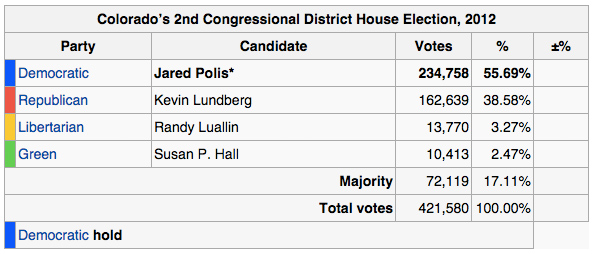
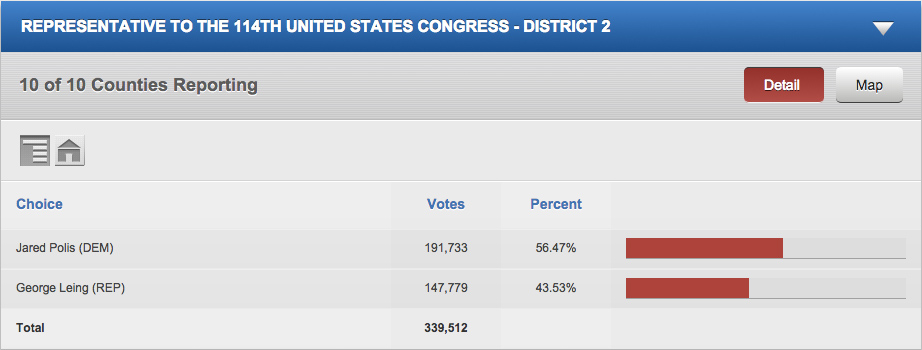
Except, now that the votes are mostly in, that's not really true: fewer people voted this year, but in percentage terms, Rep. Polis actually improved from 2012 to 2014:
Sure, you can quibble about the role of the third party candidates in 2012, and it's not really that big of an increase, but the fact remains that the 2014 "Frackapalooza" debate has demonstrably not hurt Jared Polis politically. In every objective sense, George Leing was a better candidate than 2012's Sen. Kevin "Crazypants" Lundberg, and Leing had the benefit of all of this industry-backed presumption that Jared had "overstepped." All that before we even mention that this was a "Republican wave year."
Bottom line: as we've said before, the votes by residents of communities in Polis' district to suspend or ban fracking–Boulder, Broomfield, Lafayette, and the others–are proof that Polis is representing his constituents. There's some disappointment on the left about the deal by Polis to drop his 2014 ballot measures in favor of a commission to recommend legislation on the subject, but the other side of that coin is what happens should that compromise effort fail. In that event, we expect Polis to be back, with ballot measures that can pass as this year's could have.
From these results, we'd say Polis should have something else going for him: little to fear.
Subscribe to our monthly newsletter to stay in the loop with regular updates!
Comments