Following years of controversy and divisive decisions made by past leadership, the Libertarian Party of Colorado (LPCO) is shifting its focus back to its core principles — particularly trying to run a candidate in every race.
On Saturday, at the party’s first convention since ditching its contentious ‘Liberty Pledge’ strategy, delegates selected more than 40 federal, state, and local candidates to run in the 2026 elections, including in some of the states’ most closely watched races.
As the state’s largest minor party with more than 35,000 registered voters, LPCO made headlines in 2023 when the party’s previous leadership introduced the divisive ‘Liberty Pledge’ strategy, which entailed the Libertarians not running their own candidates in tight races and instead supporting the Republican candidate, in exchange for the candidate signing a pledge to uphold Libertarian values while in office.
Following one of the strategy’s main proponents, and now-Republican candidate for Secretary of State James Wiley, losing a race for state party chair to Keith Laube in November, new leadership was eager to distance the party from the pledge. At its February meeting, the state board “formally denounced and nullified the so-called ‘Liberty Pledge.’”
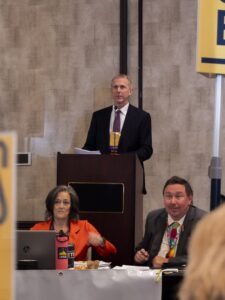
“The direction of the party, as in any political party, sort of evolves and changes, and now we’re getting back to our principles again,” said LPCO state party chair Keith Laube in an interview with the Colorado Times Recorder following the convention. “Our candidates are our best instruments to get our message out and let voters know there are better choices out there for elected officials.”
Libertarians on the Ballot
Each of the state’s eight congressional districts will have a Libertarian candidate in the race, as well as one in the race for Sen. Hickenlooper’s (D-CO) Senate seat, whose term ends this year.
In the statewide races, candidates were nominated for the governor, lieutenant governor, and treasurer races. The Attorney General race, however, will not have a Libertarian contender, as no individual who met the requirements for the office volunteered. Two candidates will run for the state Board of Education, and three will run in CU Regents races. Candidates were also nominated for six of the 18 state Senate races and for 15 of the 65 state Representative races.
The party will have its first primary race since 2020 in June, as two secretary of state hopefuls, Sean Vadney and Alex Astley, secured their place on ballots to be sent to all unaffiliated and registered Libertarian voters in June. Whoever the Libertarian nominee ends up being will be facing off in the general election against the winner of the Democratic primary and the Republican nominee, James Wiley, who, up until November, served as LPCO’s executive director.
Federal
U.S. Senate
Blake Huber
U.S. House of Representatives
CO 1: Chad Humphrey
CO 2: Gaylon Kent
CO 3: Cory Robertson
CO 4: Douglas Mangeris
CO 5: Mark Elworth
CO 6: Patty McMahon
CO 7: Dan Sallis
CO 8: David Wood
Statewide
Governer
Eric Mulder
Lieutenant Governor
Wayne Harlos
Secretary of State
Sean Vadney
Alex Astley
State Treasurer
Allison Spink
State Board of Education
District 1: Clayton Casciato
District 7: Ross Klopf
CU Board of Regents
District 2: Richard Friend
District 6: Joe Johnson
District 7: BettyRose Ryan
State House
District 7
Jeff Wilson
District 15:
Doug Jones
District 16:
John C. Hjersman
District 17:
John Angle
District 19:
Tim Johnson
District 23:
Ross Metler
District 36:
Andrew Gibson
District 38:
Norm Olsen
District 44:
John Sutton
District 45:
Caryn Ann Harlos
District 48:
Eric E. Joss
District 56:
Amy Lunde
District 61:
Kevin L. Gulbranson
District 62:
Donald Vermillion
District 64:
Charles McCollum
State Senate
District 1:
Aron Lam
District 11:
Janet Turner
District 25:
Jodie Barr
District 27:
Michele R. Poague
District 34:
Jacob Luria
District 35:
Richard Graf
David Wood
The Libertarian running in U.S. Rep. Gabe Evans’ (R-CO) 8th District, David Wood, could endanger the incumbent’s chances of reelection, given the narrow margin of victory in 2024, after the Libertarian candidate bowed out of the race due to Evans signing the ‘Liberty Pledge’ and receiving the LPCO’s endorsement.
There are currently 4,151 registered Libertarians in the district, leading some election observers to say that the absence of a Libertarian Party candidate in 2024 likely allowed Evans to pick up the votes needed to beat incumbent Democrat Yadira Caraveo in a race decided by only 2,449 votes.
Rep. Lauren Boebert’s (R-CO) reelection bid in the 4th Congressional District, though far more solid than Evans’, may also become more competitive with former Republican Douglas Mangeris entering the race as a Libertarian. Although Boebert carried the district by just over 50,000 votes in 2024, she has seen diminished support for each of her campaigns since she first won in Colorado’s 3rd District in 2020. During her 2024 run, after switching to the 4th District, the Libertarian vote was split between two candidates (one with LPCO, and the other with the Libertarian-adjacent Approval Voting Party), receiving 7,669 votes between them. The district currently has 4,888 registered Libertarians.
Several competitive races in the state legislature will see Libertarian contenders, which could result in the Republicans’ 2024 wins in the House being wiped out, and the return of the Democrats’ two-thirds supermajority. If that happens, Democrats could amend House rules, refer a constitutional measure to the ballot, and override a governor’s veto, all without any support from across the aisle.
No race could be impacted by a Libertarian candidate more than District 16, which Rep. Rebecca Keltie (R-Colorado Springs) won by just three votes in 2024, defeating incumbent Democrat Stephanie Vigil following a recount. Keltie was one of a handful of state candidates who signed the LPCO’s ‘Liberty Pledge’ and prevented a Libertarian candidate from potentially siphoning votes from her. With no official pledge to sign this year, Libertarian candidate John Hjersman and the 636 registered party members in the district may cost the race for whichever of the two Republicans, Jamie Koch and Jill Hafley, wins their primary to face Vigil in November.
Another of the state’s most-watched races, House District 19, came down to just a 110-vote margin in 2024 after Rep. Dan Woog (R-Erie) also signed the ‘Liberty Pledge’ to avoid facing a spoiler candidate and, in theory, drive the roughly 700 Libertarians in the district to support him. The district also saw a close race in 2022, with Libertarian candidate Joe Johnson receiving 1,168 votes, and Woog losing to incumbent Democrat Jennifer Parenti by 1,467. Three Democrats, including Parenti, are currently in a primary contest to face Libertarian Tim Johnson and Woog.
House District 61, although won by incumbent Rep. Eliza Hamrick (D-Arapahoe County) in an unopposed race in 2024, is traditionally a competitive seat that could see its outcome shifted by Libertarian Kevin Gulbranson’s candidacy. In 2022, Hamrick beat her Republican challenger by 1,172 votes, with 876 going to Gulbranson. The 2024 Libertarian candidate had exited the race before Election Day. Hamrick and Gulbranson will be facing Republican Scott Shamblin of Colorado Right to Life in the general election in November.
Another El Paso County race could potentially feel an impact from an LPCO candidate. House District 15, which Rep. Scott Bottoms (R-Colorado Springs) carried by 16 points in 2024, will now see Libertarian Doug Jones’ entrance into the race. And although the number of registered Libertarians in the district is just over 10% of the 7,304 vote margin by which Bottoms beat Democrat Jeff Livingston last election, Bottoms is not running for reelection this year, having instead entered the governor’s race. Two Republicans, Pricella Tiegen and Ronnie Buggs, are vying for the party nomination in the June primary to face Livingston in the general.
In the state Senate, two close races could be impacted by the presence of a Libertarian alternative — Senate Districts 11 and 27.
Rep. Thomas Exum Sr. (D-Colorado Springs) won SD11 in 2022 by 2,216 votes over his Republican challenger, Dennis Hisey, with the Libertarian receiving 2,264. Three Republicans are currently competing to face Exum Sr. and Libertarian Janet Turner in November.
Senate District 27 was carried by a wider margin in 2022, with Rep. Tom Sullivan (D-Centennial) beating out Republican Tom Kim by 10 points and 7,104 votes. Libertarian challenger Michele R. Poague’s presence in the race will likely only strengthen Sullivan’s chance of victory in November. Daryl Gibbs and Danielle Lamon currently face each other in the Republican primary.
The Post-Liberty Pledge Party
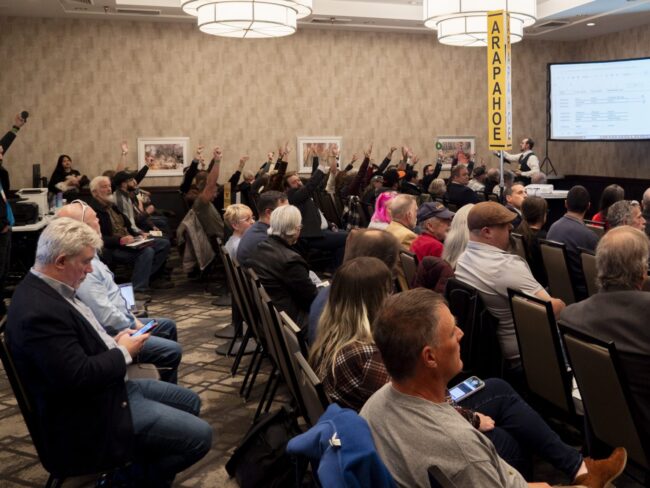
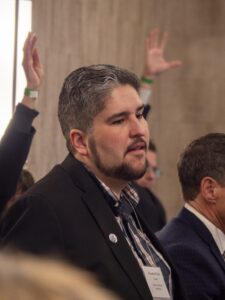
A contingent of dissenting delegates votes by a show of hands at the April 2026 LPCO Convention. Former Colorado Secretary of State Scott Gessler, bottom left, was in attendance.
The ‘Liberty Pledge,’ though recently denounced by party leadership, remained a prominent topic throughout the convention, held at the Aurora DoubleTree. While the majority of attendees appeared to be on board with the direction the party’s new leadership was taking, a contingent of roughly two dozen delegates (who sat together on the left side of the room) consistently voted against more traditional Libertarian candidates for elected office and party leadership, often voting ‘none of the above’ when an alternative candidate wasn’t available.
“We had maybe some friends that sat together that maybe have some favorite candidates in a different party — possibly the Republican party — they may not want a Libertarian candidate to run for that office,” said Laube when asked about the dissenting delegates. “At the end of the day, we will end up having candidates in those elections, so we’ll see what happens.”
Some of that contingent was made up of members or supporters of the Mises Caucus, a far-right movement within the Libertarian Party that rose to power in Colorado in 2021, a year before the movement’s takeover of the national party board as well. Though the caucus has largely lost its institutional power within the state party, some of the ideas it championed remain influential among its members.
Prominent figures in the Colorado Mises caucus, namely James Wiley, Brandon Wark, and Hannah Goodman, were the main drivers behind the ‘Liberty Pledge,’ although following Wiley’s loss in the November party election, he left the party to join the Republicans, while Goodman became a Democrat. The two former LPCO leaders have also since become engaged to one another. Wark remains a vocal figure within the Libertarian Party.
Brandon Wark
“I was part of the Libertarian Party before the Mises Caucus came along. I’m a Libertarian, so it’s where I belong,” said Wark when asked about his fellow pledge supporters leaving the party. “It’s obvious that the current board is no fan of the ‘Liberty Pledge,’ they don’t see the possibility, I think, of working with other parties.”
Wark continues to disagree with that view, however, going on to say, “if [Libertarians] want to have an influence, I would encourage anybody in the party to work with people outside of the party as well, whether they’re Democrat or Republican.”
Shortly after the party leadership election in November, Wiley and Goodman hinted at a possible attempt to retake the party during Saturday’s convention, although neither made an appearance.
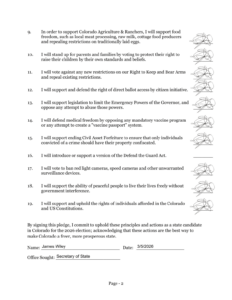
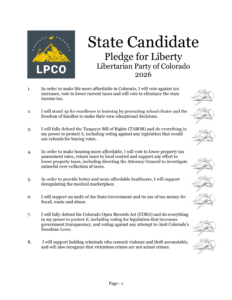
In March, Wiley posted a 2026 ‘Liberty Pledge’ that he appeared to have made himself and signed, even using the LPCO logo on the document. Laube confirmed to CTR that party leadership had not been consulted by Wiley about the pledge, made further evident by the two Libertarian secretary of state candidates competing for the party’s nomination to challenge him in the general. Laube also stated that any pledge signed after last fall was null and void.
The 2026 ‘Liberty Pledge’, posted and signed by Wiley.
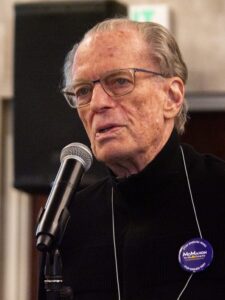
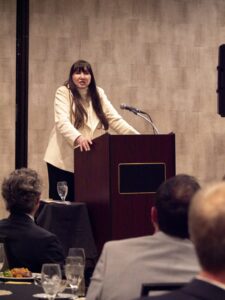
During the convention’s lunch break, 2020 Libertarian Presidential candidate Jo Jorgensen gave a speech to party donors, discussing her adherence to libertarian principles during her own campaign and the importance of other candidates doing the same.
Jo Jorgensen
“Compromising your principles is not the same as principled compromise. Principled compromise is pragmatic … you’re giving something up that you don’t want for something that you do want. I think most people in this room would prefer to give up federal reserve notes in return for gold,” said Jorgensen. “Giving up your principles for any reason is always giving up something of more value — which are your principles — for something of less value.”
Following Biden’s victory, many pundits pointed to Jorgensen’s campaign as having cost Trump the election. In an interview with CTR before her speech, she refuted that claim but stated that she didn’t have a problem with them saying it, as it may cause Republicans “to turn around and do things like support gay marriage and really cut taxes, really cut spending.”
Several party leadership positions were up for election at the convention, with most candidates appearing to draw support from either the traditional majority or the Mises Caucus and Mises-adjacent minority.
The positions of outreach director, secretary, treasurer, fundraising director, and membership director all went to candidates who appeared to be aligned with the current leadership, while the role of legislative director will be filled by Ross Metler, who, thanks to the support of the Mises-adjacent delegates, beat out the other candidate by one vote. Metler described himself as ‘somewhat’ close to Wiley and Goodman, and wore a Chainsaw Caucus pin, a group that both Wiley and Goodman both helped found and continue to lead. That group has endorsed more than 20 candidates for the 2026 primary and general elections; nearly all are Republicans, a couple are Democrats. None, however, are Libertarians.
“I am optimistic about where we’re headed right now, especially with a lot of the most divisive people having left the party, and I think that’s ultimately good for them and for us,” said Metler, who was also nominated as the Libertarian candidate for state House District 23.
When asked if he saw the convention’s results as an indication of the party returning to its principles, he was less certain, telling CTR, “I can see why people say that, but I don’t know. Principles are a funny thing, and I wish that one of our highest principles was victory.”
Delegates and party leaders alike shared Metler’s hopeful outlook when asked about the party’s future, though many of those who welcomed the direction it was heading were keenly aware of the long road between where the party is now and where they’d like to see it.
“We’re rebounding from the last couple of years, and I’m looking forward to the future,” said Laube. “Sometimes we take a bit of a swerve, but the results are what matter.”

 April 23, 2026 02:44 PM UTC
Comments