 April 22, 2026 11:30 AM UTC
Republicans Love TABOR...Whatever It Is
-
- by: Colorado Pols
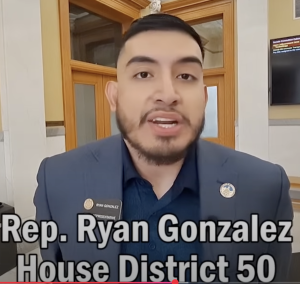
 Republican State Reps. Ryan Gonzalez and Carlos Barron discussed a meaningless resolution on Monday honoring the Taxpayers Bill of Rights (TABOR) in Colorado. The resolution (HR26-1008) was killed in the House State, Civic, Military, and Veterans Affairs Committee, but not before Gonzalez demonstrated that he actually has very little understanding of how TABOR actually works.
Gonzalez began his testimony on Monday by noting his enthusiasm for the measure passed by voters in 1992, though his history is a bit spotty:
GONZALEZ: And when I found out what TABOR was, I became fascinated. The fact that we’re the only state to have it, now you can argue, well, it’s so bad that other states don’t have it. Well, other people have tried. Other people in other states have tried, the courts have stopped them. The legislature has stopped them…
…People love TABOR. The more people understand it and learn from it and learn of it, the better that they see it. I believe that. This transcends party lines. It really does. So with that, I would just like to say, I support TABOR, I love TABOR.
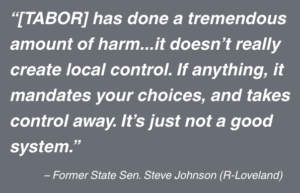
In truth, TABOR is such a shit sandwich that over the years, Colorado Republicans have gone out of their way to warn other states to avoid a similar proposal at all costs. In 2009, former Republican State Senator Steve Johnson campaigned against a TABOR-like proposal in Maine. In 2023, former Colorado GOP lawmakers Don Marostica and Bradley Young co-signed an Op-Ed in Arizona pleading with lawmakers in that state to avoid the same mistake.
After Gonzalez finished his TABOR fan boy speech, Rep. Chad Clifford (D-Centennial) asked the Greeley Republican to explain how TABOR works:
GONZALEZ: So there’s multiple components to that. So there is a formula for government growth. There is a basically like the legislature…the government cannot raise taxes without voter approval. They can lower taxes without having to ask the voters. Now, anytime they wanna keep the table surplus, they have to ask voters. And there’s other mechanisms when it comes to property taxes and local levels. It’s a very complex amendment, I would say. But overall, the moral, the bottom line, is that it involves voter approval for any sort of tax increase or revenue classification for that. So voters ultimately like to decide and approve of that.
And so that’s how I explained TABOR, short and simple, you know, make it fast. So I don’t know how you explain it to people. I’m happy to hear that. But that’s my understanding, and there’s other mechanisms too, that I would say. Are very…when it comes to explaining stuff to people, I would say I like to keep it brief. But overall, that’s a synopsis of how TABOR works.
This is where we remind you that Gonzalez is one of the two sponsors of the resolution intended to praise TABOR. Gonzalez should know what he’s celebrating, but all he can speak to is the fact that TABOR requires voter approval for any tax increase.

Asking voters to approve a tax increase is not the problem with TABOR. It is the revenue caps (and formerly the ratchet-down effects) that have made it a nightmare for the legislature to consider budgeting and funding questions.
To that end, Clifford pressed Gonzalez for more details on the thornier parts of TABOR. Here’s that word salad response:
GONZALEZ: The biggest mechanisms, and I have my notes too, but I just, because I understand what you’re saying, but I think for me, the mechanisms too, again, so for property taxes, and again, the formula for government growth spending, so population growth plus inflation can continue to grow. So we’re not basically having a fixed government revenue generating, we have it growing with population growth and with inflation. That being said, the other mechanisms for properties to a local level, governments, county, whatever, they essentially have their own mechanisms to do their taxes or tax policy, but ultimately it comes down to the voter’s approval. So I don’t know if that answers your question, but I’m happy to get some more information as well.
Gonzalez later went on to claim that inflation in Colorado was higher in recent years because of President Biden, or something. This is not true, of course, but also largely irrelevant for this discussion. In Colorado, TABOR caps government spending by a formula based on inflation plus population growth, which turns out to be a terrible way to gauge budgetary needs; it would have made a lot more sense to use something like the Consumer Price Index (CPI), which better reflects the rising costs of goods and services.
 Gonzalez finished his testimony with a celebration of “local control,” which is a concept that TABOR absolutely does not improve.
GONZALEZ: I would also say, again, local control, I believe in local control. If there’s a shortage of funding, like say with cuts or federal, whatever it is, this local municipalities can take it to the voters to, you know, whether it’s a sales tax increase or any sort of property, like mill levies, whatever it, they can take to the voter. So there’s also that local control aspect that gives them discretion versus having the whole state decide. It’s focused on the municipality in the district jurisdiction, whatever it is. To make sure that, hey, we need funding for roads, we need money for our buildings, we need to grow our wastewater plant, whatever it is, take it to the voters, let them decide, and I think ultimately, there’s no greater sense of purpose than to also have local control and let the citizens of that city and municipality decide for themselves.
Near the end of Gonzalez’s testimony, Rep. Scott “Rock” Bottoms (R-Colo. Springs) chimed in with an appropriately-incorrect bit of praise:
BOTTOMS: Representative Gonzalez, you did a fine job of explaining Tabor. It appears that you know a lot more than most sitting around this circle, so thank you for that.
There’s really no better summation of this entire discussion than one Republican praising another for delivering a completely-inadequate definition of TABOR during testimony of a resolution meant to celebrate TABOR.

 April 22, 2026 11:30 AM UTC
 Republican State Reps. Ryan Gonzalez and Carlos Barron discussed a meaningless resolution on Monday honoring the Taxpayers Bill of Rights (TABOR) in Colorado. The resolution (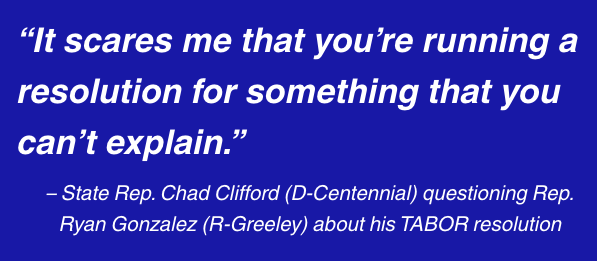
 Gonzalez finished his testimony with a celebration of “local control,” which is a concept that TABOR
Comments