Colorado Republicans in the state legislature have made it clear for years that they are not serious people and have no intention of actually trying to govern the state on any level. State Rep. Ron Weinberg (R-Loveland) said late last year that he had “no legislative agenda” and was only interested in “shutting down bills.”
Republican leaders tried to pretend that the 2026 legislative session would be different. As Colorado Newsline reports:
Republicans have new leadership in both chambers. Sen. Cleave Simpson, an Alamosa Republican, replaced former Minority Leader Paul Lundeen over the summer when Lundeen took a job leading a conservative nonprofit. Caldwell took over as the leader of the House Republicans when former Minority Leader Rose Pugliese resigned following a special session last year. Pugliese and Duran had a public falling out on the House floor.
Caldwell said he views his caucus’s role as being the “adults” in the chamber. [Pols emphasis] Since Republicans cannot pass any legislation on their own, however, their job requires working with Democrats to see their ideas make it through the legislative process.
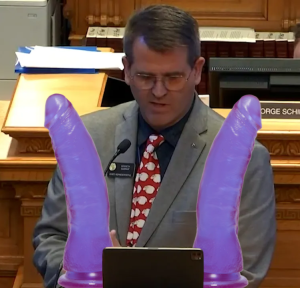
Welp, the “adults” were nowhere to be found on Wednesday. In the very first minute of discussion on the very first resolution in the State House — a standard measure to set the time and date for the Governor’s annual “State of the State” speech — Republican Rep. Ken “Dildo” DeGraaf (R-Colo. Springs) made it clear that the minority party would embark on yet another legislative session full of inanity.
DeGraaf likes nothing more than to hear himself use big words and phrases (correctly or not), and he wasted no time in launching into another of his tedious lectures before being chided by House Speaker Julie McCluskie (D-Dillon):
DEGRAAF: Now, it strikes me as odd that the neo-feudalists of this chamber, like DSA, call for “No Kings” while literally demanding a monarical [sic] society… [Pols Note: We’re assuming he meant to say “monarchical”.]
MCCLUSKIE: Representative DeGraaf, I want to get off on the right foot. I kindly ask that we have no name calling as a part of our explanation as to why we may have a particular viewpoint or opinion on either a resolution or a piece of legislation. Please proceed.
DeGraaf continued his babbling for another 10 minutes. His tedious diatribe was in reference to his proposed amendment to remove “his excellency” for the introduction of the Governor in favor of the more benign description “the honorable.” The language “his excellency” is something that has been used for decades as part of a boilerplate resolution in advance of the “State of the State,” but there’s no reason it couldn’t be changed. Indeed, House lawmakers later voted in favor of striking this term from the resolution, mostly because it’s really not that big of a deal either way and everyone wanted to get on with more important business.
DeGraaf could have gone to the podium and just said something like, Hey, we should probably change this term, and everyone could have saved 10 minutes of their lives. But that just wouldn’t do, because then DeGraaf couldn’t have shown off how smart he thinks he is.
DEGRAAF: Now, there’s a lot of problems with the term ‘Governor,’ because it ties back to, well, the feudal times — the monarical…monarch times. I’m not exactly sure how that word is. I’ll make one up later. [Pols emphasis]
Look at the big brain on Ken!
DeGraaf went on to explain how the architecture of the State Capitol is intended to show that the people hold control over the legislature because the viewing gallery is on the higher floor. Perhaps there is some truth to this idea, though the architecture probably has more to do with physics; it would be really difficult to observe legislative discussions from below the House Floor.
DEGRAAF: ‘His excellency’ is not an heritable title. It’s origins trace back to the monarchs and the colonial triciations [Pols Note: Not a real word] where it is used for viceroys and governors under British rule. In a republic, such language invokes a hierarchy incompatible with equality…
…’Excellency’ connotes a level of superiority. ‘Excellence,’ deriving from the Latin term ‘excellencia’ meaning ‘towering’ or ’eminence.’
We’d transcribe more of DeGraaf’s remarks, but we don’t want to risk permanent injury from rolling our eyes.
Colorado Republican lawmakers are not serious people interested in doing serious things. There are plenty of “adults in the room” at the State Capitol…they just don’t have an ‘R’ after their names.
Subscribe to our monthly newsletter to stay in the loop with regular updates!
Comments