(Right the first time — Promoted by Colorado Pols)
Originally posted at the Colorado Times Recorder
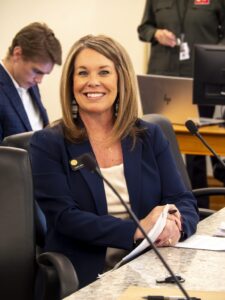
During a committee meeting at the state Capitol Tuesday, state Rep. Brandi Bradley, a Douglas County Republican, firmly pushed back against accusations from several witnesses that she was using a sweeping gun-control repeal bill as a PR stunt.
But just hours before the hearing, Bradley stated on a conservative radio program that her motivation for introducing the bill was to garner media attention and paint her Democratic colleagues as hypocrites.

The bill, referred to as the Second Amendment Protection Act or House Bill 26-1021, was sponsored by Bradley along with fellow Republican Rep. Max Brooks of Castle Rock and would have repealed almost every gun violence prevention law passed by Democrats in the state since 2013. Following a more than six-hour-long hearing by the House Judiciary Committee, the bill was postponed indefinitely by a 7-4 vote.
Bradley faced criticism from several witnesses testifying against the bill, with some describing it as a stunt for her campaign and “a slap in the face to those of us who work hard for good government in Colorado.”
While she refuted the claims during the hearing, Bradley, who is currently running for reelection, took a different tone earlier that morning.
“Absolutely, its motivation is to get national sources to look at Colorado,” said Bradley during an appearance on KHOW’s conservative talk radio show, Ryan Schuling Live, after being asked whether the bill was just an attempt to get Democrats to come out on record against the Second Amendment. The program’s host also stated that the bill likely didn’t have the votes to make it out of committee or into law, a fact which Bradley did not refute.
Later in her radio appearance, Bradley also stated that she doesn’t think that “the people of Colorado want me to pass five more bills out of 700 bills to legislate on the good people of Colorado,” referring to the maximum of five bills that a representative can introduce during a session.
During the hearing, Bradley attempted to respond directly to the accusations made against her by witnesses, saying she didn’t need a stunt to get reelected, before being cut off by Rep. Javier Mabrey, the committee’s chair and a Denver Democrat, who had to remind her twice that she was supposed to be asking the witnesses questions about their testimony during that time.
“Yes, I’m going to ask a question,” Bradley said to Mabrey before turning back to the witnesses. “This isn’t a stunt to me, I’m trying to save the taxpayers’ money … So for you to come in and accuse me of a political stunt, I’d like to ask you — I’m asking that question, why do you think $21 million is not good for the state of Colorado?”
The witness she had directed the question to, a Parker resident who had helped pass one of the bills that HB26-1021 would have repealed, responded that she had “never said that $21 million wouldn’t be good for the state of Colorado,” in reference to the estimated amount which the bill would have saved from the state budget over the next two years.

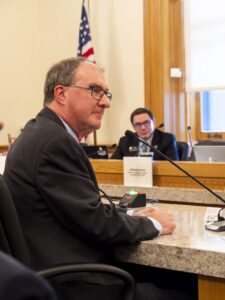
Colorado’s long and tragic history with mass shootings was a point of ongoing discussion throughout the hearing, from the Columbine High School and Aurora Theater shootings to the 2021 massacre at a King Soopers in Boulder. The mayor of Boulder, Aaron Brockett, along with several other family members of individuals who lost their lives to gun violence, testified in person against the bill.
Brockett’s testimony focused heavily on the tangible impact that gun control legislation can have on communities, and pointed to the supermarket shooting where 10 individuals lost their lives as “a visceral reminder of the importance and necessity of laws that prevent gun violence.”
Bradley later asked the mayor, with all the legislation currently in place, why the state is seeing any gun crime at all, to which he responded that he believes the laws reduce the lethality of potential shooters.
“If the King Sooper’s shooter had not been able to purchase the weapon he purchased, and instead had purchased a non-semi-automatic weapon, there’s essentially a guarantee that fewer people would have been killed in the King Sooper shooting,” said Brockett.
For victims of gun violence and their relatives, giving testimony for bills such as this one often involves reliving painful memories.
Ellen Mahoney, who has had several experiences with gun violence throughout her life and lost her husband in the King Soopers shooting, shared her story with the committee.
“I believe violence begets violence. I do not believe that more guns help us feel safer, free, or healthy. Doing nothing about gun violence won’t magically make it go away,” said Mahoney during her testimony. “In my life, I have seen gun reform reduce gun violence. Why would we ever go backwards and undo all of this?”
While she continues to oppose HB26-1021, Mahoney did walk away from the hearing with a clearer perspective on where gun-rights advocates were coming from.
“I feel like they have strong views on their position, and that was interesting for me to hear,” said Mahoney in an interview following the hearing. “I think they care about loss, and grief, and losing loved ones, but their position? They were standing up for the Second Amendment.”
Subscribe to our monthly newsletter to stay in the loop with regular updates!
Comments