

In Donald Trump’s first Presidential administration, he was often mocked for regularly claiming that the White House was two weeks away from unveiling a health care plan that would be cheaper and more effective and better tasting than the Affordable Care Act (ACA). During the 2024 Presidential election, Trump took that idea to a new absurd extreme. During an ABC News debate in September 2024, Trump uttered this now infamous line:
Asked in a follow-up question whether he has a plan to replace “Obamacare” or not, the former president replied, “I have concepts of a plan.” [Pols emphasis] He added that Americans should expect to hear more about this “in the not-too-distant future.”
Perhaps “not-too-distant future” for Trump meant “November 2025.” As MSNBC explains:
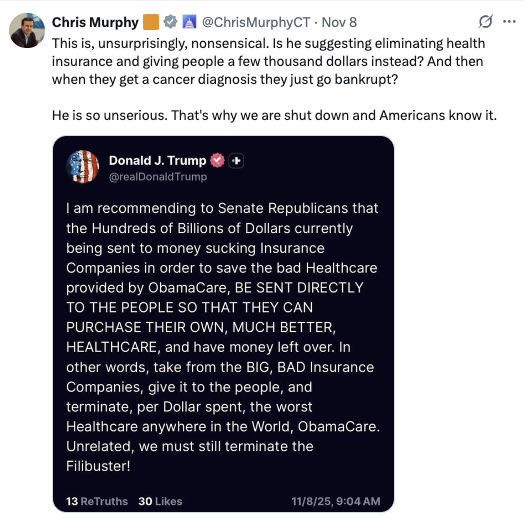
Posting on his platform Truth Social on Saturday, Trump said that he was recommending to Senate Republicans that they replace the federal subsidies for ACA premiums, which are sent to private health insurers, with money sent directly to the American people. Although Treasury Sec. Scott Bessent said there was no “formal proposal,” Republican lawmakers jumped onboard, and Sen. Rick Scott, R-Fla., said he was “writing the bill right now.”
Connecticut Democratic Sen. Chris Murphy was among those who pointed out the absurdity of this proposal:

The problem with Trump’s proposal, of course, is that it wouldn’t really do anything to “fix” health care in this country — which would be in even worse shape if not for the ACA. Back to MSNBC:
Amid such vitriol at the ACA, it can be easy to forget that the law brought America’s uninsured rate to a historic low, improved health outcomes across a range of conditions and reduced health inequities. What’s more — and what’s especially important when evaluating Americans’ health care costs — Medicaid expansion through the ACA is also associated with reductions in medical debt. These gains help explain why 64% of Americans favor the ACA, though it garners considerably less support among Republicans. [Pols emphasis]
Absent the preservation of the ACA’s core provisions, tens of millions of Americans with preexisting medical conditions would be vulnerable to outright denial of coverage by private insurers. In 2017, the health policy research group KFF estimated that 27% of non-elderly American adults had previously declinable preexisting conditions. That share has likely only increased as complications from Covid-19 have become more common and more people have enjoyed the ACA’s protections — whether gaining a primary care doctor or opting for tests that before the ACA might have revealed a preexisting condition.
This is why most Democrats wanted to hold the line on the government shutdown until Republicans guaranteed their support for extending ACA subsidies and preventing insurance premiums from DOUBLING for Americans everywhere. But now that seven Democratic Senators and one Independent folded on the shutdown without a firm commitment from Republicans on the ACA, the future of health care in this country is murkier than ever. As POLITICO reports, Senate Republicans have no intention of trying to shore up subsidies for the ACA as they instead pursue their own “concepts of a plan” for health care:
Republicans appear to be quickly pivoting from the debate around Affordable Care Act tax credits to developing their own health policy agenda, with many conservatives now feeling like they have the blessing of President Donald Trump to pursue alternative solutions to spiking insurance premiums. Among the ideas they’re considering is the creation of new health savings accounts.
The shutdown-ending deal the Senate passed Monday night lacked an extension of the Obamacare subsidies, which expire at the end of the year, and Democrats instead secured a commitment for a vote on the credits next month. Democrats who brokered that government funding compromise are insisting they’ll be able to make headway on negotiations over the tax credits and are looking to land the bipartisan health care compromise by the second week of December.
But the fractured conversations among Republicans are promising to bog down negotiations as Obamacare beneficiaries begin to lock in their rates for the year ahead. Lawmakers on both sides of the aisle are starting to privately admit it’s likely too late to avert a major premium hike for millions of Americans in 2026. [Pols emphasis]
House Minority Leader Hakeem Jeffries says that House Democrats will reject the shutdown deal that passed in the Senate on Sunday, which might be the best chance for negotiating a continuation of ACA subsidies. Because while some Republicans, such as Colorado Rep. Jeff “Bread Sandwich” Hurd (R-Grand Junction), seem willing to move forward on renewing ACA tax credits to help desperate Colorado families, we know that others are not interested in such a proposal.

As Jason Salzman explains for the Colorado Times Recorder:
Two of Colorado’s four Republican House members appear to oppose the subsidies outright. Two others say they’re open to discussing a reduced form of them, but they’re vague about the details and mum on whether they’d push for a House vote. [Pols emphasis]
The two Colorado GOP House members who are clear opponents of the health care subsidies are Reps. Lauren Boebert and Gabe Evans.
Both Boebert and Evans regularly claim that undocumented immigrants are benefitting from ACA subsidies, which is absolutely not true. Colorado Rep. Jeff Crank (R-Colorado Springs) has been his typical mealy-mouthed self on the issue, leaving only Hurd interested in doing the right thing.
Hurd has said that, when the government opens again, he wants to extend the Obamacare subsidies in some form for two years.
“Hey, let’s get the government back open, and then we can start talking about this,” Hurd told National Public Radio, explaining that he wants to “set reasonable income caps so that the help goes to the families that need it the most. And then we can build in some stronger guardrails so that the system is more accountable. And then Congress can use that breathing room in the next two years to work on long-term reform.”
But as Salzman notes, Hurd has not publicly addressed how he plans to convince House Speaker Mike Johnson to allow a vote on extending ACA subsidies.
The House seems to be the last hope on the prospect of saving Americans from catastrophic health care premium increases for another reason: Republicans still need to decide how much pain they are willing to inflict on voters heading into 2026. From Forbes:
While Trump and his congressional allies prevailed in the short-term political stare-down, the GOP now faces an impossible choice over the next several weeks. They either must agree to extend those Covid-era insurance subsidies or take sole blame for killing an effort to continue assistance that has overwhelming public support. [Pols emphasis]
No politician wants to be blamed for killing the current subsidies, which enjoy the support of a staggering 78% of the public, according to an early October KFF poll. Even 59% of Republicans support the enhanced tax credits. And that may be why the GOP will ultimately lose this war despite appearances.
It makes good political sense for Republicans to agree to extend ACA subsidies, but “good sense” and “Republicans” are two terms that go together about as well as orange juice and toothpaste. When all is said and done, we might just end up playing a game of “Election Chicken” in which Republicans decide to wait to see if 2026 voters punish them for having only a “concept of a health care plan.”
Subscribe to our monthly newsletter to stay in the loop with regular updates!
Comments