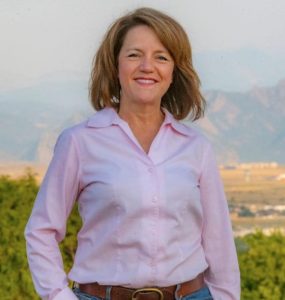
State Rep. Shannon Bird (D-Westminster) announced this week that she is resigning from the state legislature in order to focus on her campaign for Congress in CO-08.
Bird’s decision isn’t as common as you might think.
First, as The Colorado Sun reports:
The Westminster Democrat’s last day as a state lawmaker will be Jan. 5.
“The people of House District 29 deserve a representative who will be fully focused on legislative matters – and the voters of the 8th Congressional District deserve a candidate who is able to put in the 70-plus hours a week of work that it will take to flip this seat from red to blue,” Bird said in a written statement announcing her decision.
Intuitively, it might seem obvious to resign from the state legislature when seeking higher office, for a number of reasons. It is incredibly time-consuming to be both a candidate and a working lawmaker at the same time; legislators are often at the State Capitol for 12 or more hours a day during the session.
There are also fundraising restrictions for candidates. Sitting legislators can’t raise money from groups that lobby at the State Capitol while they are in session, and they are not supposed to conduct any sort of campaign business while physically inside the building. Furthermore, the legislative session takes place at the same time as the caucus process, which limits the amount of time a candidate can spend on grassroots organizing efforts for ballot access.
There is a strategic advantage, at least in theory, to remaining in the legislature while seeking higher office: Candidates have an easy platform from which to talk about policy issues and generate earned media.
For many candidates, there is also a practical reason to remain in the legislature. It’s difficult for most to give up a salary, even a small one, and to forego the family health care benefits that come with being a state employee.
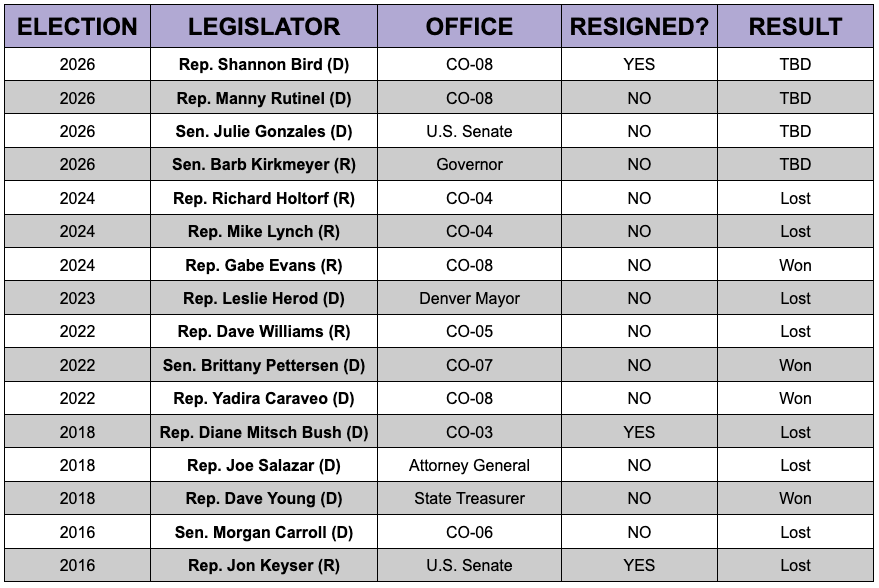
We went through the list of lawmakers who have sought higher office in Colorado in the last decade, and the results surprised us [Note: We’re not including implausible candidates such as State Rep. Scott “There is No” Bottoms, who is currently running for Governor]. Resigning in order to focus on campaigning has actually become quite rare:

It used to be a lot more common for lawmakers to give up their day jobs while seeking higher office, even though the Primary Elections in Colorado weren’t until August (Colorado moved its Primary Election to June beginning in 2012). Of course, it also used to be a lot more complicated to raise money before the widespread adoption of social media and text messaging.
Back in 2007, State Senate President Joan Fitz-Gerald resigned from her position in order to focus on the Democratic Primary in CO-02 to replace Rep. Mark Udall, who was running for U.S. Senate. Fitz-Gerald decided – correctly, in our estimation – that she needed to spend more hours in the day raising money in order to compete against fellow Democrats Jared Polis and Wil Shafroth. Fitz-Gerald ended up losing a close race to Polis, who went on to easily win the General Election.
As our chart shows, candidates for higher office who DON’T resign from the legislature don’t tend to perform worse than their counterparts. We’ll see if that holds true again in CO-08, considering that both Yadira Caraveo (2022) and Gabe Evans (2024) were sitting state lawmakers when elected to Congress. Bird is resigning her seat, but fellow Democratic challenger Manny Rutinel is not (thus far, anyway).
There’s no right or wrong answer anymore. The decision to remain in the legislature while seeking higher office seems now to be more about individual circumstances than the result of any sort of conventional political wisdom.
Subscribe to our monthly newsletter to stay in the loop with regular updates!
Comments