

U.S. Senate See Full Big Line

(D) J. Hickenlooper*

(D) Julie Gonzales

(R) Janak Joshi

80%

40%

20%

(D) Michael Bennet

(D) Phil Weiser
55%

50%↑
Att. General See Full Big Line

(D) Jena Griswold

(D) M. Dougherty

(D) Hetal Doshi

50%

40%↓

30%

Sec. of State See Full Big Line
(D) J. Danielson

(D) A. Gonzalez
50%↑

20%↓
State Treasurer See Full Big Line

(D) Jeff Bridges

(D) Brianna Titone

(R) Kevin Grantham

50%↑

40%↓

30%

CO-01 (Denver) See Full Big Line

(D) Diana DeGette*

(D) Wanda James

(D) Milat Kiros

80%

20%

10%↓

CO-02 (Boulder-ish) See Full Big Line

(D) Joe Neguse*

(R) Somebody

90%

2%

CO-03 (West & Southern CO) See Full Big Line

(R) Jeff Hurd*

(D) Alex Kelloff

(R) H. Scheppelman

60%↓

40%↓

30%↑

CO-04 (Northeast-ish Colorado) See Full Big Line

(R) Lauren Boebert*

(D) E. Laubacher

(D) Trisha Calvarese

90%

30%↑

20%

CO-05 (Colorado Springs) See Full Big Line

(R) Jeff Crank*

(D) Jessica Killin

55%↓

45%↑

CO-06 (Aurora) See Full Big Line

(D) Jason Crow*

(R) Somebody

90%

2%

CO-07 (Jefferson County) See Full Big Line

(D) B. Pettersen*

(R) Somebody

90%

2%

CO-08 (Northern Colo.) See Full Big Line

(R) Gabe Evans*

(D) Shannon Bird

(D) Manny Rutinel

45%↓

30%

30%

State Senate Majority See Full Big Line

DEMOCRATS

REPUBLICANS

80%

20%

State House Majority See Full Big Line

DEMOCRATS

REPUBLICANS

95%

5%

Generic selectors
Exact matches only
Search in title
Search in content
Post Type Selectors

Hickenlooper: Let’s Talk (Modest) Gun Control Reforms Next Year

UPDATE #4: From President Barack Obama’s emotional statement today:

The majority of those who died today were children — beautiful little kids between the ages of 5 and 10 years old.  They had their entire lives ahead of them — birthdays, graduations, weddings, kids of their own.  Among the fallen were also teachers — men and women who devoted their lives to helping our children fulfill their dreams.

So our hearts are broken today — for the parents and grandparents, sisters and brothers of these little children, and for the families of the adults who were lost.  Our hearts are broken for the parents of the survivors as well, for as blessed as they are to have their children home tonight, they know that their children’s innocence has been torn away from them too early, and there are no words that will ease their pain.

As a country, we have been through this too many times.  Whether it’s an elementary school in Newtown, or a shopping mall in Oregon, or a temple in Wisconsin, or a movie theater in Aurora, or a street corner in Chicago — these neighborhoods are our neighborhoods, and these children are our children.  And we’re going to have to come together and take meaningful action to prevent more tragedies like this, regardless of the politics.

—–

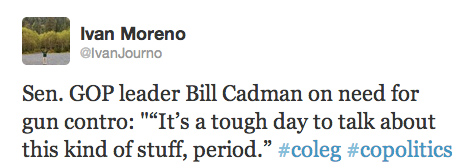
UPDATE #3: The first Colorado Republican to opine on the “is it too soon to talk about gun control?” question, quite predictably, is Senate Minority Leader Bill Cadman.


—–

UPDATE #2: A statement now available on the Connecticut shootings from Gov. Hickenlooper:

“The shooting in Connecticut is absolutely horrific and heartbreaking. We know too well what impact this kind of violence has on a community and our nation. Our thoughts and prayers are immediately with the families of those killed. We can offer comfort, but we all know the pain will stay forever.”

And from Sen. Mark Udall of Colorado:

“This tragic and senseless shooting is deeply troubling and saddening. My thoughts and prayers go out to all of the victims and their families affected by this terrible tragedy. We in Colorado experienced a similar tragedy earlier this year. Just as we came together then to grieve and support one another, Colorado and our nation will again pull together to support our friends in Connecticut.”

Also Sen. Michael Bennet, a Wesleyan graduate:

“The terrible news out of Connecticut is staggering. Like all Colorado families, my family is grieving and our hearts are with the victims, their families, and all of the students and employees at the school. This is a parent’s worst nightmare. As Coloradans, we know how this type of tragedy can shake a community to its core. We are here for Connecticut as they work together to heal in the days ahead.”

—–

UPDATE: Tragically apropos, CNN is reporting on yet another horrific mass shooting today, this time at a Connecticut elementary school.

—–

As reported by the AP via Politico yesterday:

In an interview with The Associated Press on Wednesday, Hickenlooper said that the legislative session in January would be an appropriate time to take up a debate on gun control in his state.

“I wanted to have at least a couple of months off after the shooting in Aurora to let people process and grieve and get a little space, but it is, I think, now is the time is right,” Hickenlooper said.

The comments also come after a mass shooting at an Oregon mall and a murder-suicide involving a professional football player this month touched off a national debate over gun laws…

“When you look at what happened in Aurora, a great deal of that damage was from the large magazine on the AR-15 (rifle). I think we need to have that discussion and say, ‘Where is this appropriate?'”

In the immediate aftermath of the shootings at an Aurora movie theater last summer, Gov. John Hickenlooper expressed skepticism about whether regulations on firearms might have stopped the killer from obtaining his arsenal of weapons, saying on CNN just as one example:

“This person, if there were no assault weapons available, if there were no this or no that, this guy’s going to find something. Right? He’s going to know how to create a bomb,” [Hickenlooper] said.

In Colorado, the slightest move to regulate guns is sure to be met with a furious reaction from our local and very vocal pro-gun lobby. Hickenlooper’s comments last summer were seized upon by pro-gun conservatives as evidence that not even an horrific act of violence could shake the public’s support for easy access to guns, and helped feed a narrative in the press that nothing was going to change after Aurora. Polling on the issue tends to rely on how the question is phrased, with some polls showing persistent support (for years now) for reforms such as universal background checks, but conservative pollsters like Rasmussen showing the opposite.

It’s into this delicate environment that Gov. Hickenlooper has just bravely stepped, and Democrats should give him some credit for doing so. Hickenlooper’s moderate image, often upsetting to the liberal Democratic base, could lend key legitimacy to a push for modest reforms like universal background checks for firearm sales, or limits on outsize ammunition magazines as he mentioned above. Hickenlooper’s apparent willingness to invest his hoarded political capital on this issue could honestly do a lot to relegate the “U.N. gun grab” and other unserious opposition from the gun lobby–and Republican legislators who regurgitate them–to the fringe.


Hickenlooper: “Fracking” To Fight Climate Change?

Colorado’s Democratic governor throws the conservation community a curveball on the issue of human-caused climate change, versus the controversial practice of hydraulic fracture drilling for natural gas–as the Durango Herald reports:

Hickenlooper often talked about climate issues when he was mayor of Denver, but he has been quieter on the topic since he became governor. He spent 30 minutes Tuesday morning at a conference of the Colorado Climate Network, a group of local governments that studies ways to adjust to climate change.

Acknowledging that “it drives some of my friends crazy,” the Democratic governor said embracing natural gas is the only realistic way to cut American emissions of greenhouse gases.

Hickenlooper also urged people to ramp up pressure on Congress to extend the wind-production tax credit. But he saved his strongest endorsement for a fuel that has stirred controversy in recent years.

The United States never signed the Kyoto treaty to cut greenhouse emissions, but the country is on its way to meeting the target anyway thanks to natural gas, Hickenlooper said.

“We are more than halfway toward compliance because we have these innovations in horizontal drilling and hydraulic fracturing,” he said.

Without wading too far into the contentious underlying issue, we will say that this represents a more intelligent argument from Gov. John Hickenlooper than he’s made in the past. Last year, Hickenlooper enraged environmentalists when he claimed in an energy industry-funded ad that fracking has never resulted in groundwater contamination–a claim that has been repeatedly disproven. Later, Hickenlooper claimed that “you can drink” fracking fluid, an extremely dubious claim based on one experimental “fracking” product that is not even required to be used. In yet another gaffe, Hickenlooper absurdly claimed that fracking has “literally no risk.”

These incidents cannot help but impact Hickenlooper’s credibility on the issue.

It’s clear that the public health issues presented by “fracking” in and around Colorado communities involve more immediate challenges than those presented by global climate change, though it’s true in the abstract that natural gas contributes less to that particular problem. In this latest offering, Hickenlooper presents natural gas as a “bridge” to future energy technology, and challenges opponents to find a workable alternative.

Bottom line: we’ll give Hickenlooper credit for a more intelligent case than he has made in the past, but it’s an equivocal case at best. And the question of whether “fracking’s” incremental climate change advantage offsets public health concerns? He definitely did not settle it.

Will They Stay or Will They Go?

Interior Secretary Ken Salazar may or may not be coming home to Colorado, depending on the source and the day. But Salazar answered media questions about his future plans after an event in Washington D.C. last night, and he sounded like a man…

…Well, you decide. From Environment and Energy Daily (subscription required):

“We’re thinking hard about it,” he told reporters. “My family and I are having lots of great conversations.”…

…His remarks, while brief, were some of his first since the November elections and will do nothing to tamp down speculation over whether he will continue to lead an agency that oversees energy development, recreation and conservation on hundreds of millions of acres of federal lands.

Salazar said he does not know when he will make a decision.

Salazar’s remarks come just a few days after The Center for Biological Diversity and other environmental groups sent out an odd press release promoting Arizona Rep. Raul Grijalva for Interior Secretary “when that position opens” (full release after the jump).

With Governor John Hickenlooper rumored to be a candidate for Commerce Secretary, Colorado could again find itself in a strange position of top elected officials moving back and forth to the nation’s capitol while others figure out what to do in the meantime (acting-Governor Joe Garcia, anyone?) A Hickenlooper move would obviously open up the Governor’s race for Salazar in 2014, which is an office Salazar has long coveted.

This could all get very confusing, but very interesting as well. It’s like crack for political junkies.

Scott Tipton: Still All Over The Map on “Spending”

Excerpted from Rep. Scott Tipton’s newsletter to constituents yesterday:

House Republicans remain insistent on budget cuts before looking to increase taxes, while Obama is calling for an extension of the current tax structure for all but the nation’s highest earners, households with more than $250,000 in income and individuals with more than $200,000. Those taxpayers would see their marginal income tax rates increase from 35 percent to 39.6 percent, as well as see increased rates on capital gains and inheritance taxes. U.S. Rep. Scott Tipton, R-Colo., wants to know where and how additional revenue from higher taxation would be spent, and how it would reduce spending, his office said…

It seems obvious to us that asking how “additional revenue” will “reduce spending” is kind of oxymoronic, but it at least re-emphasizes the point that Tipton is against spending.

Sort of, based on the very next point in his newsletter:

U.S. Rep. Scott Tipton, R-Colo., asked federal agricultural officials Monday to ease restrictive insurance guidelines on farmers in the San Luis Valley given the lingering drought. Tipton expressed his concern in a letter to USDA’s Risk Management Agency, stating that agency guidelines would limit farmers in the Multiple Peril Crop Insurance Program from filing claims because of less water being available.

We did some checking on this: for fiscal year 2004, for which we found a report, the Federal Crop Insurance Corporation collected $928 million in premiums, subsidized (meaning taxpayers covered) $2 billion in premiums, and incurred $3.2 billion in losses. The program’s total budget in FY 2004 was $3.4 billion. Here’s a little more historical detail from the Journal of Agricultural and Resource Economics:

Government outlays for the federal crop insurance program exceeded $9.2 billion between 1980 and 1990. Over this period, indemnity outlays totaled over $7.1 billion while premiums collected from producers were only $3.8 billion. This corresponds to net losses (excluding administrative costs) that exceed $3.3 billion and implies that, on average, farmers received $1.88 in indemnities for each $1 of premiums paid (i.e., a loss ratio of 1.88).

It’s not like we’re going to deny relief to San Luis Valley farmers, but isn’t somebody going to ask how easing payouts from already generous farm subsidy “insurance” will “cut spending?” This is a lot like Tipton’s praise for the new solar power plant in Alamosa funded by the same loan guarantee program that funded Solyndra, a company Tipton routinely vilifies.

And why doesn’t Tipton feel as strongly about your grandmother’s health care, again? It would be one thing if Tipton was consistent about “cutting spending,” something only a few members of the “Tea Party” class of 2010 can say they have been. Tipton’s problem is not wrongheaded principle, but a sense that there’s no principle at work at all.

‘Visions of Oil Shale Drums Danced in Their Heads’

This past weekend the Grand Junction Daily Sentinel ran opposing op-eds on the prospects of oil shale development in Colorado, and specifically on the Obama administration’s pending finalization of an oil shale leasing plan.  

The Obama plan is a solid improvement over an earlier plan put forth by the Bush administration.  It would help ensure that oil shale development–should it ever prove viable–happens more sensibly.  With finalization, future decisions about developing oil shale will have to recognize resources like our scarce water and the public lands of the Piceance Basin are too valuable and important to just hand over to industry without knowledge of what exactly we would be getting into.  Industry will have to be able to show what the impacts to those resources are likely to be before they are given permissions and permits to do so.  

The Sentinel columns are behind a paywall but are notable not only for the substance but for the authors. On one hand Colorado Department of Natural Resource Director Mike King–himself a western Colorado native.  On the other Brad McCloud the director of the suspiciously-named ‘Environmentally Conscious Consumers for Oil Shale’ also known as EIS Solutions, an industry-funded astrourfing PR shop.  

Of course significant questions still remain about potential impacts that might result from a commercial oil shale industry in Western Colorado. And King’s basic point is there is no reason to rush ahead, given both technologies and impacts remain unknown.  

This is because after a century of effort and billions in taxpayer subsidies to help “unlock” the secret of the ‘rock that burns’ and turn it into a commercial fuel source: zilch.  

Oh sure, there is talk as there has always been, and then another glitch, another setback, another delay. But with the Obama administration poised to finalize new leasing parameters and regulations for oil shale, the rhetoric has of late heated up. This is where the EIS Solutions op-ed comes in.  Mr. McCloud argues that the U.S. taxpayer is not making enough of the public’s resources available to industry, and not enough is the same as nothing in industry’s overblown rhetoric.    

You’re Gonna Need Us, Says DeGette To Boehner

Politico’s Darren Samuelsohn reported this weekend:

Interviews with more than a dozen House and Senate lawmakers, many of whom are primed to start whipping votes, underscored the reality that the lame-duck session could still end in tax hikes and across-the-board spending cuts.

“I wouldn’t want to put a percentage on it, but it certainly could happen,” said Rep. Jeff Flake, the Arizona Republican who next month will be sworn in as a senator.

“It’s absolutely possible. We’ve seen it happen before,” added Colorado Rep. Diana DeGette, a chief deputy whip for House Democrats.

For Boehner to be successful, DeGette said the speaker needs to remember during his negotiations with Obama that a sizeable number of Republicans are expected to jump ship on any tax agreement with the White House – whether it’s a short-term deal or something much bigger.

“The Republican leadership is going to have to realize they have to work with us,” she told POLITICO.

The delicacy of this situation for Speaker John Boehner really can’t be overstated. Given the likelihood that many conservative Republican House members will balk at any deal that violates their no-new-revenue ideological principles, Boehner will have to turn to Democrats to win House passage of any reasonable budget compromise. The problem with that, of course, is that Boehner could endanger his speakership if he arranges the passage of legislation that would be palatable to Democrats. Who he would in this scenario need to pass anything.

And remember, if nothing passes, Republicans take the blame for the resulting automatic budget cuts and tax hikes on everybody. Also, they say Democrats create a “culture of dependency?” Wait until Doug Lamborn realizes those cuts to military spending are an actual possibility.

We can’t tell you exactly how Boehner intends to thread this needle, but he has more to lose.

Postcards From The Edge

The Hill, noted for the record last week:

Nearly half of Republican voters say that ACORN – the community organizing group that closed in 2010 – aided in stealing the 2012 election for President Obama, according to a new poll released Tuesday.

The survey, conducted by Democratic polling firm Public Policy Polling, found that 49 percent of GOP voters believe that the president did not legitimately win reelection because ACORN interfered with the vote. A full 50 percent of Republicans said Democrats engaged in some sort of voter fraud.

More from Public Policy Polling’s election aftermath polling memo:

Some GOP voters are so unhappy with the outcome that they no longer care to be a part of the United States. 25% of Republicans say they would like their state to secede from the union compared to 56% who want to stay and 19% who aren’t sure.

One reason that such a high percentage of Republicans are holding what could be seen as extreme views is that their numbers are declining. Our final poll before the election, which hit the final outcome almost on the head, found 39% of voters identifying themselves as Democrats and 37% as Republicans. Since the election we’ve seen a 5 point increase in Democratic identification to 44%, and a 5 point decrease in Republican identification to 32%. [Pols emphasis]


“Swastika Guy,” circa February 2009.

Almost from the moment President Barack Obama took office, the opposition to his agenda took on an extreme, overheated sense of urgency on the right. Political rhetoric on the right evoked a sense of desperation trending toward outright rebellion–generally based on false, and often hysterical, predictions of what Obama’s agenda would mean for the country.

This irrational radicalization of the grassroots right wing reached its peak during the passage of health care reform legislation and the 2010 election cycle. The fact is, “Obamacare” as finally passed by Congress and signed into law is a far cry from true left-wing aspirations for health care reform, and has more in common with conservative proposals for reforming health care from the Heritage Foundation (or Mitt Romney) than anything one can legitimately call “socialized medicine.” This resulted in a situation where liberal base Democrats were nonplussed by Obama for “giving away too much,” while the right wing painted Obama as a “communist” unfettered by objective facts about his very much centrist actual policies.
Today, their failure is evident everywhere. The intense four-year campaign to irrationally vilify Obama is bankrupt. Only a declining number of hardcores (see poll) are not aware of this.

But those hardcores aren’t going away. Indeed, they think they define “true conservatism.”

We’re not saying this one poll is gospel, but a drop in Republican self-identification, if it’s corroborated and if it continues, could portend an historic re-alignment–real upheaval in the party, or perhaps even a new party to represent the half of America with ideologically conservative predispositions. Among many Democrats at least, there’s a sense that the GOP is permanently marginalizing itself, hastening an irrelevance for political conservatism that many even on the left would say doesn’t fairly represent the views of our ideologically divided nation.

If that’s what must happen, the question is, how many elections will it take? The answer is almost certainly more than the one we just finished. It’s not going to be pretty. The traditional Republican core of wealthy business interests has always required a coalition with other popular movements to survive, but they chose poorly in subsidizing the “Tea Party”–the latest iteration of the John Birch radical right they used to be much better about keeping at arm’s length.

Like we said last week, Republican elites who would like nothing more than to euthanize the “Tea Party” now that it is no longer useful can’t do so–because as this poll indicates, the irrational grassroots they whipped into a froth in 2010 have a life of their own. This is their base now.

And if it is pushing the GOP out of the American mainstream, nobody is stopping it yet.

They Can’t Kill The “Tea Party” (Even Though They’d Like To)

Our friend Chris Cillizza at the Washington Post with his latest “Worst Week in Washington.”

The Gadsden flag is flying at half-staff this past week.

The tea party – that plucky insurgent movement that, as recently as two years ago, began trying to reshape the Republican Party and politics more generally – finds itself flailing as 2012 draws to a close, buffeted by infighting, defeats and a broad struggle to find a second act…

The movement needs to decide whether it can survive as an outside force or whether it can become more aligned with the GOP without sacrificing the principles on which it was founded.

As evidence of the “Tea Party’s” dilemma, Cillizza cites the resignation of Sen. Jim DeMint to run the Heritage Foundation, the reported decline of FreedomWorks under allegations of mismanagement, and the loss of committee assignments by certain freshmen members of Congress aligned with the movement. The establishment GOP is, fair to say, over them.

But weren’t they always? Top-down declarations of the “Tea Party’s” demise leave out something important–the fact that the “Tea Party” was never a top-down movement.

Now, it’s true that the “Tea Party” shares, in large part, its origin with the very same Republican strategists in Washington who are now declaring them out of style. Organizations like FreedomWorks provided critical back-end support for budding “Tea Party” and so-called “9.12” groups ahead of their zenith of influence in the 2010 elections. But the fact is, those strategists didn’t create the “Tea Party”–and now that it exists, they can’t kill it, at least not without severely harming their own future prospects. The biggest reason for this is that the “Tea Party” is the Republican base, but with a new self-identification that is not under control of the Party.

Because they have no central structure, you can’t say in a blanket way that “The Tea Party” has problems. You might be able to say that grassroots conservatism has problems, but that’s not the same thing–and the reality of that is far more threatening to the Republican Party as a viable political entity. It was necessary to create the “Tea Party” to provide a home for right-wing base voters who railed against perceived failings in both parties, but would surely vote Republican.

Today, the tail may no longer wag the dog, but the GOP establishment still needs their base.

So no, we can’t really agree that the “Tea Party” had the worst week. It may turn out to be the politicians who thought they could ever “control” an irrational and headless movement.

It’s Official: National Republicans Helped Todd Akin To The Last

Politico:

The National Republican Senatorial Committee quietly sent $760,000 to the Missouri Republican Party in early November, just as the state GOP was mounting a last-minute TV ad blitz to boost Rep. Todd Akin’s sagging Senate campaign, according to records released Thursday.

The NRSC funds appear to have helped pay for the pro-Akin TV ads as he was struggling to narrow Sen. Claire McCaskill’s lead at the polls. The disclosure is highly significant because the Senate GOP campaign committee promised to abandon Akin after failing to push the conservative congressman out of the race following his August declaration that “legitimate rape” rarely leads to pregnancies because female bodies often shut down…

As as the Missouri Senate race dragged on and Akin made up some ground in the contest, the NRSC was in a quandary: Does it stick to its word and hope Akin could rebound on his own? Or should it flip-flop and send an infusion of cash into the race in a last-ditch bid to save his campaign?

Now it appears to have been the latter, certain to give fodder to Democrats eager to hit Senate Republicans on hypocrisy charges.

The swift and virtually air-tight condemnation of Todd Akin this fall by his fellow Republicans after his infamous “legitimate rape” comments was taken by many as legitimate, but the larger purpose was to shield Republicans all over the country–not least presidential candidate Mitt Romney–from the hard secondary questions about their own support for policies on abortion that agreed with Akin’s statements. Legislation that Akin had co-sponsored with many congressional Republicans, including representatives from Colorado and vice-presidential nominee Paul Ryan, to restrict the definition of rape for federal assistance purposes to “forcible” rape comes uncomfortably close to the twisted logic Akin exposed.

Well folks, you know now. Akin horrified you, but he didn’t really horrify his fellow Republicans. The “abandonment” of Todd Akin was a ruse meant to protect a party whose official platform is in agreement with Akin’s views. Period. And the moment they felt there was a strategic interest in doing so, the same National Republican Senatorial Committee that vowed never to condone what Akin said did exactly that. Because you would only find out after the election.

To say this is an important lesson for voters to remember is a profound understatement.

Jim DeMint’s Surprise

Our friends at “The Fix” run down the surprise national political news today: the resignation of South Carolina Sen. Jim DeMint. The de facto figurehead of the Tea Party is leaving his Senate seat in order to become the new president of the right-wing Heritage Foundation.

South Carolina Sen. Jim DeMint’s resignation to take over as the president of the Heritage Foundation stunned the political world on Thursday and, in the process, raised a series of fascinating questions about his future, the Senate and the future of the conservative movement.

“It’s a creative, innovative move, and demonstrative of the newer way of thinking about how to use new tools today to move an agenda, where service in government is just one way, but not the only way, to drive the conversation,” said Eric Ueland, a former Senate chief of staff and now a lobbyist with the Duberstein Group.

That way of thinking marks a sea change from even a decade ago when the idea of DeMint abandoning his relatively prime perch in the Senate – he had built a sort of conservative hub within the GOP conference – to head a think tank (even one that pays as well as Heritage) would have seemed unthinkable.

But, the past decade has shown the influence that figures outside of elected office – Rush Limbaugh, Grover Norquist to name two – can have on the shape and direction of the conservative movement.  Serving in the House or Senate is no longer – in a world of social media, 24 hour cable news heavily focused on politics and online grassroots organizing – the sine qua non for a conservative wanting to push his (or her) ideas on a national level.

There is certainly some truth to the idea that you can be politically influential outside of elected office, but outside of the U.S. Senate? It’s a stretch to think that DeMint can be just as influential, if not moreso, as the head of a think tank. It’s just just specific Constitutional power, either. It is a lot easier to raise money for other candidates or causes when you are a sitting U.S. Senator, and there is significant political power in being able to raise money for others.

As we’ve written about in this space plenty of times, the Republican Party is having a hard time trying to figure out how to “tame” the Tea Party Frankenstein that DeMint helped create in 2010. While DeMint would likely never admit as much, this struggle likely played a significant role in his decision to leave the Senate.

For some politicians, it is easier to move on to something else than to make any public move towards the middle and actual governance.

Why “Fix The Debt” Is Not Your Friend

As the Denver Business Journal’s Neil Westergaard reports:

A group that includes some of the biggest names in Colorado business is imploring Congress to cut a bipartisan deal to fix the federal debt and deficit problems, and avoid going off the so-called “fiscal cliff” before Jan. 1.

The Colorado Fiscal Leadership Council of the nationwide Fix The Debt organization, chaired by Denver oilman Peter Dea and Cole Finegan, managing partner at Hogan Lovells in Denver, sent a letter Monday to the Colorado delegation in Congress, and key members of the House and Senate, urging quick resolution of the stalemate in Washington.

In the letter, the group says Congress needs to adopt a bipartisan package that includes reforms to “all areas of the budget, including Medicare, Medicaid, tax reform and increased revenues.”

The Colorado chapter of Fix The Debt includes a hefty and at least nominally bipartisan cross-section of the state’s business elite, from Republican kingpin Phil Anschutz to Rob Katz of Vail Resorts, who has a fairly liberal reputation. But the goals as expressed by Fix The Debt don’t seem very “bipartisan” at all–from the letter in question, sent to every member of the Colorado congressional delegation and signed by the Colorado business leaders comprising Fix The Debt:

In order to develop a fiscal plan that can succeed both financially and politically, it must be bipartisan and reforms to all areas of the budget should be included.  The plan should:

– Reform Medicare and Medicaid, improve efficiency in the overall health care system, and limit future cost growth;

– Strengthen Social Security, so that it is solvent and will be there for future beneficiaries; and

– Include comprehensive and pro-growth tax reform that lowers rates, [Pols emphasis] raises revenues and reduces the deficit.

That’s right; the solution from the “bipartisan” Fix The Debt group, and all the Colorado business leaders who signed on including a number of at least nominal Democrats, is nothing more than John Boehner’s vague suggestion to “reform” (meaning cut) Medicare and Social Security, and “tax reform” that lowers tax rates. For context, a new Quinnipiac poll today says 65% of Americans want tax rates increased on income over $250,000 per year–and only 31% oppose.

Is that the side the Democrats who signed this letter are taking? Apparently so.

If Fix The Debt sounds less “bipartisan” after reading what they actually stand for, as Huffington Post reported earlier this week, there’s a good reason:

[Fix The Debt’s] bipartisanship is only skin deep, according to campaign finance records and non-profit tax filings reviewed by The Huffington Post, which reveal that Fix The Debt’s biggest backers and partners are Republicans and Republican-allied.

HuffPost previously reported that members of the campaign’s Fiscal Leadership Council currently calling for cuts to Social Security and Medicare have benefited from billions of dollars in war contracts, bailout funds and tax subsidies. But the CEOs haven’t just been taking — they’ve been giving, too, in the form of political donations to many of the lawmakers who keep the spending spigots turned on.

Of the 86 CEOs on the council, all but 10 donated to political candidates in 2012, for a total of more than $3.2 million through Oct. 17. Of that, 79 percent, or $2.5 million, was donated in support of Republicans, while only 21 percent aided Democrats.

CEO contributions to Republican presidential nominee Mitt Romney outpaced those to President Barack Obama by more than three to one…

In summary, we can’t really explain why anyone to the left of Mitt Romney himself would sign up with Fix The Debt, and both the results of the election last month and public polling clearly point to a solution very different than that recommended by this group. Democrats who have provided bipartisan cover to what appears to be a partisan Republican agenda should be asked to explain what they were thinking: that, or they should be seriously re-evaluating their decision.

It’s Time To “Get Serious,” Is It?

CBS News’ Brian Montopoli writes this morning:

Boehner and the rest of the House Republican leadership laid out their offer in a letter to the president earlier this week. It said Republicans would cut a total of $1.2 trillion in spending, but it does not actually say what would be cut. The letter broadly says that the cuts would follow those put forth in what was called “the Bowles plan,” a reference to Democrat Erskine Bowles, who quickly put out a statement saying that the letter does not represent his beliefs. (Republicans were referencing testimony that Bowles gave to the Joint Select Committee on Deficit Reduction last year. That testimony represented Bowles’ understanding of the midpoint between the two sides at the time; he noted Monday that “circumstances have changed since then.”)

Let’s give House Republicans the benefit of the doubt and assume they are calling for the cuts articulated last year by Bowles. His testimony called for roughly $600 billion in Medicare savings, in part from raising the Medicare eligibility age, $300 billion in other discretionary spending cuts, and $300 billion in cuts to other mandatory spending programs.

Despite GOP claims that they represent a middle ground, there is simply no reason Democrats would agree to these cuts. Here’s why: If the nation goes off the fiscal cliff, it faces $1.2 trillion in automatic spending cuts split between domestic spending and military spending. Republicans are effectively proposing to keep the cuts but focus them entirely areas that Democrats want to protect: Domestic spending and other entitlements. Meanwhile, under the GOP plan, there would be no cuts to defense programs — the area Republicans want to protect. Why on earth would Democrats agree to a deal in which all the cuts are made to their priorities when they could simply do nothing and let the pain be shared by both sides?

Now to be fair, Montopoli doesn’t completely single out Republicans for blame in the present impasse over a budget deal to prevent sweeping automatic budget cuts and tax hikes set to take effect at the end of the year. According to this analysis, President Barack Obama’s aggressive stand in favor of resetting the present 35% top federal income tax rate to the Clinton-era 39.5%–again, only on income over $250,000–is “far from what Republicans could swallow.”

But it’s at least a specific proposal; more than John Boehner can deliver.

When it comes to new revenue – aka, additional money coming into the government – Boehner has set a target of $800 billion. This is not insignificant: The offer has already prompted howls from some on the right who oppose any new revenue. But it is also less than substantive, since Boehner declines to say how he would make the cuts — he merely says they should come through “pro-growth tax reform that closes special-interest loopholes and deductions while lowering rates.” Does that mean getting rid of the mortgage interest deduction? Capping charitable deductions? The letter doesn’t say. [Pols emphasis]

With polling decisively indicating once again that intransigent Republicans will take the blame in the event of a failure to reach an agreement, what we have here is the equivalent of Paul Ryan’s infamous “budget with no numbers”–a proposal that really isn’t even a proposal, yet is nevertheless being insistently represented as a good-faith attempt at reaching an agreement.

Bottom line: both sides may be taking a hard line with a few weeks left to negotiate, but there’s a difference between doing so with specifics, and wasting everyone’s time. The polls say the public gets the difference, just as polls show that voters favor Obama’s proposal for raising taxes on high income earners while minimizing cuts to Medicare and Social Security.

With all this in mind, back to Boehner’s call to “get serious.”

This Won’t End Well: Republicans Trying to Control Tea Party

A lot has been written today about the Tea Party and the problems it continues to cause the wing of the Republican Party that may actually be interested in governing. First, from “The Fix“:

Almost four years removed from its initial stirrings, the tea party movement finds itself riven by internal discord, without some of its most prominent leaders and faced with a party establishment that seems ready to abandon it – or at least buck its wishes – in the face of the 2012 election results.

“The Tea party has the opportunity to remain a leading force in American politics, but to do so, it must mature, take the next step and prove it can be part of a coalition that can actually govern,” said Jesse Benton, a longtime adviser to retiring Rep. Ron Paul and now campaign  manager for Kentucky Sen. Mitch McConnell’s 2014 re-election race. “After two cycles, it’s not enough to just be the angry people waving Gadsden Flags and yelling about Washington.”…

…One senior Republican party strategist, granted anonymity to speak candidly about the future of the tea party movement, expressed concern that while the tea party was at a “low point” today, the coming legislative fights in Congress could lead to a renaissance in the movement.

“What I worry about is that the fiscal cliff/debt ceiling negotiations become like TARP, which is what started this,” said the GOP strategist. “We get a deal that is good for the country but our base goes crazy and it gets them all ginned up again.”

As we’ve written before in this space, moderate Republican leaders understand all too well that the Tea Party is crippling their chances of winning back control from Democrats on both the national and state level. Republican leaders are doing what they can to weaken the influence of Tea Party-backed elected officials, but we don’t see a happy ending here. As the Associated Press reports:

House Speaker John Boehner’s decision to take plum committee assignments away from four conservative Republican lawmakers after they bucked party leaders on key votes isn’t going over well with advocacy groups that viewed them as role models.

Reps. Tim Huelskamp of Kansas and Justin Amash of Michigan will lose their seats on the House Budget Committee chaired by Rep. Paul Ryan next year. And Reps. Walter Jones of North Carolina and David Schweikert of Arizona are losing their seats on the House Financial Services Committee.

The move is underscoring a divide in the Republican Party between tea party-supported conservatives and the House GOP leadership.

“This is a clear attempt on the part of Republican leadership to punish those in Washington who vote the way they promised their constituents they would – on principle – instead of mindlessly rubber-stamping trillion dollar deficits and the bankrupting of America,” said Matt Kibbe, president of the tea party group FreedomWorks.

When you add this news to the fracturing of Speaker Boehner’s caucus and the seemingly rudderless GOP Senate leadership, you’ve got a nice recipe for a crap casserole. We’ve said it before: The Tea Party is absolutely killing the Republican Party. They had a nice honeymoon in the 2010 midterm elections, but it’s been all downhill ever since.

And the GOP has no idea how to stop it.

American Muslims to GOP: Change or Lose Our Votes, Permanently

“Do I really need to spell this out for you?” is traditionally a rhetorical question.

But, when the subject at hand is American Muslims’ votes, the GOP consistently answers, “Yes.” Whether Republicans are inviting internationally infamous Islamophobes to speak at the Western Conservative Summit, or turning a deaf ear when voters reject Islamophobic GOP incumbents, they simply don’t seem to see any reason to mend fences or bury hatchets. In 2012, 85% of Muslim votes went to President Obama, a statistic Republican commentators prefer to use in their attacks on the President, rather than as the wake-up call it should be to their party.

A coalition of American Muslim organizations has formed to send a message directly to the GOP, starting with a full-page ad in the conservative Washington Times, spelling it out for Republicans.

According to the Council on American Islamic Relations (in a press release received by email):

That open letter to the GOP states in part:

“We are writing to offer an open invitation to reassess your party’s current relationship with American Muslims. As with other demographics, American Muslim support for Republicans has dropped precipitously in recent years. This shift away from the GOP is not set in stone, but its future direction is dependent on choices your party makes.”

In other words: Put Islamophobes in the corner, or face a future where Muslims are permanently stationed outside your “big tent,” voting consistently for Democrats.

Could You At Least Try To Be Accurate?

We read a story today by political reporter Kurtis Lee of the Denver Post that left us with many more questions than answers. It’s not about an issue we spend much time on, but the claims made in this story seemed so outlandish that we found it necessary to ask more questions.

And yes, it’s pretty much as bad as we thought.

Today’s story concerns a national group, founded by New York City Mayor Michael Bloomberg, called Mayors Against Illegal Guns. At least 13 Colorado mayors have joined this organization, including Denver Mayor Michael Hancock, Golden Mayor Marjorie Sloan, Lakewood Mayor Bob Murphy, and Northglenn Mayor Joyce Downing, among some 720 nationwide. Notably not on this list, however, is Aurora Mayor Steve Hogan. After the shooting at an Aurora movie theater this summer, obviously Hogan’s non-participation in this campaign is worth noting.

Mayor Hogan says that he has “ideological problems” with the group, and that gun control policy is a local issue, not a national one. This arguably ignores the facts around interstate trafficking in guns (see: Golyansky, Greg), but it’s within the realm of opinion–not a false statement per se.

The false statements come when Lee quotes Dave Kopel of the right-wing Independence Institute, and lets Kopel make several totally absurd claims about Mayors Against Illegal Guns without bothering to check any of them out. Kopel tells Lee that “Bloomberg’s group supports a lifetime ban on gun possession for anyone who has ever been arrested for a drug offense–even if that person was later found innocent. … The group likewise promotes a lifetime ban for anyone who has ever been ordered to receive counseling for any mental problem.” Lee says Kopel’s comments are based on “proposed legislation supported by Bloomberg in Washington.”

We sent a request to a staffer at Mayors Against Illegal Guns at New York City Hall for more information, and here’s what they had to say about Kopel’s accusations as uncritically reported by Kurtis Lee. If this is right, Lee’s story is so far off the mark it’s really quite irresponsible.

The most blatant error in his statement is regarding the drug abuser claim–the Fix Gun Checks bill DOES NOT support a lifetime ban for a drug arrest: (1) the fix gun checks bill extends the window that drug arrests makes a person prohibited from one to five years (not lifetime) and (2) the language of the bill is that an inference of drug abuse “may be drawn” from an arrest within the past five years–it does not require that the inference be drawn.

Current federal law prohibits “unlawful user” of any controlled substance and federal regulations allow an inference of unlawful use to be drawn if the person has “multiple arrests for such offenses within the past 5 years if the most recent arrest occurred within the past year.” 27 CFR 478.11. The original Senate fix gun checks bill modifies that definition to allow an inference of unlawful use for a drug arrest within the past five years.  The House version of the bill does not include this provision.

As for Kopel’s claims regarding psychological counseling and guns:

Regarding the mental health claim, the Fix Gun Checks bill does not promote a lifetime ban for “anyone who has ever been ordered to receive counseling for any mental problem.”  Instead, the bill classifies a person as prohibited if they are ordered by a court, board or other lawful authority, “in response to marked subnormal intelligence, mental illness or incompetency,” to receive counseling.

Current federal law prohibits anyone who has been involuntarily committed to a mental hospital or “adjudicated as a mental defective,” which includes people who have been found incompetent to stand trial.  27 CFR 478.11.  The Fix Gun Checks bill extends that definition to include anyone who has been ordered by a court or other lawful authority to receive mental health treatment “in response to marked subnormal intelligence, mental illness or incompetency.”  Also, it does not apply to anyone who voluntarily seeks mental health treatment.  

So what does this all mean, gentle reader?

It’s simple: if this is right, Kopel is lying, and the Denver Post, through negligence or complicity, is helping. The response we easily obtained from Bloomberg’s group appears nowhere in Lee’s story. In fact, there’s nothing whatsoever to give readers an indication Kopel may not be telling the truth–Lee actually validates Kopel’s nonsense by asserting it is “referring to proposed legislation supported by Bloomberg in Washington.” That’s just not true, folks.

Anyway, we assume Mayor Bloomberg knows how to ask for a correction. We just wanted to point out for our record how silly and one-sided Kurtis Lee’s “journalism” is in this case. And we’re obligated to note that this is not the first such incident with him.

Colorado Internal Polls Reveal Why Romney Never Saw It Coming

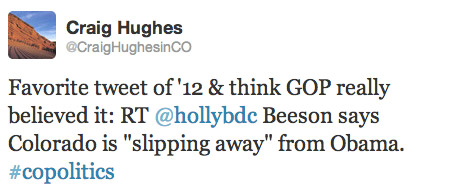
Our friend Craig Hughes of RBI Strategies Tweeted not long after the election:

Well, as The New Republic’s Noam Scheiber reports today, Hughes was more right than anybody knew–that is, about what Republicans, around the country but particularly here in Colorado, believed would be the outcome going into an election they were about to lose.

It’s no secret that the Romney campaign believed it was headed for victory on Election Day. A handful of outlets have reported that Team Romney’s internal polling showed North Carolina, Florida, and Virginia moving safely into his column and that it put him ahead in a few other swing states. When combined with Ohio, where the internal polling had him close, Romney was on track to secure all the electoral votes he needed to win the White House. The confidence in these numbers was such that Romney even passed on writing a concession speech, at least before the crotchety assignment-desk known as “reality” finally weighed in.

Less well-known, however, are the details of the polls that led Romney to believe he was so close to the presidency. Which other swing states did Romney believe he was leading in, and by how much? What did they tell him about where to spend his final hours of campaigning? Why was his team so sanguine about its own polling, even though it often parted company with the publicly available data? In an exclusive to The New Republic, a Romney aide has provided the campaign’s final internal polling numbers for six key states…

The numbers include internal polls conducted on Saturday, November 3, and Sunday, November 4, for Wisconsin, Pennsylvania, Minnesota, Iowa, Colorado, and New Hampshire. According to Newhouse, the campaign polled daily, then combined the results into two-day averages.

In the polling data provided to TNR by Mitt Romney’s chief internal pollster Neil Newhouse, Romney has a 2.5 point lead on President Barack Obama in Colorado over the weekend before Election Day. As you know, the President won Colorado by almost 5.5 points. The range of explanations offered by Newhouse in this story vary from Latino voters (which while significant, don’t fully cover the spread), over-reliance on self-identified “highly likely voters,” and the perils of polling on a Sunday. Each one of these, the story goes, unintentionally helped contribute to the false sense of optimism projected by the GOP going into Election Day.

This story again answers the question of whether the Romney campaign was convinced it was going to win, or whether there was a more complicated process of spin for the base that the higher levels of the campaign knew wasn’t true. Right to the very top, this was a campaign that did believe victory was imminent, and was genuinely surprised when it failed to materialize.

What this story doesn’t seem to adequately capture, beyond the raw numbers of how wrong they were, is the depth of the bubble–with the exception of Gallup and a few clearly GOP-skewed pollsters, Obama’s win in Colorado was accurately forecast in several pre-election polls.

It’s also worth noting, as Hughes did, that longtime local GOP operative Rich Beeson was Romney’s political director. Beeson’s willing participation in the groupthink and flawed assumptions that led the Romney campaign to believe Colorado was in their column shows the extent of the break with a reality they should have seen coming at them like a Mack truck.

Answer: a perhaps unprecedented extent.

Open Line Friday!


Image via RushLimbaugh.com

Secretary of Commerce Hickenlooper, Anyone?

Sources are discussing today the possibility, as of now very much unconfirmed, that Colorado Gov. John Hickenlooper may be offered the job of Secretary of Commerce, replacing former Secretary John Bryson who resigned over the summer due to medical reasons.

This comes to us from a credible source. That said, we’re not at all sure this would be the best move for Hickenlooper career-wise, especially given his rumored higher aspirations. On the other hand, the degree to which Hickenlooper considers an offer would say plenty about how realistic he considered those aspirations.

In any event, it would be quite the Gold Dome shake-up, wouldn’t it?

Nice (Former) Ink, Dude

Remember this guy?

Here’s a refresher:

Eric Hartsburg will no longer be the “Romney face-tat guy” in about a year–the length of time it’ll take for him to remove this tat in 7-10 sessions with “Dr. TATTOFF.” Hartsburg says he’s abandoning the ink because of his candidate’s post-election behavior, especially comments claiming Obama bought minority, youth, and low-income votes with “gifts”:


“It stands not only for a losing campaign but for a sore loser,” Hartsburg said. “He’s pretty shameful as far as I’m concerned, man. There’s no dignity in blaming somebody else for buying votes and paying off people. I can’t get behind that or stay behind that.”

Hartsburg, a wrestler, will regret the loss of a certain notoriety which expanded his fight opportunities–but he also admits that, “You can’t walk around with a big ‘R’ on your face.”

Keep that in mind, Republicans, if Rubio runs in ’16…

Denver Well-Represented in State House Committees

The new Democratic House Majority announced committee chairs and vice-chairs this week, and Denver does well at the top.

New House Speaker Mark Ferrandino, who also represents a Denver district, chose 6 Democrats as chair or vice-chair of a committee (there are 11 total committees):

  • Appropriations: Reps. Claire Levy (D-Boulder) and Crisanta Duran (D-Denver)
  • Business, Labor & Economic & Workforce Development: Rep. Angela Williams (D-Denver) and Rep.-elect Tracy Kraft-Tharp (D-Arvada)
  • Finance: Reps. Lois Court (D-Denver) and Jeanne Labuda (D-Denver)
  • Health, Insurance & Environment: Rep. Beth McCann (D-Denver) and Sue Schafer (D-Wheat Ridge)
  • Judiciary: Rep. Daniel Kagan (D-Cherry Hills Village) and Pete Lee (D-Colorado Springs)
  • Meanwhile, Jane Norton Seeks 2010 Campaign Debt Lifeline

    The Grand Junction Sentinel’s Charles Ashby updates on 2010’s U.S. Senate primary loser, former Lt. Gov. Jane Norton. Here’s a reason, maybe just one but a good one, the more recent lists of likely GOP candidates to challenge Mark Udall in 2014 haven’t included her name:

    Norton, a Grand Junction native who lost the 2010 Republican Party nomination to Weld County District Attorney Ken Buck, owes as many as 18 creditors nearly $476,000.

    But while she’s tried to raise additional funds to cover that debt over the past two years, she’s only managed to pull in a few thousand dollars [Pols emphasis] to help pay off her mostly out-of-state creditors, her husband, Mike Norton, said.

    As a result, her campaign, Jane Norton for Colorado Inc., filed a debt settlement plan with the Federal Election Commission offering to pay about 4.6 cents on the dollar…

    Norton said his wife blames people who ran the campaign, but declined to point fingers at anyone specifically.

    “Jane entrusted a group of people with the responsibility to manage and run the campaign, and do with the resources that were made available,” Mike Norton said. “That just didn’t happen.”

    He stopped short, however, of naming specific people, including former Grand Junction state senator Josh Penry, who ran the campaign for more than three months before the August 2010 GOP primary, when she earned 48 percent of the vote.

    Back in May of 2011, Norton was praised by New Hampshire Sen. Kelly Ayotte as a “terrific” potential candidate in 2014, and Norton’s brother-in-law, powerful D.C. lobbyist Charlie Black held a fund raiser for both Ayotte and to retire Norton’s primary debt.

    Apparently that fundraiser didn’t go so well? Not what we would expect from Charlie Black.

    Needless to say, this puts Norton at a significant disadvantage to starting fresh in 2014, particularly if the settlement plan is not approved. Even if it is, while there is no doubt a deep pool of consultants and vendors to replace any with whom bridges that have been burned, we would expect them all to ask for payment in advance from Norton wherever possible.

    Bottom line: the stars aren’t aligned for Norton in 2014 like they (almost) were in 2010, and her lingering campaign debt problems are just another symptom of her unresolved weaknesses. The expected difficulty of this race for any Republican candidate is probably deterrent enough, and the embarrassment of stories like this one surely won’t help. It’s well known that Norton came out of the 2010 Senate primary bitterly disappointed, and she probably does believe she would have beat freshly-appointed Michael Bennet. But that moment is gone forever.

    Colorado Senate Seat “Likely Democratic”

    Roll Call has an early rundown of where the 2014 Senate races are ranked in order of competitiveness. Colorado is listed as “Likely Democratic” among the 33 Senate races, which puts Sen. Mark Udall’s seat well outside the top tier:

    The early read from both sides is that Udall is in a strong position for re-election. Even Republicans concede that he has deftly positioned himself as a moderate on fiscal and social issues.

    But the DNA of Colorado is a swing state, and midterm races are typically difficult for the president’s party, especially during a second term. Republicans fell just short of ousting Democratic Sen. Michael Bennet in 2010. Therefore, the GOP is optimistic and several names have already surfaced. The Republican who strikes the most fear in the hearts of Colorado Democrats is Rep. Cory Gardner.

    Other possible challengers include 2008 Senate candidate Bob Schaffer, former Rep. Bob Beauprez and state Attorney General John Suthers.

    Nothing new there (at least not to readers of Colorado Pols). Republican Rep. Cory Gardner is mentioned as the “scariest” potential GOP candidate, and also picked up a mention in a similar story on The National Journal (subscription required).

    Is Gardner really “The Republican who strikes the most fear in the hearts of Colorado Democrats?” On the whole, of course not. But this is all relative to other potential GOP candidates, and with that background Gardner is definitely the one that would be most worrisome for Udall.

    Gardner’s relative strength is key in this discussion, because Udall would still be a heavy favorite for re-election if Gardner was the GOP candidate. And that is exactly why Gardner won’t run for Senate in 2014. He’s doing the smart thing by letting his name float out there for 2014, because any discussion of Gardner as a Senate candidate only enhances his name ID and perceived strength among Republicans.

    Gardner won’t run against Udall because it is too big of a political risk. He can hold his current House seat for as long as he wants, so there’s no rush to move up. If he did decide to run against Udall and lost, Gardner would be out of elected office without having had time to grow his political network (a Republican would likely replace Gardner in CD-4, which would preclude him from trying to retake his old seat in 2016).

    Gardner is in a great position to be mentioned as a top Senate challenger, which is only happening because the GOP has no bench in Colorado. He won’t run, but for now there’s no benefit to officially removing his name from the rumor mill.

    Boehner’s Caucus Needs Caulking

    Republican disagreement over the “Fiscal Cliff” is growing by the day, if not the hour. A CNN headline this afternoon says it all: “GOP Divide Over Obama Tax Plan Goes Public.”

    A rift among House Republicans on whether to give Obama what the wants became public Wednesday, with two conservatives saying the tax proposal would likely pass if brought to a vote.

    House Speaker John Boehner immediately shot down the call by veteran Rep. Tom Cole of Oklahoma for the chamber to approve the Senate measure, saying he disagreed with his colleague. House GOP aides insisted there was no plan to bring the proposal up for a vote.

    However, the public call by Cole — which echoed similar statements from conservatives in recent weeks — as well as his prediction that the Senate proposal would pass in the House showed an increasing desire among House Republicans to move beyond an issue that has harmed them…

    …”I think right now my advice to the leadership is that they should let the Democrats pass a tax increase because we will see that the economy will stall because of that tax increase, and then they will own it completely,” [Idaho Republican Rep Raul] Labrador said, despite his personal opposition to such a measure.

    It’s really hard to see a good ending for Republicans on this debate, and that quote from Rep. Labrador betrays the GOP anxiety. When individual Republicans are messaging around a vote that hasn’t occurred, it clearly shows that there is no appetite to continue avoiding the inevitable.

    The cracks in the GOP caucus are too pronounced to mend at this point, and the longer Speaker Boehner delays on a floor vote, the worse it becomes for Republicans.  

    Suthers and Senate: Conflicting Rumors

    Republican Attorney General John Suthers is apparently giving (semi) serious thought to running for U.S. Senate against incumbent Democrat Mark Udall.

    We really don’t believe that Suthers will end up as a candidate for Senate, but it makes sense that he would have early discussions about the possibility. In 2010 Suthers was heavily recruited by Texas Sen. John Cornyn (Cornyn was the head of the NRSC in 2010 and 2012) to run against Democrat Michael Bennet. Suthers declined and instead ran for re-election as Attorney General. Two years later, Suthers remains one of the few remaining high-profile Republicans in Colorado, but running against Udall would seem to be much tougher than challenging Bennet in 2010; Bennet was a top-tier pickup opportunity for Republicans in 2010, but Udall is lower on the list in 2012 for a number of reasons (name ID and the fact that he is a true elected incumbent, to name two reasons).

    As we discussed last week, Republicans can count the number of top GOP names on one hand, which means someone like Suthers will be wooed early. But while Suthers has at least expressed some interest in the Senate in years past, we’d be very surprised if he actually decided to jump in the race for 2014.

    Colorado Labor Leaders Push Social Security, Medicare Protection

    A press release this morning from the Colorado AFL-CIO:

    Colorado labor leaders are in Washington D.C. today to discuss the severe impacts to Colorado of a Congressional deal from the lame duck Congress. According to a new report released by the AFL-CIO, 693,000 Coloradans could be negatively impacted if Congress attempts cuts to Social Security, including 94,000 people with disabilities and 47,000 children. Of the 619,000 who get their health care coverage from Medicaid, 374,000 children and 49,000 seniors could be affected if the lame duck Congress makes cuts to Medicaid benefits. Social Security, Medicare and Medicaid combined deliver $17.8 billion per year into Colorado’s economy.

    “We are in Washington today to let our Congressional delegation know the importance of protecting Medicare, Medicaid and Social Security and other vital services that support our working families,” said Mike Cerbo, executive director of the Colorado AFL-CIO. “Retirees, people with disabilities and children shouldn’t have to suffer because some in Congress want to give more tax breaks to the very richest. We need to create an economy that works for everyone and rebuild the middle class-and that doesn’t start with balancing the budget on their backs.”

    As the so-called “fiscal cliff” approaches, members of Congress have suggested cuts to benefits for Social Security, Medicare and Medicaid even while calling for renewing tax cuts for the richest 2%. If those tax cuts are renewed, the richest 2% in Colorado would receive an average of $31,650 in tax cuts, while the rest of Coloradans would receive an average of $1,340. The 2012 House Republican budget plan would cut federal support to Colorado’s Medicaid program by at least $7.1 billion (22 percent) over 10 years.

    Read AFL’s one-pager of facts on Colorado and the fiscal debate in Washington here.

    Recent Comments


    Posts about

    Donald Trump
    SEE MORE

    Posts about

    Rep. Lauren Boebert
    SEE MORE

    Posts about

    Rep. Gabe Evans
    SEE MORE

    Posts about

    Colorado House
    SEE MORE

    Posts about

    Colorado Senate
    SEE MORE

    44 readers online now

    Newsletter

    Subscribe to our monthly newsletter to stay in the loop with regular updates!