U.S. Senate See Full Big Line

(D) J. Hickenlooper*

(D) Julie Gonzales

(R) Janak Joshi

80%

40%

20%

(D) Michael Bennet

(D) Phil Weiser
55%

50%↑
Att. General See Full Big Line

(D) Jena Griswold

(D) M. Dougherty

(D) Hetal Doshi

50%

40%↓

30%

Sec. of State See Full Big Line
(D) J. Danielson

(D) A. Gonzalez
50%↑

20%↓
State Treasurer See Full Big Line

(D) Jeff Bridges

(D) Brianna Titone

(R) Kevin Grantham

50%↑

40%↓

30%

CO-01 (Denver) See Full Big Line

(D) Diana DeGette*

(D) Wanda James

(D) Milat Kiros

80%

20%

10%↓

CO-02 (Boulder-ish) See Full Big Line

(D) Joe Neguse*

(R) Somebody

90%

2%

CO-03 (West & Southern CO) See Full Big Line

(R) Jeff Hurd*

(D) Alex Kelloff

(R) H. Scheppelman

60%↓

40%↓

30%↑

CO-04 (Northeast-ish Colorado) See Full Big Line

(R) Lauren Boebert*

(D) E. Laubacher

(D) Trisha Calvarese

90%

30%↑

20%

CO-05 (Colorado Springs) See Full Big Line

(R) Jeff Crank*

(D) Jessica Killin

55%↓

45%↑

CO-06 (Aurora) See Full Big Line

(D) Jason Crow*

(R) Somebody

90%

2%

CO-07 (Jefferson County) See Full Big Line

(D) B. Pettersen*

(R) Somebody

90%

2%

CO-08 (Northern Colo.) See Full Big Line

(R) Gabe Evans*

(D) Shannon Bird

(D) Manny Rutinel

45%↓

30%

30%

State Senate Majority See Full Big Line

DEMOCRATS

REPUBLICANS

80%

20%

State House Majority See Full Big Line

DEMOCRATS

REPUBLICANS

95%

5%

Generic selectors
Exact matches only
Search in title
Search in content
Post Type Selectors

Want To Filibuster? Sure, But Keep It Real

Huffington Post:

Use of the filibuster to stall legislation — when the minority party refuses to end debate on a bill unless 60 senators vote to do so — has escalated in recent years, rising from a rarity to the norm. Senate Majority Leader Harry Reid (D-Nev.) has been signaling his readiness to curb the tactic, often noting that he has faced 385 filibusters during his leadership while Lyndon Johnson had to deal with only one when he ran the Senate.

A number of proposals are under consideration, including a bill sponsored by Sen. Jeff Merkley (D-Ore.) and others that would essentially require an old-fashioned “Mr. Smith Goes to Washington”-style filibuster: Minority opponents of a measure would actually have to take the floor and hold forth for hours, rather than simply signal their intent to obstruct.

Making such a rule change in the Senate would normally require a 67-vote majority. But when the Senate comes back into session in January, Democrats could use a set of procedural rules often called the “nuclear option” and pass the changes with a simple 51-vote majority.

Two years ago, a similar proposal for reforming the filibuster from Colorado Sens. Mark Udall and Michael Bennet was defeated. Under that proposal, like the one from Sen. Jeff Merkley described above, would not ban filibusters, but would require that Senators engaging in a filibuster to actually occupy the podium in the Senate–not merely threaten to do so.

The partisan posturing you’re seeing around this debate is no accident, as the Washington Post’s Greg Sargent writes:

The extent of GOP filibustering is unprecedented. This chart shows that cloture motions (a rough measure of filibustering) suddenly spiked during the Obama years. Yes, they also spiked in 2007-2008, but according to Congressional scholar Norman Ornstein, the vast majority of those filibusters were mounted by Republicans, presumably to block legislation designed to embarrass George W. Bush. (Indeed, the motions to end filibusters during that period were filed mostly by Dems.)

The nature of GOP filibustering is unprecedented. Ornstein says this is true in two ways: First, in the extensive blockading of what used to be considered routine Senate business. And second, much of the filibustering is part of a concerted party strategy. “You’re not just looking at filibusters done by rogue senators or factions, like southern Democrats in the 1950s,” says Ornstein. “It’s the first time we’ve had a wide range of filibustering by a whole party.”

Desire by Democrats to reform the filibuster, to break the logjam caused by a GOP minority determined to obstruct, is of course tempered by the knowledge that Democrats will themselves someday find themselves in the minority. When that happens, they will surely want minority rights preserved. With that said, there’s an objective case to be made that Senate Republicans have taken the filibuster to an extreme Democrats have never even considered; which has resulted in a serious breakdown in the ability of that chamber to function.

Since it’s politically not easy to defend the current filibuster practice in the Senate, which requires only the threat of a filibuster to stall legislation, Republicans are expected to fight the use of Senate procedure to pass filibuster reform without the usually required two-thirds in favor. Democrats objected when a Republican-controlled Senate considered this option, the story goes, so to employ it now would be hypocrisy. Talking about this battle over Senate procedure and rules is preferable to explaining why Republicans are unwilling to filibuster in the manner the public expects them to, by actually holding the floor and speaking.

Democrats will win this battle if they can make it about Republicans’ unwillingness to make simple and sensible changes to reduce gridlock in the Senate. The debate shouldn’t be about the “nuclear option,” but rather why it’s necessary. If Mitch McConnell is upset about rule changes made by simple majority, he should be made to explain why there aren’t 60 votes to pass them. There is no proposal we know of that would “end” the filibuster, and the compromise measure likely to be introduced in January is certain to fall well short of the hyperbole coming from the GOP. As we said, Democrats are mindful of their own future as they look at this.

Are we wrong? Is there a poll we missed that says gridlock is cool by voters now?

Once Again, GOP Faces Blame For “Fiscal Cliff” Deal’s Failure

The Hill, once again, as many times as necessary:

A new poll finds the public views the looming “fiscal cliff” as a serious crisis for the nation and would blame Republicans more than President Obama if Washington fails to reach a deal.

Forty-five percent surveyed in a new CNN/ORC poll said they would blame congressional Republicans if there is no agreement, with 34 percent pointing the finger at Obama…

By a 52-44 split, Republicans surveyed in the poll said they favor a combination of spending cuts and tax increases over only spending cuts.

Democrats surveyed overwhelmingly support both elements in a deal, with six of 10 independents wanting both cuts and tax increases.

Fifty-six percent say taxes on the wealthy should be high, while 36 percent support low rates to help boost investment and job growth.

It’s a similar situation to what congressional Republicans faced in 2011, when polls showed clearly that Republicans would be the ones to take the blame for any negative consequences of a failure to reach a fiscal deal at that time. And as it turns out, they did take the blame–the outcome clearly demonstrated in President Barack Obama’s re-election.

That said, there are many details to consider: how much play is there to negotiate between spending cuts and revenue increases? What’s the ideal “ratio” of revenue to spending cuts, if any? What programs should be protected, like Medicare, even at the cost of raising taxes? How do the human costs of “entitlement reform” factor in relation to the goal of reducing expenses?

One thing’s for sure, it’s past time to have an honest conversation about these issues. And that is exactly what Republicans have spent the last four years avoiding, hoping that any attempt at intelligent discussion of fiscal policy could be pre-emptively shouted down.

But Republicans lost the election. What will change is the question, and only they can answer.

La Plata County: Blue Bedrock For Retaking CD-3?

An insightful story in Sunday’s Durango Herald by reporter Emery Cowan:

La Plata County voters favored the president by a margin of 57 percent to 41 percent four years ago. This year, 53 percent of voters supported Obama and 44 percent of voters supported Mitt Romney…

Only one La Plata County precinct supported Obama in 2008 but favored Romney in 2012. Precinct 29 in the northern Animas Valley supported Obama 54 percent to 45 percent in 2008. In 2012, 47 percent of voters supported Obama and 51 percent supported Romney. No precinct that favored John McCain in 2008 went for Obama in 2012.

The county’s Democratic tilt in every other race, from county commissioner to state representative, reverses a rightward drift in 2010 and more closely mirrors how the county voted in 2008.

The county favored Democratic candidate Mike McLachlan for the state House of Representatives by a margin of 54 percent to 46 percent. McLachlan, of Durango, unseated incumbent Rep. J. Paul Brown, of Ignacio.

Sal Pace, candidate for the U.S. House of Representatives who was beaten by incumbent Rep. Scott Tipton, won the county by a margin of 49 percent to 46 percent.

What you have in La Plata County are several factors that should favor Democratic election wins going forward. Arguably the biggest is the growing population and affluence of Durango, one of the state’s most educated cities. The county as a whole is likewise experiencing economic growth–both in liberal-favored industries like tourism, and energy development. But notwithstanding somewhat softer performance for Obama this year than in 2008, the trend toward electing Democrats in La Plata County shows little sign of slowing in the long term.

Among other things, that’s important because Rep. Scott Tipton’s CD-3 seat is, at least on paper, quite competitive. Tipton won more easily than expected this year, and that may make Democrats think twice about competing for his seat in 2014. That said, CD-3’s principal Democratic base is Pueblo, while Republicans more or less own Mesa County. Tipton’s ties to nearby Cortez are of course a strong point in La Plata County, and in a diverse district like this one, it’s important to not lose too badly in the places where you’re destined to lose. That can be as important, in fact, as running up the score in your base regions.

But even with that hole card in play, this is a battleground increasingly favorable to Democrats. Perhaps that will catch up with Tipton, or his successor, as it did J. Paul Brown.

Cory Gardner, Doug Lamborn Join Susan Rice Bully Squad

Since the election, it’s been widely reported that Secretary of State Hillary Clinton intends to retire in the next few weeks. Speculation about her possible replacement is currently focused on Susan Rice, the United States ambassador to the United Nations. In the immediate aftermath of the attack on the American consulate in Benghazi, Libya on September 11th of this year, Rice initially stated on television that the attacks were due to protest over an anti-Muslim YouTube video, though it has been determined to have been a well-coordinated terrorist attack.

Republicans sought before the election to blow the Benghazi affair up into as large a scandal as possible for perfectly understandable political reasons. Now that the election is over, that motive still exists but with a longer view–and congressional Republicans are still pushing the issue. And to a point, they should. Democrats too are interested in fully accounting for what happened.

Unfortunately, as the Washington Post reported last week, Republicans are taking a reasonable point of inquiry way too far, and making a joke of their oversight responsibility:

97 House Republicans co-signed a letter this week warning President Obama that Rice’s public comments after the attack on the mission in Benghazi “caused irreparable damage to her credibility both at home and around the world.”

The members also told Obama that making Rice “the face of U.S. foreign policy” in the coming years as his next secretary of state “would greatly undermine your desire to improve U.S. relations with the world and continue to build trust with the American people.”

“Ambassador Rice is widely viewed as having either willfully or incompetently misled the American public in the Benghazi matter,” the lawmakers wrote. “Her actions plausibly give U.S. allies (and rivals) abroad reason to question U.S. commitment and credibility when needed.”

Signers of this letter include Colorado Reps. Cory Gardner and Doug Lamborn.

In an editorial today, USA TODAY outlines the stupidity, not to mention the almost comical hypocrisy, of Republicans going after Rice over her early comments about the Benghazi attack:

Working from talking points put together by intelligence officials and later edited by others, Rice peddled the story that the attack sprang from a spontaneous protest, spurred by an anti-Muslim video produced by an American.

That account turned out to be wrong, but it’s hardly a reason to block Rice’s potential nomination. After all, if misleading comments based on flawed intelligence were disqualifying, Colin Powell would have been forced to resign as George W. Bush’s secretary of State and Condoleezza Rice never would have succeeded Powell. Powell’s powerful speech before the United Nations in 2003, proclaiming proof of Iraq’s weapons of mass destruction, helped push the United States into a misguided war. Condoleezza Rice also touted the story line about Iraq’s supposed nuclear program, warning on CNN that “we don’t want the smoking gun to be a mushroom cloud.” No such weapons were found.

Susan Rice’s comments about events in Benghazi are at best a sideshow. Instead of obsessing about what she said on TV after the tragedy, lawmakers ought to be more concerned about finding out what went wrong and preventing a repeat. Why weren’t security warnings heeded and requests for more protection granted? As U.N. ambassador, Rice most likely had zero involvement with those decisions.

To summarize:

1. Even if they’re right, they’re going after the wrong person, and

2. How quickly they forget.

There’s another dimension to this story that we do want to address, though. Following the GOP’s letter and media tour against Susan Rice, who is African-American, some Democrats angrily reacted to singling her out for criticism. Rep. James Clyburn accused Republicans who signed the letter noted above of employing “racial code words,” in part by describing Susan Rice, a Rhodes scholar with a resumГ© to match anyone’s, as “incompetent.”

Without a doubt, the resumГ©s of politicians such as our own Cory Gardner and Doug Lamborn seem quite humble compared to Rice. And after the election we just had, where women and minority voters played a key role in GOP defeats around the nation, making your first big post-election splash by attacking a black woman really seems like a stupid thing to do–doesn’t it?

Bottom line: we’re not going to allege that Gardner and Lamborn had racist or sexist ulterior motives in signing on to this letter. But just as they have the right to throw around specious charges ripe for political backfire, you all have the right to think whatever you want about their motives. And the stereotype reinforced by this episode…is not about Susan Rice.

Three Names You’ll Soon Forget (If Republicans Want To Win)

Before Thanksgiving, FOX 31’s Eli Stokols profiled three Colorado Republicans who profess, or are at least rumored to be interested in statewide office in 2014–one of whom appears on our introductory 2014 Big Line, the other two do not. In none of the three cases do we see a winning prospect for the GOP, but that does, we suppose, merit a brief explanation.

Three Colorado Republicans whose names are being mentioned as possible statewide candidates in 2014 all tell FOX31 Denver that it’s way too soon to even think about mounting a campaign.

But none of those three – former U.S. Senate candidate Bob Schaffer, state Sen. Greg Brophy and former Congressman Bob Beauprez – would rule out the possibility that their name might be at the top of the GOP ticket in two years.


Bob Schaffer parasails off the Northern Mariana Islands. Photo credit: CSU Library

Former Rep. Bob Schaffer’s run for the U.S. Senate in 2008 against Mark Udall almost certainly ended his viability for high elected office. In the course of Schaffer’s 2008 campaign, several incidents in his record emerged as permanent disqualifiers. The worst of these was Schaffer’s alleged assistance in the coverup of labor abuses in the Northern Mariana Islands, a place Schaffer visited as part of a junket arranged by now infamous ex-lobbyist Jack Abramoff.

Schaffer’s involvement in Abramoff’s lobbying campaign to prevent federal labor law from being applied in the Northern Mariana Islands was exposed in a devastating series of front-page stories in the Denver paper by Michael Riley. Although other items in Schaffer’s record would certainly cause problems, such as his time on the board of directors of an energy nonprofit that collapsed in allegations of defrauding the federal government, the Abramoff/Marianas scandal is the one we honestly think Schaffer cannot live down.

Failed 2006 gubernatorial candidate Bob Beauprez is the one person in this story who does appear on the 2014 Big Line, as a possible candidate for U.S. Senate against incumbent Democrat Mark Udall. He also has more familiar aspirations for statewide office: in 2010, Beauprez’s name briefly circulated as a potential alternative to the imploding GOP gubernatorial candidate, the laughably unqualified Dan Maes. This year, Beapurez faithfully served as the leading Colorado surrogate for Mitt Romney’s presidential campaign.

We listed Beauprez only because of the recent work he has done to re-up his name ID after several years of relative obscurity, and the lack of the kind of career-ending scandal in his past like Schaffer’s Abramoff debacle. But as we noted in our write-up of the Line, Beauprez was perhaps the worst serious gubernatorial candidate in the state’s history–certainly the worst before Maes himself. Beauprez’s 17-point loss to Bill Ritter in 2006 was a truly disastrous end to Beauprez’s long and expensive effort, which began with a nasty (though aborted) primary challenge from Marc Holtzmann.

The fact is, now that Beauprez is not in line for a Romney administration job, we can’t rule him out of a 2014 run. We can, however, pretty safely rule him out from winning.

The inclusion of state Sen. Greg Brophy in any list of potential candidates for 2014 statewide office is one of the more humorous developments in the aftermath of the GOP’s sweeping losses in Colorado this year. For reasons that even were forced to occasionally concede, Brophy has been regarded as an intellectual heavyweight in the Colorado Senate Republican Minority. As one example, we gave Brophy props during this year’s legislative session for joining with the ACLU to abolish criminal libel in Colorado.

Unfortunately, Brophy has otherwise done everything he can to ensure the GOP stays a minority.

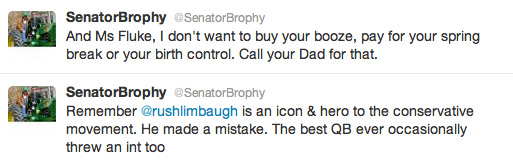
The biggest profile-raiser in all of Brophy’s years in the legislature came this year, after he crassly insulted Georgetown University law student Sandra Fluke via Twitter over insurance coverage for birth control–in defense of radio shock-jock Rush Limbaugh’s infamous reference to Ms. Fluke as a “slut.” In doing so, Brophy gave a local face to the Democrats’ “War on Women” campaign, while Fluke began campaigning in Colorado for Barack Obama.

The result is that more Colorado voters, especially women voters, know Brophy’s name for his insults to Sandra Fluke than anything else he’s done. For a man frequently touted by Republicans as a guiding intellectual force in the Senate Minority, this was unforgivably stupid of him. The facts show once again that women voters were a major component of GOP losses in this state, and Brophy proudly played a key role in setting the scene that alienated them. In any race the GOP would ever hope to win, Brophy is not the candidate.

As a result, our friend Eli Stokols continues:

To many conservative activists, “the Bobs”, Schaffer and Beauprez atop the 2014 ticket, would amount to another GOP ticket of older, white, establishment Republicans…

[Colorado GOP chairman] Call told FOX31 Denver that the party is indeed looking at more people than those who have sought or held elected office before.

One problem the GOP has is many of their “rising stars,” like former Navy pilot Lang Sias and Colorado Springs civic patron Jennifer George, lost their elections. Continued defeats in election after election rob the Republican bench of fresh faces, and leaves the last generation of Republican candidates feebly bearing the party’s standard. As we’ve said, we don’t honestly know how Republicans are going to escape this compounding problem.

But we can tell you that these three has-beens are not the way.

Thanksgiving Weekend Open Thread


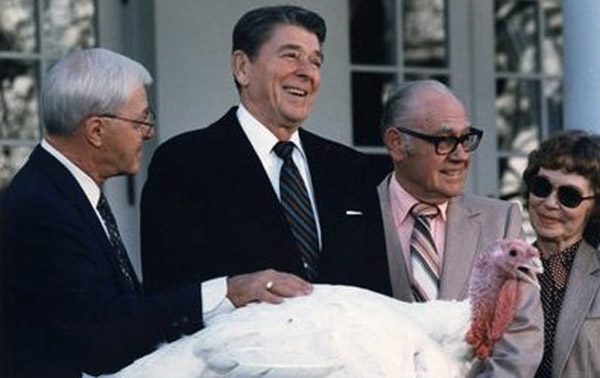
Photo courtesy Reagan Presidential Library

Hudak Wins in SD-19; No Recount Necessary

State Senator Evie Hudak has won her reelection bid against Republican opponent Lang Sias, according to the most recent tabulations reported by the Jefferson County Clerk and Recorder.

The current tally, posted Thursday, includes votes cast by overseas and military voters as well as those who had to “cure” their ballot because of questionable or missing signatures. Despite conservative assertions that military voters would favor Sias, a combat veteran of both Gulf Wars, the late-game vote actually widened Hudak’s edge. With these votes counted, Hudak leads the Republican by 411 votes, just a hair over the .5% margin necessary to trigger a mandatory recount.

The clerk’s office reports that there are still between 7,300 and 7,600 provisional ballots which remain to be counted before the election results are certified on November 20th, but it’s unlikely the SD-19 share of those votes will sway the race one way or the other. Although Hudak’s leading by only a razor-thin margin, Jeffco’s history lends no reason to believe that the provisional numbers will disproportionately favor Sias. Even if they did, Hudak’s advantage is just large enough to hedge against any unlikely gains for the Republican.


While there will not be a mandatory, county-funded recount, both Sias and the Republican party have the legal right to request one at their own expense. Hudak reports on her Facebook page that Sias has conceded, however, and she’s already joined her caucus in organizing for next year’s legislative session.

With Hudak’s victory, the Democrats have swept every single competitive legislative race in the county. That does not bode well for Jefferson County Republicans – by all accounts, with a few notable exceptions, the party ran its most promising candidates this year. That no Republican pulled out a single competitive state-level victory here evidences that the same national demographic shifts which betokened Barack Obama’s re-election are at play in the county. Republicans have been losing their grasp on Jeffco for years, of course, but 2012 signals that there’s little they can do to stop the bleeding.

Cross posted from Jeffco Pols

The Debut of the The Big Line: 2014

Every 10 years Colorado is without a high-profile statewide election (U.S. Senate, Governor, AG, Treasurer, Sec. of State), and we’re damn glad to see that election cycle in our rear-view mirror. That’s five whole races that we couldn’t pontificate about in the 2012 cycle.

Take a look at left to see the first version of The Big Line: 2014. The first new Big Line of the cycle is usually more question than answer, but steady losses by Republicans in 2010 and 2012 have narrowed down considerably the list of potential 2014 candidates.  

Click after the jump for a brief rundown of the who and why in The Big Line: 2014.

Labor Nudges Bennet, Udall on “Fiscal Cliff”

FOX 31’s Eli Stokols:

Exactly two weeks after Election Day, three of the country’s biggest labor unions have joined forces to run television ads in a handful of states, urging lawmakers to support the president’s position in ongoing negotiations over the “fiscal cliff.”

The 30-second ad asks Colorado Sens. Mark Udall and Michael Bennet, both Democrats, to support “jobs, not cuts.”

“We need Senators Bennet and Udall to continue to stand up for us by investing in job creation, extending the middle class tax cuts and protecting Medicare, Medicaid and education from cuts,” the narrator of the ad says…

“This election was about securing a mandate to fight for the middle class,” Scott Wasserman, the executive director of Colorado WINS, told FOX31 last week. “We’re just making sure Sens. Udall and Bennet are doing just that by fighting for jobs and defending against cuts that will hurt the middle class.”

Sen. Michael Bennet has recently joined up with a bipartisan “Gang of Six” negotiating bloc (which technically consists of eight members now with Bennet and Sen. Mike Johanns of Nebraska) that has attempted a few times to put together a large-scale agreement on entitlement spending, deficit spending, and tax policy. Likewise, Sen. Mark Udall has repeatedly made a deficit reduction deal a stated top priority.

In both cases, we think it’s fair to say our Colorado Senators have made advocates for the protection of Social Security, Medicare, and other domestic programs–protection and preservation of materially equivalent benefits–a bit nervous, with the obvious caveat that they are easier to deal with on the issue than Republicans. As the lame-duck battle over resolving the so-called “fiscal cliff” created by the Budget Control Act of 2011 gets underway, liberals are keen to translate the results of the recent elections into a mandate for ending the Bush tax cuts, and protecting institutions like Medicare that have been recently threatened.

Politically, it’s a relatively high-stakes moment, especially for Udall as re-election looms. To be part of a well-received solution to a long vexing and emotional problem would be a great thing for Udall’s career. On the other hand, it’s not a debate we’d want to end up on the wrong side of.

Denial: It’s More Than a River in Africa, Frank McNulty

Former Speaker of the Colorado House Frank McNulty, as you know, did not even attempt a run for House leadership in caucus elections held a little over a week ago. The reason is pretty simple: McNulty presided over a disastrous and sweeping loss of the GOP’s House majority, ensuring through his ham-fisted bungling of reapportionment, and his thuggish mishandling of civil unions legislation that enjoyed majority support, a shriveled GOP minority with greatly diminished hope of recapturing a majority for years to come.

But as the Highlands Ranch Herald reported last week, there’s a different story McNulty tells himself–presumably out of denial, because we don’t know anybody who would buy it.

McNulty, who has served in the state House since 2006, was elected as speaker in 2010. And despite easily defeating Democratic challenger Gary Semro 63-37 in the election, the decision was made afterward that the Highlands Ranch incumbent would not seek a leadership role within his party this time around.

McNulty said that “maintaining and growing a majority is a much different proposition” than maintaining continuous leadership, and he pointed to the fact that he is term-limited as one reason he chose not run for the role of minority leader in 2013. Mark Waller of Colorado Springs, one of 10 Republicans who were elected without Democratic opposition, will fill that role…

“Regardless of the agenda that the Democrats push, our goal will be to work in a strong bipartisan manner,” McNulty said. “The people of Colorado don’t like gridlock, they are tired of gridlock and over the past two years we showed that we don’t have to have gridlock and that Republicans and Democrats can work together. Hopefully that will continue now even that the Democrats have the majority.” [Pols emphasis]

Got that, folks? “Maintaining and growing a majority” is more important than having the same leadership! So naturally, McNulty didn’t see the need to stick around.

Now is not the time to point out that McNulty neither maintained nor grew his majority.

Because, you see, Republicans will “work in a strong bipartisan manner.” Because “the people of Colorado don’t like gridlock” and “over the past two years we showed that we don’t have to have gridlock!” Hopefully this Golden Age won’t end now that the Democrats are back in charge.

As long as you don’t let reality intrude on this wholly fictional version of history, it sounds really great for Republicans. No need for introspection, or to change strategy or message. In fact, reading Frank McNulty’s recap, you might not realize that Republicans lost at all!

Alternatively, we understand modern psychiatry has a pill for this condition.

No More Todd Akins–Means No More Ken Bucks

Politico reports on discussion underway among national Republican strategists to prevent, if you will, a three-peat of that party’s self-inflicted losses in key U.S. Senate races. Of course, publicly opposing the “Tea Party” like this will most likely just anger them further:

Read their lips: no more Todd Akins.

In the wake of the GOP’s Election Day beatdown, influential Republican senators say enough’s enough: Party leaders need to put the kibosh on the kind of savage primaries that yielded candidates like Akin – and crippled Republican prospects of taking the Senate in two straight election cycles…

All easier said than done, of course. Tea party types have relished showing the chosen candidates of the Washington establishment a thing or two – and it’s hard to see them laying down arms overnight. But after a sure-bet election in 2012 turned into an electoral disaster, Republicans say resolving their primary problem is, well, their primary problem.

Now, top Republicans are considering splitting the difference between the heavy hand they wielded in 2010 that prompted sharp blowback from the right and their mostly hands-off approach of 2012. Both strategies produced a handful of unelectable candidates, so senators are gravitating toward a middle ground: engage in primaries so long as they can get some cover on the local level.

“We ought to make certain that if we get engaged in primaries that we’re doing it based on the desires, the electability and the input of people back in the states that we’re talking about,” Kansas Sen. Jerry Moran, the incoming National Republican Senatorial Committee chairman, told POLITICO. “And not from the perception of what political operatives from Washington, D.C., think about who ought to be the candidate in state X.”

Unfortunately for Republicans now looking at 2014 as their next shot at redemption, Sen. Jerry Moran’s prescription above is a hopelessly conflicted message once again. One of the biggest problems, perhaps the biggest problem for the GOP has been this: the “input of people back in the states” has selected, for two consecutive election cycles, the least electable candidates.

Here in Colorado in 2010, the substantially more electable former Lt. Gov. Jane Norton lost the U.S. Senate primary to the candidate backed by local “Tea Party” interests, Weld County DA Ken Buck. In fact, the National Republican Senatorial Committee (NRSC) was in the process of putting their thumb on the scale for Norton, to the extent that Buck was reported to be dropping out of the race, before a local revolt against the NRSC forced them to back off.

Do you see how that’s a rather different scene than the one Sen. Moran is describing?

Bottom line: the problem is not that national Republican strategists in Washington D.C. have been making horrible recruitment choices and forcing them on local Republican voters. The problem is that the Republican base is rejecting the choices made by national Republicans, and substituting their own unelectable candidates. Therefore Moran’s talk about getting “engaged in primaries” based on “input of people back in the states” is actually about squelching local input, and candidates that run counter to the choices “people back in the states” have been making.

The hope being that GOP primary voters will realize their candidates need appeal beyond the far right base. That is one of the most important lessons of 2012, as it was in 2010–and in neither case is it apparent that lesson has been learned. Here in Colorado, it’s totally unknown whether changes among local Republicans will take place that would be needed for them to prevent 2014 from becoming a repeat of 2010’s loss in this state. And if national Republicans were to muscle in a moderate candidate for 2014, will the base tolerate it any more than they did then?

At this point, how can the national Republican party impose a slate on their base that the base doesn’t want? It’s odd to think in these terms with regard to an allegedly democratic process, but that honestly is the state the Republican Party finds itself in today–at the mercy of a base that has veered very far from the mainstream. The real irony is, Republicans deliberately radicalized their voters for the express purpose of winning elections. 2010 was the high water mark.

Now that they have failed, it’s a very long road back.  

Support Grows For Federal Marijuana Law Change–Can It Pass?

As the Colorado Independent’s Scot Kersgaard reported Friday:

Colorado U.S. Rep. Diana DeGette introduced legislation today that would exempt states from federal laws banning the sale, possession and use of small amounts of marijuana by adults. The bill so far is being co-sponsored by Colorado Democrat Jared Polis and Republican Mike Coffman as well as a number of other representatives from around the country.

The bill is known as the Respect States’ and Citizens’ Rights Act.

It would spell out that any state that passes its own laws governing marijuana and/or medical marijuana would be exempt from certain sections of the Controlled Substances Act.

Colorado and Washington voters last week passed measures that legalize limited possession of marijuana and also legalize retail sales of marijuana. Voters in both states gave marijuana 10-point majorities.

In Colorado, the governor, the attorney general and both U.S. senators say they need guidance from the federal government before deciding how to proceed on implementation of the law.

We’ve been talking for a week now about new legislation from Rep. Diana DeGette of Denver following the passage of Amendment 64 earlier this month, and a similar initiative in Washington state. Amendment 64 legalizes both the possession and, once a regulatory system is in place, retail sale of marijuana in Colorado, leading to DeGette’s bill to amend federal law governing controlled substances and end the conflict created by Amendment 64’s passage.

The addition of Republican Rep. Mike Coffman to sponsorship of the bill, titled the Respect States’ and Citizens’ Rights Act, is a very significant development, though we still have no way of predicting if this can actually pass Congress and be signed into law by President Barack Obama. We’ve been clear that our natural propensity is to support the will of Colorado voters, and the leadership shown by the Colorado congressional delegation to resolve the conflict created by Amendment 64’s passage is commendable. That said, there is…well, maybe not an objection to be raised, but perhaps a conversation to be had about the precedent being set here. As Rep. DeGette of course knows, there are circumstances where a speedy push to neuter federal law to make way for “states’ rights” might not be so, you know, progressive.

In this case, though, and especially with Coffman’s support as a foe of legalization, there appears to be consensus: honoring voters’ wishes with regard to legalizing marijuana is the right thing to do. A poll follows–does the Respect States’ and Citizens’ Rights Act have a shot?

Hudak Wins in SD-19; No Recount Necessary

State Senator Evie Hudak has won her reelection bid against Republican opponent Lang Sias, according to the most recent tabulations reported by the Jefferson County Clerk and Recorder.

The current tally, posted Thursday, includes votes cast by overseas and military voters as well as those who had to “cure” their ballot because of questionable or missing signatures. Despite conservative assertions that military voters would favor Sias, a combat veteran of both Gulf Wars, the late-game vote actually widened Hudak’s edge. With these votes counted, Hudak leads the Republican by 411 votes, just a hair over the .5% margin necessary to trigger a mandatory recount.

The clerk’s office reports that there are still between 7,300 and 7,600 provisional ballots which remain to be counted before the election results are certified on November 20th, but it’s unlikely the SD-19 share of those votes will sway the race one way or the other. Although Hudak’s leading by only a razor-thin margin, Jeffco’s history lends no reason to believe that the provisional numbers will disproportionately favor Sias. Even if they did, Hudak’s advantage is just large enough to hedge against any unlikely gains for the Republican.


While there will not be a mandatory, county-funded recount, both Sias and the Republican party have the legal right to request one at their own expense. Hudak reports on her Facebook page that Sias has conceded, however, and she’s already joined her caucus in organizing for next year’s legislative session.

With Hudak’s victory, the Democrats have swept every single competitive legislative race in the county. That does not bode well for Jefferson County Republicans – by all accounts, with a few notable exceptions, the party ran its most promising candidates this year. That no Republican pulled out a single competitive state-level victory here evidences that the same national demographic shifts which betokened Barack Obama’s re-election are at play in the county. Republicans have been losing their grasp on Jeffco for years, of course, but 2012 signals that there’s little they can do to stop the bleeding.  

Officials Statewide Follow Stan Garnett’s Lead on Amendment 64

(Disclosure: I was a proponent of Amendment 64.)

As reported here on Pols yesterday, Boulder District Attorney Stan Garnett announced that his office will be the first to begin conforming to Amendment 64 by dismissing cases of adult marijuana possession. Since then, prosecutors and police in Denver, Mesa, and La Plata counties have indicated they will be following his lead.

The Denver paper reports this morning that Denver District Attorney Mitch Morrissey’s office will no longer charge adults 21 and older for private marijuana possession, and it is reviewing pending cases to determine whether they fall under the law.

In Grand Junction, KREX CBS 5 reported last evening that Mesa County District Attorney Pete Hautzinger’s office will begin taking Amendment 64 into consideration police will no longer be citing adults for possession:

The Grand Junction Police Department recently stated: “Although the final certification of the election results have not yet occurred, effective immediately it is the policy of the GJPD not to cite persons age 21 or older that possess and/or consume marijuana, 1 ounce or less of marijuana, and/or cultivate and possess six or less plants as allowed by the amendment.”

And in Durango, the Horse Gulch Blog reported last evening, that La Plata County District Attorney Todd Risberg’s office is also going to take action to follow the initiative:

“Realistically, even if we proceed those cases to be able to seat a jury who says we think this should be against the law at this point, you know we don’t have a reasonable likelihood of success, and we ethically shouldn’t prosecute those cases,” said Risberg [Emphasis added]. “Any new cases coming in, they wouldn’t get to even a hearing before the law is in effect and they wouldn’t be illegal then, so there’s no point in that.”

Will TBD Up The Ante? It All Depends on Hickenlooper

As the Durango Herald’s Jordyn Dahl reports:

Leaders of TBD Colorado say the key finding of the initiative is that Colorado’s economy is “unsustainable without major fiscal and constitutional reforms.”

The eight-member board of directors of To Be Determined Colorado released its recommendations Wednesday to Democratic Gov. John Hickenlooper, who established the initiative to determine a grand plan for the state.

The board based its recommendations on 70 public meetings with 1,200 Coloradans across the state during the last year. The initiative, which had a budget of $1.2 million and was funded by donations, focused on five issues: education, health, transportation, state budget and state workforce.

Opponents of TBD Colorado said the initiative was a way for Hickenlooper to lay the groundwork for a tax increase. While the recommendations do not directly call for tax increases, it does say revenue options have to be weighed against public services Coloradans want. [Pols emphasis]

Here’s what the summary report from TBD Colorado itself says:

In recent years, the state’s revenues have not kept pace with the underlying growth in the Colorado economy because many of the fastest-growing sectors are either exempt from tax or are taxed at a lower rate than other sectors. Even though Colorado’s revenues are now increasing as the economy begins to recover, the state will be unable to grow its way out of the coming fiscal gridlock unless structural changes are made. Projected demographic shifts, such as an aging population and the increased medical costs that flow from that, will only accelerate the stresses on the state’s budget.

Respecting the role of Colorado voters, who have ultimate authority on increasing taxes, revenue options must be weighed against public services Coloradans wish to receive.

We haven’t had much to say about Gov. John Hickenlooper’s TBD Colorado initiative, because there hasn’t been much to say. Hickenlooper’s administration convened these facilitated meetings all over the state as their way of taking the citizenry’s pulse on a wide variety of fiscal issues, as well as asking what essential services citizens expect the government to provide.

The TBD Colorado initiative takes place against a backdrop of a known and very bleak fiscal reality for the state of Colorado. As a recent study by the University of Denver determined, revenues in Colorado are structurally insufficient to provide even the present level of services to the state’s growing population. By 2025, that study indicated the state will be billions short of basic needs. In addition, the Lobato education funding lawsuit has exposed a lack of “rational relationship” between the state’s funding mechanism for public education and the constitutional requirement to provide a “thorough and uniform” education to all students.

Bottom line: Republicans are increasingly wary of the TBD Colorado initiative, because it is just the latest in a series of findings that the state’s fiscal situation is not sustainable–and the only solution, once all efficiencies and waste have been squeezed out of the system, is to increase revenue. We’ve said it a hundred times, and we’ll say it again: Colorado’s tax burden is significantly below the national average, and that low tax burden has a direct relationship to the state’s chronic inability to fund essential services. Something has to give.

It will be up to Hickenlooper turn his focus groups into a tangible plan of action. After the humiliating defeat of Proposition 103 in 2011, a defeat largely attributed to the failure of Democrats like Hickenlooper to invest their political capital in investing in education, it’s clearer than ever what the key ingredient in any real solution is going to be.

And that ingredient is leadership.

If Not For You Meddling Kids, African Americans, and Hispanics

Washington Post, defeated presidential candidate Mitt Romney goes all Scooby Doo villain:

Mitt Romney is blaming his loss in the presidential election on “Obamacare” and other “gifts” he says President Obama handed out to African Americans, Hispanics and other core supporters, according to news reports Wednesday.

The defeated Republican candidate told donors in a conference call that Obama targeted those demographics, along with young voters and women, through programs such as health-care reform and “amnesty” for children of illegal immigrants, according to articles posted online by the New York Times and Los Angeles Times. Both papers appeared to have listened to the call or obtained at least partial transcripts.

In explaining his overwhelming electoral college defeat last week, Romney said Obama followed what he called the “old playbook” of seeking votes from specific interest groups, “especially the African-American community, the Hispanic community and young people,” the New York Times said. “In each case they were very generous in what they gave to those groups,” he added, according to the paper.

The Los Angeles Times quotes Romney directly:

“With regards to African American voters, ‘Obamacare’ was a huge plus – and was highly motivational to African American voters. You can imagine for somebody making $25-, or $30-, or $35,000 a year, being told you’re now going to get free healthcare – particularly if you don’t have it, getting free healthcare worth, what, $10,000 a family, in perpetuity, I mean this is huge. Likewise with Hispanic voters, free healthcare was a big plus.”

Pivoting to immigration, Romney said the Obama campaign’s efforts to paint him as “anti-immigrant” had been effective and that the administration’s promise to offer what he called “amnesty” to the children of undocumented immigrants had helped turn out Latino voters in record numbers.

“With regards to Hispanic voters, the amnesty for the children of illegals – the so-called Dream Act kids – was a huge plus for that voting group,” he said. “On the negative side, of course, they always characterized us as being anti-immigrant, being tough on illegal immigration, and so forth, so that was very effective with that group.”

Back in September, the presidential race was upended by the release of a secretly-recorded video of GOP presidential candidate Mitt Romney disparaging roughly 47% of the nation as voters who “believe that they are victims, who believe the government has a responsibility to care for them, who believe that they are entitled to health care, to food, to housing, to you-name-it.” And you’ll recall Romney spent the rest of the campaign, a few hiccups aside, trying unsuccessfully to live those disastrous remarks down.

Well folks, the campaign is over, and Romney just confirmed he felt that way all along.

As The Hill reports, Republicans with a future are throwing Romney under the wheels:

A former surrogate for Mitt Romney’s campaign called the former GOP nominee “absolutely wrong” in blaming his recent election loss on President Obama giving “gifts” to black, Hispanic and young voters…

“I absolutely reject that notion,” Louisiana Gov. Bobby Jindal (R) said Wednesday on a conference call with donors, according to the Los Angeles Times. “I don’t think that represents where we are as a party and where we’re going as a party. And that has got to be one of the most fundamental takeaways from this election…”

“We have got to stop dividing the American voters,” he said. [Pols emphasis]

That’s as damning an indictment of the GOP in 2012 as any Democrat could offer. We’ll take Bobby Jindal at his word about where he wants his party to go, but must take issue with the claim that Romney doesn’t represent “where we are as a party.” As in today.

Because for the present, Romney most certainly does.

Boulder County DA Dismissing Marijuana Cases Post-Amendment 64

That in a brief statement today on Boulder County DA Stan Garnett’s Facebook page:

Amendment 64 passed in Boulder County, 66%-33%; accordingly, the 20th JD DA’s office will dismiss all pending possession of MJ less than an ounce, and MJ paraphenalia cases, for defendants over the age of 21. Cases of driving under the influence of MJ (or any other drug, including alcohol) remain a top priority.

It’s the first such move in Colorado, coming after a number of prosecutors in Washington state took similar action in the wake of that state’s passage of Initiative 502. In response to questions from John Schroyer of the Colorado Springs paper, Garnett says he’s not waiting:

Gazette John Schroyer: Does this mean you’re dismissing them starting now? Today? Or does “will dismiss” mean starting once Gov. Hickenlooper signs the amendment into the constitution?

Stan Garnett: Immediately, John. My senior staff and I have concluded that we have no reasonable likelihood of securing a unanimous jury verdict of guilty on such cases, which is the ethical standard that applies to commencing or maintaining a criminal prosecution in Colorado.

We expect Garnett’s action will not be the last, but it’s the first real action taken after passage of Amendment 64 we know of. Politically, it’s a bold move for Garnett to be the vanguard on this issue, but it could pay significant dividends. We recall Garnett’s run for Attorney General in 2010, and it’s a good bet he’ll endear himself to lots of statewide voters by being the first Colorado prosecutor to put Amendment 64 into practical effect–dropping marijuana possession charges on the grounds that convictions are no longer possible (or appropriate).

Perhaps it will incentivize Gov. John Hickenlooper to grow some spine of his own.

Dick Morris Admits What You Already Know

Newshounds:

Dick Morris visited the Hannity show [Monday night] to explain how he got it so wrong with his prediction of a “landslidey” Romney win. After blaming Hurricane Sandy and acknowledging that he got it “dead wrong” about the demographic turnout, Morris made a jaw-dropping admission. That his prediction was designed to help turn around Romney’s failing campaign…

Morris openly admitted his prediction was an election ploy:

“Sean, I hope people aren’t mad at me about it… I spoke about what I believed and I think that there was a period of time when the Romney campaign was falling apart, people were not optimistic, nobody thought there was a chance of victory and I felt that it was my duty at that point to go out and say what I said.” [Pols emphasis] And at the time that I said it, I believe I was right.

Dick Morris, a former advisor to Bill Clinton turned into a relentlessly pro-GOP cheerleader and laughably inaccurate predictor of future political events, was brought to Colorado by the conservative group Americans for Prosperity in September. At the time, Morris was of course confidently predicting a landslide victory on Election Day for Mitt Romney.

They say “fake it ’til you make it,” but as we’ve established, in 2012 they were just…faking it.

Bennet DSCC Rumors Recirculate

Politico:

Colorado Sen. Michael Bennet has been offered the DSCC chairmanship post and discussed the possibility with Senate Majority Leader Harry Reid on Monday, a Senate aide confirmed to POLITICO.

Bennet was offered the post, which is currently held by Sen. Patty Murray, late last week, and is considering it, a different source familiar with the discussions said.

Bennet’s name has been among four that have been floated publicly as possibilies – Sen. Amy Klobuchar, Sen. Kirsten Gillibrand, and Sen. Sheldon Whitehouse are the others.

On November 12th, 2010, we wrote a post titled Bennet To Head DSCC? where we discussed Sen. Michael Bennet’s brief but very good record with fundraising and high-level strategy–further experience with which he gained as a close advisor to President Barack Obama’s re-election campaign this year. Bennet declined the DSCC chair then, but naturally, having the head of the DSCC in-state would be a boost for Sen. Mark Udall’s re-election effort in 2014.

Petition for Obama on Marijuana Policy…Growing

As The Huffington Post explains:

On Monday, politics columnist and KHOW talk-show host David Sirota, filed a petition through the Obama administration’s “We the People” program on the White House website requesting the president support a federal law to protect marijuana legalization in Colorado and Washington and any other states that decide to pass similar laws in the future…

…Less than 24 hours since Sirota started the petition it has nearly 10,000 signatures, but the petition needs a total 25,000 to reach its goal. Read the full petition here.

The congressional proposal that Sirota references is regarding the proposed legislation that Colorado Reps Diana DeGette (CD1), Ed Perlmutter (CD7) and Jared Polis (CD2) are working on independently and together that would exempt states that pass marijuana legalization legislation from the federal Controlled Substances Act, The Colorado Independent reported over the weekend.

Here’s the link for the petition. Last week’s election results have put Colorado front and center on the marijuana legalization fight.

Extremely Unfortunate 7NEWS Producer Dusts Off Resume

Courtesy AmericaBlog via Westword’s Michael Roberts:

In a piece on the 5pm news about now-resigned CIA director David Petraeus and his affair with his biographer, Paula Broadwell, ABC News’ Denver affiliate put a photo of the biography on the screen, but the book had an awfully odd name.

The name of the Petraeus biography is, in real life, “All In.”

But gentle reader, that’s not the Google Image search result they ran with. Oh no. 7NEWS’ statement issued a little while after this cover was splashed on national blogs, via Westword:

It was a regrettable and embarrassing error. We are mortified this appeared during our 5 p.m. news broadcast. The editor pulled the image of the book cover from the Internet without realizing it had been doctored. We sincerely regret the error and have corrected the story to prevent any recurrence of its broadcast. We are following up internally as well, to avoid a repeat of this inexcusable oversight.

The lesson being for those who desire continued employment in television news: look carefully at images you find via Google Image search before you put them on live television.

The still image courtesy AmericaBlog is after the jump. As always, we implore our readers to keep their comments on a PG-13 (or R-rated from the 1980s) level. Thanks.

Nuns on the Bus Rap Paul Ryan’s Knuckles

Paul Ryan might be gone from the national stage for now, but the controversy over the “Ryan Plan” budget remains front and center as Congress returns to work today.

On the one hand, the media is heavily playing up the present narrative of the country teetering at the edge of a “fiscal cliff” as negotiations over a budget deal before the end of the year begin. That deal is needed to head off severe and automatic cuts required by the Budget Control Act of 2011, scheduled to go into effect if Congress can’t work out a compromise.

As the Colorado Springs Independent reports, Sister Simone Campbell’s Nuns on the Bus are preaching a very different “what would Jesus do” message:

The executive director of Network, a 40-year-old progressive organization of nuns, is featured this month in Rolling Stone’s story “The Sisters Crusade,” a piece that opens with her struggle to sit down with former vice-presidential candidate Paul Ryan to talk about the national budget…

No matter that President Obama has won a second term – “we have a bit more work to do,” she said to a group of about 75 people. “The election is over, and we might all think, ‘Oh praise God we don’t have to watch those ads anymore.’ But the fact is, our work has just begun. Because tomorrow Congress reconvenes, God help us.”

Their Faithful Budget, a “social justice rebuttal” to the GOP Ryan budget, lays out a plan that focuses on “reasonable revenues for responsible programs.” You might recall the Nuns on the Bus tour over the summer and fall, which was disparaged by Republicans at the time as politically “divisive.” That’s a harder charge to make stick after the election, isn’t it?

On Monday the sisters toured both ends of our state’s political spectrum, making stops in Colorado Springs and Boulder. This morning, they’re speaking with press outside Senator Michael Bennet’s Denver office, 1127 Sherman St., at 9:30AM.

Fifty local nuns and other faith leaders at each site will join nationally recognized Sister Simone Campbell in standing up for federally funded services such as nutrition assistance, early childhood education and job training that provide pathways out of poverty for millions of families.  

Faith leaders have joined together to create an alternative “Faithful Budget,” promoting comprehensive, compassionate and affordable budget principles to help lift the burden on the poor, rather than increasing it. They will urge Senator Michael Bennet and the rest of Colorado’s congressional delegation to consider this as they return to Washington.

Deep Thoughts With Grover Norquist

The Hill:

Influential antitax lobbyist Grover Norquist said Monday that President Obama won reelection by painting GOP nominee Mitt Romney as a “poopy-head” and that Democrats should not interpret his victory as a mandate for higher taxes.

“We just had an election: The House of Representatives was elected, committed to keeping taxes low. The president was elected on the basis that he was not Romney and that Romney was a poopy-head and you should vote against Romney,” Norquist said on CBS’s “This Morning.”

…Norquist, like many Republicans, rejected the idea that the results of the election – which left President Obama in the White House and Democrats controlling the Senate – equaled a mandate for the Democratic agenda.

Huffington Post with the followup question:

Host Norah O’Donnell pushed back. “Well, I’m not sure that’s what the president called Mitt Romney, Grover,” she said. “That’s not the debate that was had … he said very clearly throughout the debate that the wealthiest Americans should pay more and he won eight of the nine battleground states and Republicans failed to reclaim the White House or the Senate.”

“What about the exit polls that show a broad support for raising taxes on the wealthiest americans. Are you wrong?” she asked.

Norquist pointed to negative advertising against former GOP nominee Mitt Romney…

And here we see the latest conservative rationalization for last week’s defeat–it wasn’t the conservative agenda Mitt Romney ran on that was rejected, but the person of Mitt Romney, as presented so negatively by President Barack Obama’s re-election campaign.

But this ignores the public polling that overwhelmingly showed support during the 2011 debt ceiling debacle for ending the Bush tax cuts for the wealthiest, and exit polls from this election that found six in 10 voters think taxes need to go up–on the rich, if not everyone. This seems to reflect understanding among voters that tax rates in America are at their lowest level in generations, and those historically low tax rates have a direct relationship to the nation’s chronic budget deficits and ballooning debt. If that’s right, voters did make a choice Tuesday.

And folks, it wasn’t which one is a “poopy head.” Why is Grover Norquist so feared again?

A Few Words on the “Conservative Entertainment Complex”

By now, you’ve probably seen this clip of conservative strategist David Frum, commenting on NBC News Friday on last week’s defeat of GOP presidential candidate Mitt Romney:

“Republicans have been fleeced and exploited, and lied to by a conservative entertainment complex,” Daily Beast and Newsweek contributing editor David Frum told Friday’s Morning Joe panel in a discussion on the outcome of the 2012 election.

Frum, who is a Republican and once served as a speechwriter for President George W. Bush, has criticized conservative media outlets in the past for “immers[ing] their audience in a total environment of pseudo-facts and pretend information.” Frum joined Morning Joe on Friday, in part, to discuss his new e-book “Why Romney Lost: And What the GOP Can Do About It.”

Politico’s Jonathan Martin explores the subject of an intellectually “closed” GOP, and self-reinforcing message environment further in a story today titled “The GOP’s media cocoon.”

Even this past weekend, days after a convincing Obama win, it wasn’t hard to find fringes of the right who are convinced he did so only because of mass voter fraud and mysteriously missing military ballots. Like a political version of “Thelma and Louise,” some far-right conservatives are in such denial that they’d just as soon keep on driving off the cliff than face up to a reality they’d rather not confront.

But if the Fox News-talk radio-Drudge Report axis is the most powerful force in the conservative cocoon, technology has rendered even those outlets as merely the most popular destinations in the choose-your-own-adventure news world in which consumers are more empowered than ever.

Facebook and Twitter feeds along with email in-boxes have taken the place of the old newspaper front page, except that the consumer is now entirely in charge of what he or she sees each day and can largely shut out dissenting voices. It’s the great irony of the Internet era: People have more access than ever to an array of viewpoints, but also the technological ability to screen out anything that doesn’t reinforce their views.

Here in Colorado, the 2012 election season saw the biggest explosion of “alternative” right wing media outlets we’ve ever seen. In previous elections, we’ve seen various blogs and “news” sites set up by Colorado conservatives come and go, never making much difference. In 2012, though, the local online punditry space was positively flooded by conservative sites like the Colorado Observer, Colorado Media Trackers, the Colorado News Agency, the Colorado Public Advocate, and My Colorado View–in addition to existing sites such as WhoSaidYouSaid, the People’s Press Collective, Complete Colorado and Colorado Peak Politics. That’s not even a full list.

In short, folks, the “conservative entertainment complex” was absolutely a major part of Colorado’s elections in 2012, and not just via the influence of national talking heads like Rush Limbaugh. As a critical swing state, a battery of local right wing “news” sites was set up to locally reinforce the platform and candidates the GOP fielded here and nationally.

These fake news sites served several important purposes for Republicans: some were used to provide “citations” for attack mailers, or to float attacks on Democrats that Republicans were unable to convince mainstream reporters to run with. Those were then picked up and distributed through more conventional distribution channels like local conservative AM talk radio, or fed up the chain into national conservative news giants like the Fox News Channel. In addition, these outlets “worked the refs,” shrilly attacking mainstream reporters via social media over stories they didn’t like. In October, they became ardent champions of Rasmussen’s increasingly unreal tracking polls. This model more or less depended on a weakened local mainstream media, unable to debunk the volume of material emanating from so many outlets.

And as you know, until Election Day, the confidence projected by the Republicans in Colorado was bulletproof. Not only would the GOP win, but they would win big.

David Frum continues:

“The problem with GOP leaders is they’re cowards, not that they’re fundamentally mistaken,” Frum said. “The real locus of the problem is the GOP activist base and the GOP donor base. They went apocalyptic over the past four years and that was exploited by a lot of people in the conservative world.”

“Apocalyptic” sums it up very well. Remember when Jon Caldara told “Tea Party” rallygoers that Obamacare would result, as in definitely, in Caldara “losing another child?” The kinds of irrational and apocalyptic arguments made by the right wing against Democrats in general, and Barack Obama in particular, have been so over the top that a self-reinforcing conservative media echo chamber environment was required in order to hold it all together. On Election Day, of course, it all came crashing down–but failure doesn’t change the fact that the extreme campaign of character assassination against Democrats in the last four years, reinforced in 2010 and not effectively repudiated until last Tuesday, was part of a very deliberate strategy.

But if you believe it, if you believe that Obamacare is going to kill Jon Caldara’s child, or that the President of the United States is “not an American,” or that the U.N. is coming to take your guns…well, it doesn’t matter if this indicates you are psychologically unbalanced. Because the people who fed you that nonsense only cared how you were going to vote.

It’s possible, given the apparently broad recognition after the election that journalistic information delivery was supplanted on the right with, essentially, a propaganda machine willingly embraced by those it sought to deceive, that we are in the last days of a long assault on objective truth for political purposes. But the true nature and failure of that campaign should never be forgotten by either party–especially Republicans, now brought to ruin, and these ugly truths on display.

Yes, the GOP must change, and their reality bubble is where we would begin.

DeGette Stands Up For Colorado Voters, Hickenlooper Not So Much

ABC News follows up on the passage of Amendment 64, legalizing marijuana in Colorado:

Voters in Colorado and Washington pushed the limits even further when they approved ballot measures Tuesday allowing adults over 21 to possess small amounts of marijuana under state regulation and taxation.

Colorado Gov. John Hickenlooper has said Colorado will respect the will of voters but added that he was awaiting word from the U.S. Department of Justice on how to proceed.

“In a situation like this, where our law is at loggerheads with federal law, my primary job is to listen first,” the governor said.

Hickenlooper opposed the ballot measure and has downplayed the likelihood of a commercial marijuana market materializing in Colorado.

“Based on federal law, if it’s still illegal under federal law, I can’t imagine that 7-Eleven is ever going to sell it,” he said.

In a Denver paper editorial today, we’re told of a new amendment to the federal Controlled Substances Act proposed by Rep. Diana DeGette that would simply exempt state laws regarding pot. It’s odd to learn of such a thing from an editorial as opposed to a news story, but we expect advocates for Amendment 64 will be happy to see it nonetheless.

So where does that leave Gov. Hickenlooper? Considerably less proactive, folks.

Hickenlooper’s first response to the passage of Amendment 64 was to warn proponents “don’t break out the Cheetos and gold fish too quickly.” Hickenlooper probably thought he was being cute, but doesn’t that seem a little insulting to the 53% of Colorado voters who approved this? Certainly not all of those voters were pot smokers with the munchies–they had other, more serious reasons for voting to legalize marijuana.

Like ending a failed policy that has needlessly criminalized millions of people.

On Friday, Gov. Hickenlooper and state Attorney General John Suthers, who has pledged to implement Amendment 64, had an inconclusive phone call with U.S. Attorney General Eric Holder. Again, Amendment 64’s advocates are showing restraint in their public comments, but there is a sense that Hickenlooper is almost hoping the feds will put the kibosh on Amendment 64, and is purposefully not doing enough to support the will of the voters here.

With all of that in mind, and especially given Gov. Hickenlooper’s charge to uphold the will of Colorado voters–more directly his responsibility than DeGette’s–we think he should strongly consider adopting a more aggressive stand. We certainly aren’t downplaying the conflict between state and federal law, obviously that’s the 800-pound gorilla in the room.

But for Gov. Hickenlooper to more or less insult an electoral majority, while meekly awaiting the edict of federal law enforcement on Amendment 64, makes him appear feckless and contemptuous of the same Colorado voters who elected him–even more of whom, we are obliged to point out, voted to legalize marijuana than voted for John Hickenlooper in 2010.

Bottom line: on this issue, like marriage equality for gay and lesbian people, reproductive rights for women, and sane immigration reform, we see a new majority consensus emerging with generational change. The issues aren’t related except in the respect that the voters are really beginning now to act against what they see as wrong–and reject politicians who don’t.

Which side do you think Hickenlooper should be on?

Recent Comments


Posts about

Donald Trump
SEE MORE

Posts about

Rep. Lauren Boebert
SEE MORE

Posts about

Rep. Gabe Evans
SEE MORE

Posts about

Colorado House
SEE MORE

Posts about

Colorado Senate
SEE MORE

39 readers online now

Newsletter

Subscribe to our monthly newsletter to stay in the loop with regular updates!