 May 11, 2026 08:54 AM UTC
Republican Governor Hopefuls Pitch Mass Deportations, Jail Threats

- by: Suzie Glassman
(A fun-filled evening for the whole family! — Promoted by Colorado Pols)
Originally posted at the Colorado Times Recorder
Fundraising frontrunner Victor Marx skipped the forum to stream a live event from his Black Forest training compound. This reporting incorporates his discussion of forum question topics throughout.
Two Republicans and one formerly Republican independent running for Colorado governor took the stage in Parker on Wednesday night to pitch mass deportations, jailing the attorney general, and abolishing property taxes. The fourth, the GOP fundraising leader, skipped the forum and spent the evening explaining why his donor list shows the same person living in five different cities.
The Douglas County Citizenry forum opened with organizers describing the night as a model of civil discourse and constitutional engagement. What it produced was a sitting state legislator threatening to jail two Democratic statewide officials by name, a former Republican mayor announcing he expects to beat the GOP nominee in November as an unaffiliated candidate, and a frontrunner who held a parallel livestream from a Black Forest training compound to defend his campaign finance filings against what a conservative talk radio host had called “more than suspicious” patterns.
The last time a Republican won the Colorado governor’s office, George W. Bush was in his first term. One of these four candidates will be the party’s nominee on June 30.
The forum drew what moderators described as a standing-room-only crowd in the gym at North Star Academy, a K-8 school in Parker. The forum was co-sponsored by the Lincoln Club of Colorado, the Douglas County Republican Women and the Douglas County Young Republicans.
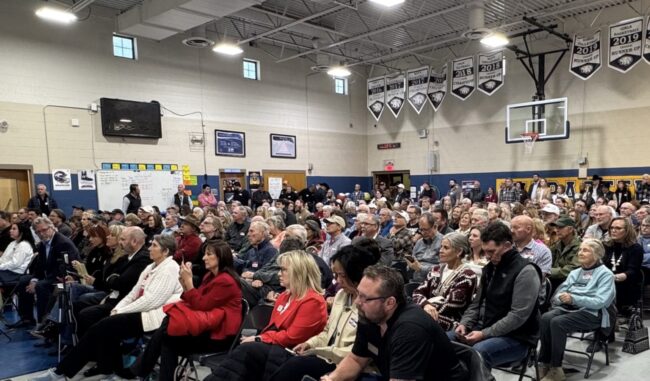
The forum’s audience filled half of the school gym. Photo: Douglas County Citizenry
State Rep. Scott Bottoms of Colorado Springs, State Sen. Barbara Kirkmeyer, a Weld County Republican and Greg Lopez, the former Parker mayor and former U.S. representative who recently left the Republican Party to run as an unaffiliated candidate, joined the debate. Conservative talk radio host Mandy Connell co-moderated with Deb Flora, the founder of the citizenry organization.
The fourth major candidate, Colorado Springs missionary leader Victor Marx, declined to attend and instead held a competing online event from a five-acre training compound in Black Forest. The format was less candidate forum than mission debrief. Marx and two longtime associates, both former military and intelligence operatives, spent much of the broadcast recounting overseas rescue operations they say they have conducted over the years.
Marx, who has led the GOP fundraising race and won 39.5% of the delegate vote at the state assembly, told his livestream audience the primary was effectively over and that he no longer needed to share a stage with the others. “By every intent and purpose, we’ve already won the primary,” Marx said. “It’s down to three. But I’m telling you, the reality is, it’s down to one.” Bottoms, not Marx, actually topped the field at the assembly with 45% of delegate support.
At the Parker forum, Bottoms set the tone early, repeating a message he has used at multiple forums this cycle, including a February Douglas County GOP gubernatorial forum, where he claimed 40,000 to 45,000 Venezuelan cartel members are operating in Colorado. He told the Parker audience that as governor, he would deploy the National Guard alongside local sheriffs and police into Aurora to shut down what he described as an armed Venezuelan cartel presence operating as a “militant military army force” inside the city.
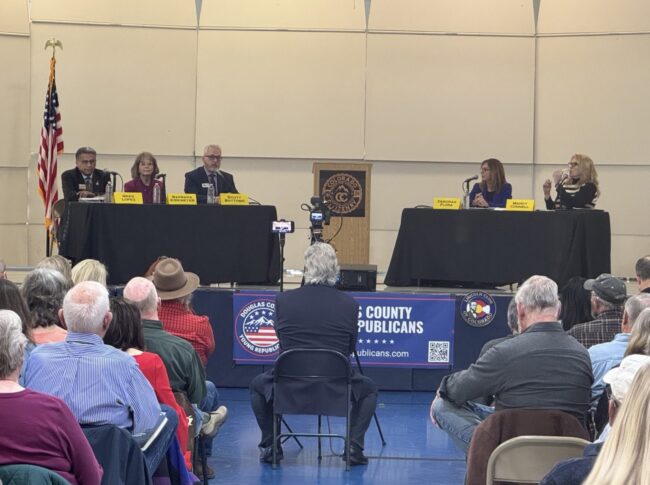
Lopez, Kirkmeyer, and Bottoms (L), with moderators Deb Flora and Mandy Connell (R) Photo: Douglas County Citizenry
“We will go into the Venezuelan cartel area in Aurora and we will shut them down,” Bottoms said, drawing applause. “We’re going to eradicate that militant military army force that is as armed as the police department is.”
Aurora police have publicly described the actual situation differently. The department confirmed in 2024 that “components” of the Venezuelan gang Tren de Aragua are operating in the city, but characterized the gang’s activity in Aurora as isolated rather than systemic and said the gang has primarily targeted other Venezuelan immigrants for extortion, intimidation and kidnapping. As of late 2024, local authorities had arrested eight people and linked 10 to the gang.
A federal operation in August 2025 charged 28 people on drug and firearms offenses, including eight suspected Tren de Aragua leaders. NPR’s reporting on the federal case found that many of the charges were existing gun and drug cases rather than new arrests. Deploying the National Guard into a U.S. city for law enforcement would also raise Posse Comitatus and constitutional questions Bottoms did not address.
“We will put him in jail too”
Bottoms repeated his assertion that he would direct law enforcement to arrest Attorney General Phil Weiser if Weiser blocked federal immigration enforcement.
“If somebody like Attorney General Weiser tries to stand in the way of that, we will put him in jail too,” Bottoms said.
Colorado’s attorney general is independently elected by voters statewide under Article IV of the state constitution. The governor has no legal authority to order the arrest or prosecution of another constitutional officer.
Bottoms went further, telling the crowd that local officials who maintain sanctuary policies could also face arrest. “If you’re the mayor of Denver and you’re trying to have a sanctuary city, you’re going against the Constitution, we’re going to put you in jail,” he said. No legal mechanism exists for a governor to unilaterally jail a mayor over policy disagreements.
Marx, on his livestream, took a softer rhetorical tone but landed in a similar policy place. He said he would direct state law enforcement to cooperate with Immigration and Customs Enforcement on day one and rejected the premise that Coloradans should object. “I don’t know why people wouldn’t want a safer state,” he said. “It’s just common sense.”
Kirkmeyer offered a more conventional approach. She said she would “use every resource available” as governor to challenge Colorado’s sanctuary laws in court and would cut state spending directed toward services for undocumented immigrants. “We will start telling them that U.S. citizens that reside in Colorado matter more,” she said.
Kirkmeyer launched her campaign in September 2025 as a “common sense conservative” who would “work with people” rather than “play political games.” Her record fits the brand on process if not on policy. She votes for the state budget, a stance that has drawn rebukes from her own state party, and she’s been a bipartisan sponsor of major budget legislation on the Joint Budget Committee. She is also among Colorado’s most anti-abortion lawmakers, helped lead a 2013 effort by northern Colorado counties to secede from the state, and made Weld County a “Second Amendment sanctuary” as a county commissioner.
That mixed profile was on display in Parker. After Bottoms told the audience that “we are mentally ill within that building” and that voters needed to put “a non-mentally ill governor in the governor’s seat,” Kirkmeyer used her next turn to push back. “I just want to first point out that Representative Bottoms and I are not mentally ill,” she said. “We are meant to work together. We two are not.”
It was the only direct on-stage rebuke of Bottoms by another candidate all night. But she did not push back on his pledge to deploy the National Guard against Aurora, his threat to jail Weiser, or his claim that property taxes are unconstitutional. On policy substance, she let the most extreme claims of the night stand.
$10 billion in cuts and “Big Balls”
On the state budget, Bottoms, who votes against it every year and has called it “a shell game,” said he had assembled a team to help him cut $10 billion from a state budget he described as “pushing 50 billion.” He told the audience he had been in conversations about recruiting Edward Coristine, the former Department of Government Efficiency staffer who used the online handle “Big Balls,” to assist.
“We’re asking Big Balls to come to Colorado to help us with this,” Bottoms said. “We will DOGE everything and fix this economy.”
The Colorado legislature enacted a $46.8 billion budget for 2026-27. Gov. Jared Polis’s original proposal was $50.7 billion. Cutting $10 billion would amount to a roughly 20% reduction in total state spending or more than Colorado spends on its entire K-12 public school system in a year.
The state budget is constitutionally required to balance and is largely driven by mandatory spending on schools, Medicaid and transportation. Coristine resigned from his federal role in mid-2025. Whether he has agreed to join a Colorado gubernatorial campaign could not be independently verified.
Kirkmeyer pushed back on the suggestion that the budget process is fundamentally broken. She said the state constitution requires a balanced budget and noted that lawmakers have already been making cuts to address a roughly $1.1 billion shortfall in the general fund. She proposed a 5% across-the-board reduction in every department.
Marx promised something more sweeping. He said his administration would launch “agency-wide financial audits on day one” and post a “live spending dashboard” for every state contract over $10,000 in real time. “We have to find out where the money is being spent,” he told viewers.
“Get rid of property tax”
Both Bottoms and Lopez argued the state should move to eliminate property taxes entirely, with Bottoms calling them unconstitutional.
“I believe it’s unconstitutional to have property tax and I also believe it is unconstitutional to have income tax,” Bottoms said. “So those decks are hit, we need to get rid of all of them.”
Article X of the Colorado Constitution explicitly authorizes both taxes. Property taxation has funded local government since statehood in 1876 and is the primary revenue source for school districts, fire districts, libraries and county services across Colorado. Article X, Section 17 grants the General Assembly the power to levy income taxes. Eliminating either would require Colorado voters to approve a constitutional amendment and force a complete restructuring of how local services are funded. A governor cannot do it by executive order.
Marx took a less absolute position on his livestream, telling viewers he would “cap” property taxes and expand the senior homestead exemption. He framed the issue around a question from a viewer named Debbie Watkins, who said she pays $800 more in property taxes than she did a few years ago, despite the senior exemption and “no improvements made.” Marx called the situation “criminal” and tied it to what he described as bloated state spending.
Lopez focused his housing pitch on the cost burden imposed by metro districts, which he said charge $50,000 per water tap and $40,000 per sewer tap, driving the cost of new homes beyond the reach of younger buyers.
Kirkmeyer, who was a lead Republican sponsor of a bipartisan 2024 measure that reduced statewide local property taxes by more than $1 billion and capped annual revenue increases, called for further reductions but did not endorse elimination. She said she would work with local governments rather than override their zoning authority.
TRACER and a $300,000 question
The biggest news of the evening for Marx, however, was not a policy proposal. It was the explanation he offered for irregularities in his campaign finance filings with the Colorado Secretary of State.
A day before Marx’s livestream, conservative talk radio host Ross Kaminsky published an investigation on Substack documenting what he called “more than suspicious” patterns in Marx’s filings with TRACER, the state’s online campaign finance disclosure system run by the Colorado Secretary of State’s office. Kaminsky reported that single donor names appeared multiple times in the database, with different cities, states and employers across what were supposedly contributions from the same person. He shared one example of a donor whose six listed contributions showed four different cities of residence and three different occupations, including “homemaker,” “retired” and an employee of a tire company.
Kaminsky also reported that he contacted a woman whose name appeared in TRACER as a repeat Marx donor. She told him by phone she had not donated to the campaign. When Kaminsky walked her through the database, she found her name listed as having donated from multiple Colorado cities and from multiple other states.
Asked about the discrepancy on his livestream, Marx attributed it to an Excel error.
“It was a data entry issue,” Marx said. “Our fine young man, who’s a mathematician teacher, was using Excel, and there it was just a data issue that when he entered it into the TRACER system Secretary of State, it loaded wrong.”
Marx said the corrected version would be uploaded the following morning at 9:05 a.m. and that the underlying records were intact. His campaign manager, Buddy Jericho, who is co-founder and CEO of an AI-driven intelligence software company called Indago Technologies and serves on the board of Marx’s ministry, All Things Possible, added that “a clerical error does not affect the amount that was raised.”
Kaminsky, in an update to his post Wednesday evening, called the Marx campaign’s explanation unsatisfactory. “It does not attempt to explain the varying employment information for the same donor across multiple donations nor does it explicitly say that the data the government has is an accurate representation of contributions made to the campaign,” he wrote. He stopped short of accusing Marx personally of wrongdoing but wrote that the patterns are consistent with what could be either a “straw donor” scheme, which is illegal under both state and federal campaign finance law or “the campaign not actually raising as much money as they’ve claimed.”
Marx has reported raising $1.66 million in the 2026 reporting period through April, leading the GOP field and has total fundraising since entering the race approaching $2.3 million. Whether the dollar totals are accurate, and whether the names attached to them are real, are separate questions Marx’s Excel explanation does not resolve.
On Friday, the Secretary of State’s Election office granted the Marx campaign’s request to re-file his report, though it declined their request to delete the original.
The TRACER discrepancies were not the only credibility question Marx used the livestream to push back against.
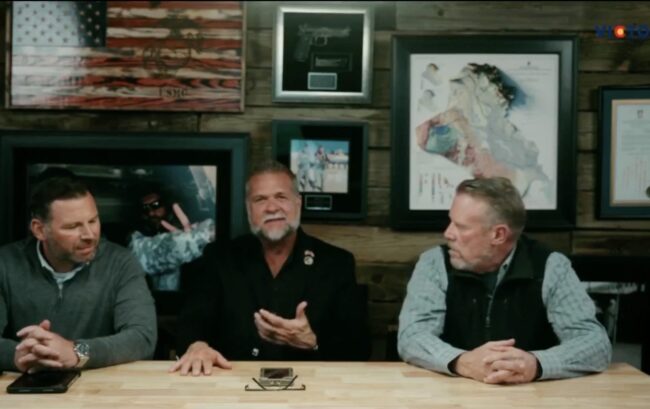
Victor Marx (center) with Buddy Jericho (left) and Mark Geist (right) Photo: Marx campaign livestream
He also spent significant time defending the rescue missions his All Things Possible ministry says it has conducted in Cambodia, Iraq and Syria, after recent skepticism in conservative media about the scale of those claims. “There’s been questions out there about the validity of me doing, us doing work overseas,” Marx said. “Just because some of you folks have never done it out there, it doesn’t mean it ain’t getting done.”
Lopez leaves the party
Lopez, who served as Parker’s mayor and won a 2024 special election to fill the remainder of former U.S. Rep. Ken Buck’s term in Colorado’s 4th Congressional District, used his opening statement at the Parker forum to address his decision to leave the Republican Party and run as unaffiliated.
“My values have not changed. I am a strong, compassionate conservative,” Lopez told the audience. “But we all know that in Colorado, when it comes to the voting blocs, the unaffiliated voter is now the majority voting bloc.”
Lopez is correct on the math. Colorado’s unaffiliated voters surpassed 50% of active registered voters in September 2025, up from 42% five years earlier. As of December, unaffiliated voters represented 49.7% of the total electorate. Democrats made up 25.1% and Republicans 22.8%. Surveys suggest unaffiliated voters lean Democratic by roughly 60-40.
Asked by Bottoms whether his candidacy would split the conservative vote and hand the race to a Democrat, Lopez rejected the framing.
“If someone votes for me versus some other conservative, that’s not splitting the vote. That’s democracy,” Lopez said. He predicted he would win the November election by four points and 90,000 votes.
Three years of pedophile-ring claims
Pressed by moderators on his repeated public statements that pedophile rings operate at the state Capitol, Bottoms said he has been working with the FBI for years on the allegations but has produced no public evidence.
“I’ve known for the last three years that there are pedophile rings in the House, in the Senate, up in the Governor’s office,” Bottoms said. After saying he is working with Tom Shea of the FBI’s Denver Field Office, Bottoms said he is now working with “a private group” because he distrusts the bureau’s pace. Supervisory Special Agent Shea did not immediately return voice and text requests for confirmation of his involvement with Bottoms. This article will be updated with any response received.
Bottoms acknowledged he has not named anyone publicly. “If I call people’s name out on this kind of thing, I don’t have the weight of the FBI or somebody else involved in this,” he said.
There is no public record of any federal investigation matching the description Bottoms provided. 9News reported in February that Bottoms has been “unable to offer any evidence” of his allegations. Making criminal accusations against unnamed people at the state Capitol without supporting evidence creates real reputational and legal risk to anyone who might be falsely suspected.
Getting the basics wrong
Several claims made during the Parker forum did not align with Colorado law or recent legislative history.
Bottoms told the audience that police, sheriffs and ICE are barred by state law from working together. Colorado’s 2019 sanctuary law, restricts the use of state and local resources for civil immigration enforcement. It bars arrest or detention based solely on a civil immigration detainer and prohibits Colorado entities from entering 287(g) agreements with ICE. It does not, however, prohibit cooperation when a federal judge has issued a warrant or in the course of a criminal investigation. Local sheriffs in El Paso and Teller counties continue to work with ICE within those constraints. A 2025 follow-up law, Senate Bill 25-276, reemphasized the existing civil-detainer restrictions but did not alter the framework for cooperation on criminal cases.
Lopez said he would champion restoring qualified immunity for police officers, blaming Colorado’s 2020 police accountability law, passed with overwhelming bipartisan support in the wake of the George Floyd protests, The law did not eliminate qualified immunity at the federal level, where officers can still invoke it under Section 1983 claims. It created a separate state civil cause of action that doesn’t allow officers to invoke qualified immunity, and it capped their personal liability at 5% of a final judgment, up to $25,000, if their employer determines they didn’t act in good faith.
Bottoms also claimed lawmakers had just passed a bill fining restaurants $1,000 for placing too many ketchup packets in takeout bags. A real bill exists, but his description of it doesn’t match the legislation. Senate Bill 26-146 requires restaurants and delivery services to ask customers before automatically including single-use items such as condiments, utensils and napkins. Customers can still receive any of those items by request. The bill’s fines escalate with repeat violations, reaching up to $1,000 for a third or subsequent violation. The legislation passed the Colorado House the day before the forum but has not yet been signed into law.
What the loudest applause revealed
Douglas County remains one of the most reliably Republican counties in the Denver metro area. Donald Trump carried it by roughly 10 points in 2024, the only major Denver-area county he won. Kamala Harris carried Jefferson, Arapahoe, Adams Boulder, Broomfield, and Denver counties; the Denver metro overall went 63%-37% for the Democratic ticket. The donors, activists and officeholders who fill Douglas County’s GOP central committee meetings have an outsized influence in the state’s Republican primary because they show up.
On Wednesday night, the candidate they cheered loudest was a state legislator who pledged to imprison Colorado’s twice-elected attorney general, called property and income taxes unconstitutional, claims without evidence that a pedophile ring operates inside the Capitol, and promised to send soldiers into a Colorado city to “eradicate” what he described as an enemy military force. The candidate they didn’t see at all spent the evening in a Black Forest training compound explaining glaring discrepancies in his campaign finance report.
Colorado Republicans have to pick one of them. The primary is June 30.


Comments