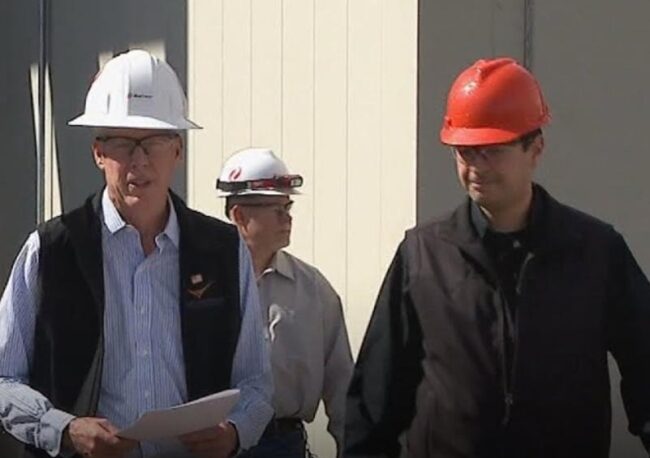
With gas prices edging their way toward $4 a gallon in Colorado, local frackvangelist turned Energy Secretary Chris Wright continues to do what he can to calm global energy markets, an effort that hasn’t gone well after Wright’s false claims about military escorts for oil tankers in the Strait of Hormuz sent the price of crude oil gyrating questionably early last week before resuming its overall upward momentum.
As Fortune’s Tristan Bove reports, Wright is steadfast in his assurances that gas prices will drop precipitously after a few more weeks of war on Iran, and fall back below $3 a gallon by summer. The only problem? Wright’s own analysts at the Department of Energy don’t agree with that rosy assessment:
The domestic impact of the conflict in Iran is visible on brightly lit neon signs outside tens of thousands of gas stations across the U.S. Average fuel prices are now $3.84 a gallon, up 31% from a month ago. And it might be a long time before drivers see gas below $3 a gallon again, despite recent statements from the Trump administration claiming otherwise.
Administration officials have framed spiking gasoline prices as short-lived pain that will resolve itself quickly. “Americans will feel it for a few more weeks,” Energy Secretary Chris Wright told NBC over the weekend, adding that he saw a “very good chance” that gas prices would dip below $3 a gallon come summer…
But that’s not what the experts at the Energy Information Administration say:
Gasoline costs in the U.S. for 2026, including taxes, could average around $3.34 a gallon, according to a projection published last week by the Energy Information Administration (EIA), a semi-independent statistical agency under the Energy Department’s purview. As things stand, things aren’t likely to improve much next year, with per gallon prices averaging out at $3.18, according to the EIA.
It’s a significant revision from February, the last forecast before the conflict began, when the expected average for 2026 was $2.91 and $2.93 next year. The EIA suggests gasoline prices are already near their peak, and will mostly moderate for the rest of 2026 and throughout 2027, as transit through the strait gradually resumes starting in April 2026. But even under this scenario, the projections do not foresee gasoline prices falling below $3 per gallon at any point between now and the end of 2027.
After Republicans like Rep. Gabe Evans made declining gas prices a central campaign message over the past year, helping offset higher costs voters are paying for basically everything else, the explosive increase in gas prices since Donald Trump launched his “war of choice” on Iran almost three weeks ago have seriously undermined one of the only redeeming arguments vulnerable Republicans had going into this year’s midterm elections. The apparent indifference with which Trump plunged the nation into a war with nebulous and shifting goals has shocked and divided MAGA loyalists and hardened the non-MAGA public in opposition.
And if the Energy Department is right–the analysts, not the Secretary–every time Americans fill up their gas tank between now and November, they’ll get a more compelling political message than any advertisement can deliver.
Trump hasn’t just ceded the affordability argument by going to war with Iran–he’s handed it to Democrats on a silver platter.
Subscribe to our monthly newsletter to stay in the loop with regular updates!
Comments