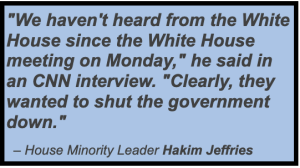
The first federal government shutdown since 2018 entered its second full day today. It will continue (at least) through tomorrow because the Senate is on recess until Friday in honor of Yom Kippur.
We’ll provide regular shutdown updates as the news warrants, so let’s get to it…
As The Denver Post reports:
Tens of thousands of Colorado workers were in limbo Wednesday as the latest partial shutdown of the federal government played out in Washington, D.C., resulting in furloughs across the country.
About 54,300 federal employees work in Colorado, according to the Colorado Department of Labor and Employment. That doesn’t include nearly 38,000 active-duty military service members who are based in the state, according to the Defense Manpower Data Center, and must continue serving without pay.
It wasn’t immediately clear Wednesday how the tens of thousands of civilian workers were spread across the different federal agencies with presences in Colorado, including at the Federal Center in Lakewood, government labs and other sites. Not all workers are furloughed, with significant exemptions in some agencies. Excepted employees, or those whose work includes protecting life and property, are expected to continue working, though they won’t be paid until the shutdown ends.
But some impacts were evident. The vast majority of staff and researchers at the National Oceanic and Atmospheric Administration in Boulder were out of work due to the shutdown, according to U.S. Rep. Joe Neguse’s office, with some — from the National Telecommunications and Information Administration and the National Weather Service — working without pay.
Though the exact number of furloughed workers wasn’t available, most of the research at NOAA labs had stopped.
National Parks remain open in Colorado, though most federal employees will be furloughed. The State of Colorado is spending up to $7.5 million to help continue food services for the Women, Infants and Children (WIC) program. Immigration courts at workers at the Environmental Protection Agency (EPA) are still on the job — for now.
Nationally, some 600,000 federal workers are sitting at home and will not be receiving paychecks anytime soon.
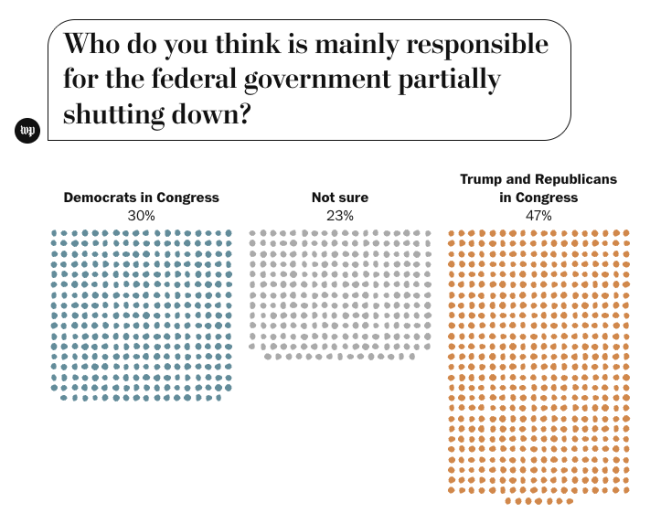
New polling from The Washington Post shows that Republican hopes of pinning the shutdown on Democrats isn’t working:
The Post’s poll finds significantly more Americans blame President Donald Trump and congressional Republicans for the shutdown than Democrats, though many say they are not sure. People express moderate concern about the shutdown’s impact at this early stage, with “somewhat concerned” the most common answer. A large majority support Democrats’ call to extend federal health insurance subsidies in general, though just under half support the party demanding this if it extends the government shutdown.

These numbers are consistent with other recent polling showing that Americans are really not confused about which party is in charge of the federal government at the moment.
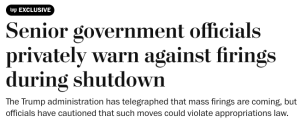
The last government shutdown, in 2018, was also the longest in U.S. history and ended when then-President Trump caved on demands for funding a wall at the southern border. Trump is talking tough today about firing a bunch of federal workers, but as The Washington Post reports, not everybody in his administration is on board:
Senior federal officials have quietly counseled several agencies against firing employees while the government is shut down — as President Donald Trump has suggested he will — warning the strategy may violate appropriations law, according to two people familiar with the matter who spoke on the condition of anonymity to discuss sensitive internal deliberations.
The officials cautioned that firings — known as RIFs, or reductions in force — could be vulnerable to legal challenges under statutes labor unions cited this week in a lawsuit seeking to block threatened mass layoffs. For example, the Antideficiency Act prohibits the federal government from obligating or expending any money not appropriated by Congress. It also forbids incurring new expenses during a shutdown, when funding has lapsed; some federal government officials have concluded the prohibition could extend to the kind of severance payments that accompany reductions in force.
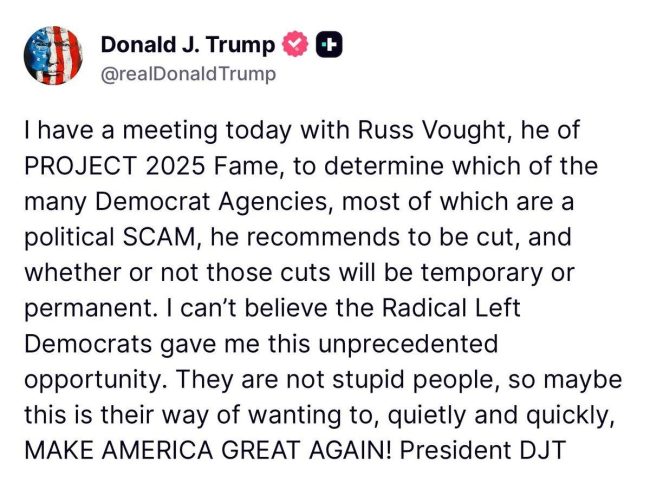
Trump and White House Budget Director Russell Vought, whose office oversees apportionment law and has led the administration’s preparation for terminations, have repeatedly said mass dismissals would come during a government shutdown. Plans for such firings have been developed at several agencies, according to two federal officials familiar with the matter who, like others interviewed for this article, spoke on the condition of anonymity to detail internal conversations. Those plans, which have yet to take effect, dictate smaller reductions in force than what the White House has projected.
Of course, Trump has tended not to concern himself with petty things like “laws” and “regulations,” but a Truth Social post from the Big Orange Guy today carries an undercurrent of false bravado:

As POLITICO notes, this shutdown is different in many ways than shutdowns of the past. Both Democrats and Republicans have their reasons for supporting a shutdown. In a strange comment, House Speaker Mike Johnson said today: “I literally have nothing to negotiate.”
There are also benefits for Trump in quelling questions on other topics such as the economy and his connections to Jeffrey Epstein.
Trump is also using the shutdown to target blue states for funding reductions in a move that would be impeachable in a more sane timeline. As Reuters explains:
President Donald Trump’s administration on Wednesday froze $26 billion for Democratic-leaning states, following through on a threat to use the government shutdown to target Democratic priorities.
The targeted programs included $18 billion for transit projects in New York, home to Congress’s top two Democrats, and $8 billion for green-energy projects in 16 Democratic-run states, including California and Illinois.
Targeting blue states like this has some Republicans very nervous:
Republican Senator Thom Tillis said he was concerned that the freezing of infrastructure funds for New York could make it harder for Congress to exit the shutdown.
“They need to be really careful with that, because they can create a toxic environment here,” Tillis said. “So hopefully they’re working with the leader, and the leader with them, on not creating more work to get us out of this posture.”
Meanwhile, as USA Today notes, not everything is coming to a halt:
Government shutdown or not, construction on President Trump’s pet project, a 90,000-square-foot ballroom replacing a large part of the East Wing, is continuing apace.
The $200 million dollar project, unveiled in July, will feature gilded interiors and seat 900 people.
If only you could shut down gauche.
Subscribe to our monthly newsletter to stay in the loop with regular updates!
Comments