U.S. Senate See Full Big Line

(D) J. Hickenlooper*

(D) Julie Gonzales

(R) Mark Baisley

80%

20%↓

10%

(D) Phil Weiser

(D) Michael Bennet

(R) Victor Marx
50%↑

50%↓

20%
Att. General See Full Big Line

(D) Jena Griswold

(D) M. Dougherty

(D) Hetal Doshi

40%↓

30%

30%

Sec. of State See Full Big Line
(D) J. Danielson

(D) A. Gonzalez

(R) James Wiley
50%↓

40%↑

10%
State Treasurer See Full Big Line

(D) Jeff Bridges

(R) Kevin Grantham

80%↑

20%↓

CO-01 (Denver) See Full Big Line

(D) Diana DeGette*

(D) Milat Kiros

(D) Wanda James

70%↓

20%↑

10%↓

CO-02 (Boulder-ish) See Full Big Line

(D) Joe Neguse*

(R) Somebody

90%

2%

CO-03 (West & Southern CO) See Full Big Line

(R) Jeff Hurd*

(D) Alex Kelloff

(D) Dwayne Romero

(R) Ron Hanks

50%↓

30%↓

30%↑

20%

CO-04 (Northeast-ish Colorado) See Full Big Line

(R) Lauren Boebert*

(D) E. Laubacher

80%

20%

CO-05 (Colorado Springs) See Full Big Line

(R) Jeff Crank*

(D) Jessica Killin

53%↓

48%↑

CO-06 (Aurora) See Full Big Line

(D) Jason Crow*

(R) Mel Tewahade

90%

2%

CO-07 (Jefferson County) See Full Big Line

(D) B. Pettersen*

(R) Somebody

90%

2%

CO-08 (Northern Colo.) See Full Big Line

(R) Gabe Evans*

(D) Shannon Bird

(D) Manny Rutinel

45%↓

30%

30%

State Senate Majority See Full Big Line

DEMOCRATS

REPUBLICANS

80%

20%

State House Majority See Full Big Line

DEMOCRATS

REPUBLICANS

95%

5%

[wpdreams_ajaxsearchlite]
May 06, 2026 11:37 AM UTC

Legislature Takes First Step in Fighting Dumb Ballot Measures

Democrats in the state legislature are working to pass a bill in the final days of the 2026 session to protect funding for key services in the face of another proposed ballot measure seeking to divert state revenue to specific projects. On Tuesday, HB26-1430 (“Transportation Funding Adjustments”) passed out of the House Transportation, Housing, and Local Government Committee and is now headed to the floor of the House of Representatives.
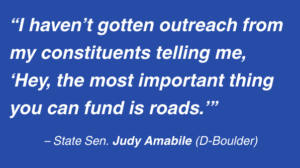
Sara Wilson of Colorado Newsline has more on this late legislative effort to get in front of potentially dangerous impacts from the proposed ballot measure Initiative 175:

Lawmakers warn that the initiative would reroute money from priorities like public education and healthcare amid a difficult budget reality. The Legislature recently approved a state budget that had to close a $1.5 billion deficit, and future years are not expected to be easier.

They say the authors of the ballot initiative are telling voters it would fund roads without raising taxes, but that funding would actually come at the cost of other state programs.

“If you ask the voters, ‘Would you like to fix roads but defund public education? Would you like to fix roads but impact the ability to seek healthcare in your community?’ Then that’s something we have to pay attention to,” said Rep. Andy Boesenecker, a Fort Collins Democrat. “But that’s not the question they’re asking voters. The question they’re asking voters is, ‘For no additional dollars to you, would you like to repair roads in our community?’ Who wouldn’t say yes to that? I think it’s our obligation as a Legislature to be truthful.” [Pols emphasis]

Initiative 175, whose backers are collecting petition signatures to get it on the November ballot, would direct existing taxes and fees related to gas and car use to fund road repairs and “road transportation,” to the tune of about $700 million annually. It is backed by the Restore Our Roads Coalition and funded by the Colorado Construction Industry Coalition.

As we’ve discussed over the years in this space, right-wing funders have increasingly focused their efforts on passing ballot measures instead of beating their heads against the wall supporting incompetent Republican candidates for elected office. Groups such as Advance Colorado are putting most of their eggs in the initiative basket, often with complicated and unworkable proposals that are meant to tie the hands of legislators trying to make difficult funding decisions.

Some of these initiatives sound good in theory, and lawmakers are rightfully worried about the unintended consequences. In 2024, for example, voters approved Proposition 130, which directs $350 million in state funding for local law enforcement. Most voters wouldn’t instinctively oppose more money for law enforcement (well, in 2024, anyway), but the bigger issue is about what DOESN’T get funded as a result. These ballot initiatives create long-term spending mandates that handcuff state lawmakers trying to deal with other funding priorities — a problem exacerbated in years like 2026 when legislators have been forced to make $1.5 billion in cuts. As Boesenecker explained to Colorado Newsline, “If we had an extra $700 million to fund transit in our state, we probably would have used it this last budget cycle to not cut (Medicaid) reimbursement rates.”

Legislative Democrats are smart to be getting aggressive in pushing back on these single-minded ballot measures. As a press release from House Democrats explains:

If approved, Initiative 175 would require the state to spend around $700 million a year on highway projects without providing any new revenue. This comes on the heels of back-to-back-to-back $1 billion cuts to the budget. Initiative 175 would require $700 million in cuts to K-12 education, higher education and Medicaid, leading rural hospitals and clinics to close, tuition to increase, and to a new budget stabilization factor for K-12. In addition to devastating education and healthcare funding cuts, Initiative 175 would defund the DMV, the Peace Officer Standards and Training fund, the Emergency Medical Services fund and DUI prevention efforts. [Pols emphasis]

If Initiative 175 were to pass in November, HB26-1430 would make a number of changes to transportation funding to mitigate the harms from the initiative. Contingent on Initiative 175 being adopted by voters, the bill would temporarily reduce the excise tax on gasoline and special fuel, vehicle registration fees and road usage fees. The reduced revenue would open up more general fund dollars to support critical government functions like education and healthcare, reducing the revenue that would have to be refunded under TABOR. Also known as the Colorado Budget Protection Act, HB26-1430 would create the Support Road Transportation Fund to house the $700 million allocated by the approval of Initiative 175. The money in this fund would replace certain transportation-related general fund transfers.

At least the roads are nice!

The response from the Colorado Contractors Association has been to whine about the legislature not respecting the will of the voters their members, which is a silly oversimplification. Nobody is saying that Colorado doesn’t need more money for road maintenance, but because of the draconian TABOR limits in Colorado, directing $700 million toward roads means taking $700 million away from education and health care.

Colorado’s “citizen initiative” process allows outside groups can spend millions of dollars to pass single-issue spending initiatives benefitting their supporters; over time, these individual initiatives create a gordian knot of mandates that are left to others to solve. Good on Democratic lawmakers for trying to get ahead of this looming disaster.

Comments

Recent Comments


Posts about Donald Trump

Posts about Rep. Gabe Evans

Posts about Rep. Lauren Boebert

Posts about the Colorado House

Posts about the Colorado Senate


103 readers online now

Newsletter

Subscribe to our monthly newsletter to stay in the loop with regular updates!