Ostensibly, ballot initiatives are meant as a way for the average citizen to create political change without the Legislature. But over half of the initiatives which could be put to Colorado voters in 2026 have been spawned by a single dark money organization: Advance Colorado, the state’sbest-fundedconservative political group.
Of the 87 ballot initiatives listed on the website for the Colorado Title Board, which manages the state’s ballot initiative process, Advance Colorado president Michael Fields is listed as a proponent for 61 of them. Out of those 61, 44 have either been withdrawn, expired or been denied; 20 have had their titles set successfully; and 2, at the time of writing, have been approved for circulation.
Advance Colorado has used its resources to push initiatives onto the ballot in prior election cycles, as well.
Advance Colorado, called a “dark money” group because it does not disclose its donors, was behind last year’s Proposition 128, requiring those convicted of violent crimes to serve longer sentences before being eligible for parole, and Proposition 130, which increased state funding for law enforcement. Both initiatives were passed by voters.
Another initiative from Advance Colorado, Amendment 80, would have created a “constitutional right to school choice.” It failed due to opposition from conservative education advocates. Another measure, which would have put a cap on property taxes, was withdrawn after Democrats, threatened by the possibility of the measure passing and causing a budget crisis due to lost tax revenue, caved and held a special session to address property tax reform.
Many of the initiatives submitted by Advance Colorado this year are functionally duplicates of each other, addressing the same issue but with differences in verbiage. This allows them to later decide which variation has the best chance of passing and withdraw the others, one expert explained.
“A lot of this is just testing out certain legal theories, certain policies and see how they translate into ballot language,”Joshua Mantell, Director of Government Relations at the progressive Bell Policy Center, told the Colorado Times Recorder. “… They’re also trying to kind of tease out who’s opposing which [initiatives], and which part of it they are most opposed to. And so a lot of this is just trying to understand the state of play, both in terms of their own ballot initiative and also the opposition’s strategy to better be able to run the campaign later.”
A spokesperson for Advance Colorado did not respond to a request for comment; this article will be updated with any response received.
The Initiative Process
In Colorado, citizens can submit proposed changes to state law or the state constitution via the initiative process, which is administered by the state’s Title Board. There, proposals must first pass legal review and any wording challenges from opponents.
Once they are approved by the Title Board, though, proposals still face an uphill climb to reach the ballot. To qualify, initiatives must gather a steep number of signatures from registered Colorado voters: statutory proposals need an amount equal to 5% of the votes cast for Colorado Secretary of State in the prior general election (for this cycle, 124,238), while proposals to amend the constitution must satisfy the additional hurdle of gathering 2% of the total required signatories from each of the state’s 35 senate districts.
If enough signatures are gather and verified to make the ballot, initiatives become law if they receive a majority of the vote (or 55% for constitutional amendments), without requiring a vote of the legislature.
Such a high requirement necessarily privileges moneyed interests who can afford to pay professional firms to gather signatures over those who must rely on volunteers. But there can be benefits for volunteer signature collection too.
“The benefits of doing volunteer collection is you’re really having conversations with people and letting them know what the ballot initiative is about,” said Mantell. “My experience with paid signature gatherers is they’re less concerned about what the measure itself is than getting that signature. And so you’re not really convincing folks through the signature gathering process.”
Even then, many initiatives are withdrawn by their proponents before they can be put to Colorado voters.
Bypassing the Legislature
In recent years, Colorado Republicans have slipped into a legislative minority. Without enough legislative votes to pass their agenda, conservative activists have turned to the ballot initiative process as the only way to pass a conservative policy agenda in what’s now a solid-blue state.
“Since we’re in such the minority, the best way to do it in Colorado is through our Constitution,” said Republican legislative aide Schumé Navarro at a September event. “We have the ability to petition the people in the government to put these on as ballot initiatives. This is a little workaround that we have with the legislature.”
Many of these initiatives, including some of those from Advance Colorado, attempt to undo policies passed by Democrats in either the legislature or local municipalities.
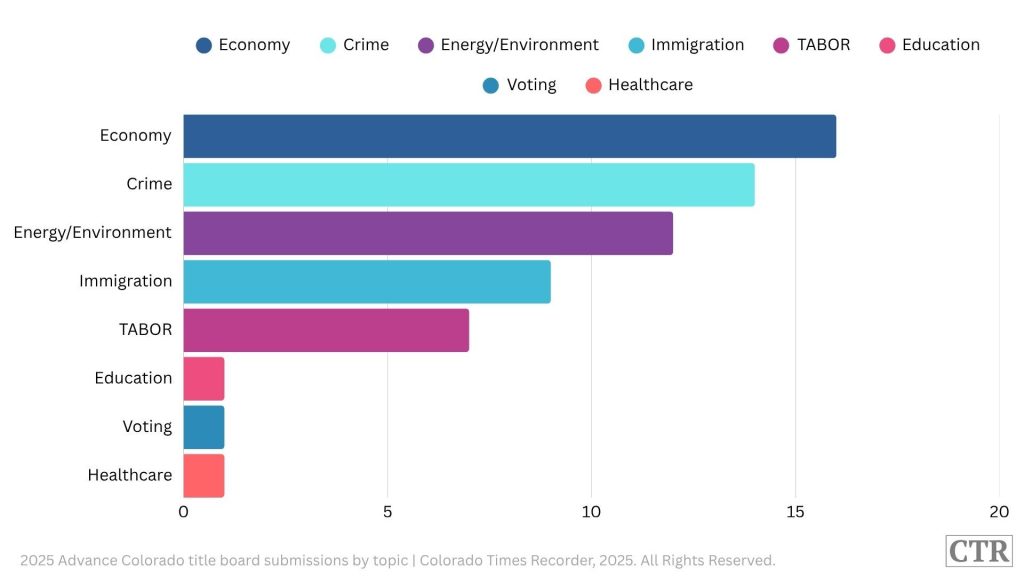
The numerous initiatives submitted by Advance Colorado aren’t limited by to just one or two subjects. These span a variety of policy areas, including taxes, environmental policy, and creating harsher penalties for certain crimes.
Advance Colorado: Taxes & Regulations
Several of the Advance’s initiatives aim to curtail future Democratic attempts to maneuver around Colorado’s Taxpayer Bill of Rights (TABOR), which, among other things, requires that tax increases must be passed by voters rather than the legislature.
These would expand TABOR’s restrictions on raising money, either through fees, or expanding existing taxes. Of the initiatives with their titles set, four (#121, #122, #136, and #158) would apply to fees, and three (#124, #137, #159) would apply to tax expansions.
In addition to blocking the state government from gaining extra revenue, Advance Colorado has two initiatives approved – #65 and #156 – that would decrease the state’s income tax to 4.20% and 3.4%, respectively. Colorado’s current income tax rate is set at 4.4%.
Another initiative, #119, hearkens back to U.S. President Donald Trump’s campaign promise of exempting tips from federal taxes. If passed, the initiative would replicate the exemption for both tips and overtime pay from state-level taxes.
Initiative #96 attempts to preempt government bans on appliances that use natural gas. Colorado recently implemented an air quality rule banning gas-powered lawnmowers during summer months, but the state said it would not immediately enforce the policy.
Lastly, Initiative #138 again attempts to preempt left-wing policies, but this time one that has not yet been passed into law in Colorado: single-payer health insurance, a form of universal healthcare. Under the guise of maintaining a “right to private health insurance,” this initiative would ban state and local governments from requiring Coloradans to “contribute to or participate in a single-payer insurance system,” which would threaten the funding of such a system.
Another proposal from Advance Colorado attempts to tap into a popular conservative boogeyman: the myth of widespread voter fraud. Initiative #66 would instate stricter signature verification requirements on mail-in ballots, as well as require voters to include their social security number or state ID. Conservative activists largely began championing these reforms in the wake of Donald Trump’s defeat in the 2020 election, which Trump and others have claimed without evidence was stolen by, among other things, fraudulent mail-in ballots.
Advance Colorado: Crime
Other initiatives from Advance Colorado attempt to use the ballot initiative process to make Colorado tougher on crime.
Conservatives have frequently used claims of rising crime (especially in urban, politically liberal areas), and promising to crack down on said crime if elected, to gain a political edge over Democrats. These claims tend to run counter to actual crime statistics; in fact, since spiking upwards during the first years of the COVID-19 pandemic, violent crime has actually dropped nationwide. Colorado Springs, the most conservative of Colorado’s major cities, was one of six cities across the country to see an increase.
Multiple initiatives attempt to deter crimes by increasing penalties. For instance, #91 and #155 are aimed at increasing the severity of punishments for theft and motor vehicle theft.
#85 goes after fentanyl possession. Under a 2022 law, possession of one gram or more of a substance containing fentanyl is charged as a felony, but possessing less than a gram is charged as a misdemeanor. Advance Colorado’s initiative would rewrite that law tomake felony charges apply for any amount of a drug containing fentanyl, no matter how small. It would also harshen the existing penalties for distribution of the synthetic opioid, and remove a clause downgrading charges to a misdemeanor if the defendant was not aware they were distributing fentanyl.
Initiative #59 would create a mandatory sentencing requirement for child sexual assault, mirroring a bill pushed by Republicans during the 2025 legislative session.
Another initiative, #58, would exclude people who are accused of committing certain crimes – including violent crimes, motor vehicle theft, or assaulting a police officer – from paying bond to leave jail before their trial.
Another attempts to empower state law enforcement officers to help the federal government target immigrants. If a person is charged with a crime, and police determine that they are not legally in the U.S., Initiatives #94 and #95 would require those officers to report them to the Department of Homeland Security. This would override state laws preventing law enforcement from sharing an individual’s immigration status with ICE. It would also override some local ordinances enacted by Denver and other cities, that conservatives deride as “sanctuary policies,” where local officials agree not to enforce certain parts of federal immigration law.
Of these, Initiatives #85 and #95 have both been approved for circulation. Records show two firms, Blitz Canvassing and Victor’s Canvassing, are being paid to gather signatures. Advance Colorado announced this week that it would turn in over 200,000 signatures for Initiative #85.
Other Conservative Initiatives
Though they aren’t submitting nearly as many proposals as Advance Colorado, other conservative groups are also turning to the citizen ballot initiative process as a way to pass their agenda in a blue state.
One such group is Protect Kids Colorado, a group that last year attempted to push through multiple ballot initiatives that would have restricted the rights of transgender children. Most of these were defeated at the Title Board, and the two that were approved for circulation failed after the group’s all-volunteer signature gatherers could not obtain enough signatures to qualify for the 2024 ballot.
Now, Protect Kids Colorado is going through the process once again, this time with the assistance of former Republican secretary of state Scott Gessler. The group is running three initiatives.
The other, #108, echoes Advance Colorado’s strategy of deterring crime through raising punishment: it would increase the penalty for child trafficking to life imprisonment.
All three initiatives initially coasted through the Title Board’s oversight, but had to be re-filed after one proponent apparently left Colorado. They have since been re-approved, and the group is currently circulating petitions, aided by religious leaders. Members of Protect Kids Colorado will once again use volunteers, rather than paid signature gatherers, to try to acquire the necessary 124,238signatures.
Another set of initiatives, all addressing transportation funding, has had its titles set. Republican consultant and former Aurora City Councilman Dustin Zvonek, a principal at 76 Group, pitched initiatives matching these in a July interview with KOA Radio’s Ross Kaminsky.
“It seems weird that we’d have to do this, but the fact of the matter is we do,” said Zvonek on air. “And what the measures would do is it would require the legislature, this legislature and future and governors to actually use the money that we collect on the sales and use tax for the sale of automobiles, on car parts, delivery fees, all the things that over the years.”
The five initiatives, #126, #162, #163, #174, and #175, would require Colorado to spend funds allocated for roads on nothing other than roads. According to Zvonek, this is intended not just to fund road maintenance, but to prevent funding from going to public transportation and bike lane infrastructure.
“We don’t want to see more light rails and bike lanes, things that we know that, where it’s popular for, you know, the controlling party in our state to invest our transportation dollars,” Zvonek said to Kaminsky. “We want this to go into roads, bridges that have for years been neglected and underfunded.”
76 Group did not immediately respond to an inquiry asking if it is associated with these initiatives.
Longtime anti-abortion activists Angela Eicher and Faye Barnhart have once again submitted initiatives aiming to ban abortion by conferring legal protections onto fetuses from the moment of conception. One of these had its title set late last month, but was later challenged and had its title struck.
While its initial attempts this year to reach the ballot fell short of signature gathering requirements, a group called Advocates for Smart Wolf Policy says it plans to re-introduce its measure to block wolf reintroduction in Colorado, Colorado Politics reported. Wolf reintroduction was initially passed by Colorado voters via ballot initiative in 2020.
Progressive Initiatives
The Bell Policy Center has banded together with multiple other advocacy groups as part of the Protect Colorado’s Future coalition, in an attempt to submit progressive proposals through the Title Board. The group’s goal is to give Coloradans a chance to approve a graduated income tax – meaning higher taxes for those with higher incomes.
“So currently, TABOR says that everybody’s income must be taxed at the same rate, regardless if you’re a billionaire or you’re making minimum wage,” Mantell told the Colorado Times Recorder. “Your income is taxed the exact same rate. Which means that when we look at the full tax code, the wealthy are paying significantly less of their income in taxes than everybody else. And so we don’t think that this is fair. We’re also facing a state budget that is in crisis, both due to TABOR’s restrictions on spending as well as the federal cuts from H.R. 1 [Trump’s budget bill] that are coming down the line that will greatly reduce funding for health care and food assistance.”
This proposal has faced some snags in its initial attempts to reach the ballot. Initiative #147 was at first approved by the Title Board. However, the Title Board reversed its decision last month after a motion for rehearing was filed by Advance Colorado’s Fields and others.
Miscellaneous Initiatives
Two proposals have their titles set that do not appear to have connections to advocacy groups:
#49 would create a carveout in property tax law for veterans of the U.S. military determined to have “sustained a 100% permanent and total disability or Total Disability based on Individual Unemployability (TDIU), as determined by the United States Department of Veteran Affairs, as a direct result of their military service.” If the measure passes, these individuals would be exempt from paying property taxes on their primary residence.
#81 would change how students are admitted to Colorado public colleges. If passed, it would require these institutions to automatically admit any student who graduated from a Colorado high school in the top 10% of their class, along with publicly displaying grade point average (GPA) requirements to apply. It would also remove language from existing law instruction colleges to “make an effort to recruit in-state students” from rural areas. This initiative is currently approved to collect signatures.

 November 24, 2025 10:33 AM UTC

Comments