

[wpdreams_ajaxsearchlite]
 December 11, 2019 12:49 PM UTC
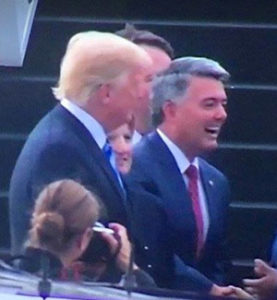
If you haven’t already done so, stop what you’re doing and read the story driving the day’s political news in Colorado, an impressive deep dive into Sen. Cory Gardner’s re-election prospects from the Colorado Sun’s Jesse Paul. Paul’s feature-length exploration of the challenges facing America’s Most Vulnerable Senator™ going into the 2020 elections touches on themes we’ve been talking about in this space literally for years, and are combining now to create a perfect storm for Gardner from which there may well be no escape. The first four paragraphs of Paul’s story summarize Gardner’s dilemma perhaps better than any story we’ve read anywhere:
In 2016, when Donald Trump ran for president, Colorado’s Republican U.S. Sen. Cory Gardner didn’t mince his words about the GOP nominee: “I cannot and will not support someone who brags about degrading and assaulting women.”
Gardner was reacting to an “Access Hollywood” recording of the candidate bragging about sexual assault. He said he didn’t vote for Trump, instead casting a ballot for Mike Pence, now vice president, as a write-in candidate.
Flash forward to today, and Gardner’s political world is now spinning in the opposite direction. [Pols emphasis]
Gardner made an early endorsement of Trump’s 2020 reelection campaign. He has a direct line of communication to the president — they speak on the phone fairly regularly. And he has refused to answer questions about whether Trump’s interactions with Ukraine’s president — which are now the subject of impeachment proceedings — were wrong.
Of all the many unresolved contradictions in Gardner’s record, the evolution from calling for Donald Trump to pull out of the 2016 presidential race in October of that year saying “I cannot and will not support someone who brags about degrading and assaulting women,” to today where Gardner has not only endorsed Trump’s re-election but headlines fundraisers for Trump in New York City, is arguably the most damning. Jesse Paul’s attempts to get an answer to this fundamental question from Gardner were not successful, but Gardner is going to face the question again and again between now and next November. Short of admitting that tax cuts are more important to him than sexual assault, otherwise known as political suicide, we just don’t see how Gardner will ever have a satisfactory answer.
In every discussion of the upcoming U.S. Senate race in Colorado pitting an as-yet undetermined Democratic challenger against Gardner, a recurring theme is Gardner’s unusual degree of vulnerability as the narrow winner of his Senate seat five years ago, in a state whose politics have steadily been migrating leftward away from Gardner’s Republican brand both before and since. Gardner won his seat by less than two percentage points in 2014, an upset victory that relied heavily on re-invention to distract from a staunchly conservative record that would under other circumstances have rendered Gardner unelectable statewide.
At the same time, Gardner cannot simply move left to match the state’s political trajectory, since that means jilting the Republican base who overwhelmingly support Trump and in all probability will continue to do so until they take their last breath no matter what happens. Colorado’s independent plurality electorate may force candidates to reach beyond their base, but without the Republican base behind him Gardner cannot possibly put together a majority coalition to hold his seat.
With all of this in mind, it may be as today’s story concludes that the only feasible choice for Gardner is to hitch his wagon to Trump to the bitter end. But without some means we can’t envision today of deflecting the wrath of Colorado voters finally able to vote against Trump personally, the polls are right–and Cory Gardner’s fate is all but sealed.
Subscribe to our monthly newsletter to stay in the loop with regular updates!

Comments