THURSDAY UPDATE: The battle to save net neutrality now moves to the House, where all eyes are on Rep. Mike Coffman to see if lip service will translate to votes at the critical moment they’re needed:
Evan Greer, deputy director at Fight for the Future, a nonprofit that has advocated for an open internet since 2011, told Courthouse News this week that the prospect of achieving the simple majority in the House is “doable.”
“But it’s an uphill battle,” Greer said.
“Fifteen House Republicans voted against the CRA to gut broadband privacy rules last year and a handful of others like Reps. Mike Coffman of Colorado, Don Young of Arkansas, Jeff Fortenberry of Nebraska, Dave Reichert of Washington, John Curtis of Utah have already publicly criticized the FCC repeal,” she said.
Even if the resolution clears Congress and makes it to President Donald Trump’s desk, there’s a still a chance he could veto it.
But it’s not a given, Greer said.
“Getting this to Trump’s desk would be a massive victory for the net neutrality movement,” she said. “It would show that there is a clear mandate for strong, enforceable net neutrality protections. Even if Trump vetoes it, it will set a tone for any future congressional fights to come and beat back attempts by ISPs to push watered down legislation that undermines net neutrality while claiming to save it.”
The whole series of tubes is watching.
—–

A dramatic vote in the U.S. Senate today delivers a stinging rebuke to the Trump administration and Federal Communications Commission chairman Ajit Pai in particular–overturning new rules that would have gutted longstanding regulations requiring equal treatment of all internet data. CNN reports:
The Senate voted Wednesday to pass a measure that would repeal changes to net neutrality rules that were recently adopted by the Republican-controlled Federal Communications Commission.
The measure, which was backed by all 49 Democrats and Republican Sens. Susan Collins of Maine, Lisa Murkowski of Alaska and John Kennedy of Louisiana, will be sent to the GOP-led House, where it’ll likely go nowhere — and President Donald Trump is unlikely to back it.
While Collins’ support had been public leading up to the vote, Murkowski’s and Kennedy’s “yes” vote came as a surprise to some.
Democrats used the Congressional Review Act to force a vote — a law that allows Congress to repeal agency rules and regulations on a simple majority vote, instead of a 60-vote threshold needed to break procedural hurdles on most legislation, the kinds of traditional roadblocks where Senate leadership could typically hold up such a proposal.
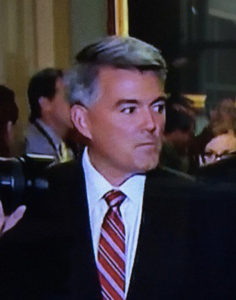
NPR reports Sen. Cory Gardner’s vacant sloganeering while yet another issue with lopsided public support passes him by:
Republicans overwhelmingly support ending net neutrality because they want to shift regulatory power away from the federal government and toward the private market. Republicans also argue that Democrats are playing on unfounded fears that Internet service providers will jack up costs and anger their consumer base. “If the Democrats want to run on regulating the Internet, I think that’s a losing strategy,” [Pols emphasis] said Sen. Cory Gardner, R-Colo., who runs the Senate GOP’s 2018 campaign operation and voted against the resolution.
A poll from last February demonstrates just how fundamentally out of touch this statement is:
Outside of Washington, D.C., net neutrality isn’t a partisan issue. Americans from red and blue states alike agree that equal access to the internet is a right, including: 79% of Colorado residents, [Pols emphasis] 81% of Arizona residents, and 80% of North Carolina residents.
91% of Americans believe consumers should be able to freely and quickly access their preferred content on the internet. Support for net neutrality is growing: When Mozilla and Ipsos asked this same question in 2017, 86% of Americans believed this…
76% of Americans believe internet service providers (ISPs) should treat all consumer data the same, and not speed up or slow down specific content. This opinion is most common among older Americans (80% of adults ages 55+) and Americans with a college degree (81%). 63% of Americans do not think that ISPs will voluntarily look out for consumers’ best interests, compared to 32% who agree with this statement…
So here’s where this issue stands just a few months from the midterm elections: when Republicans took control of the White House in 2016, ending net neutrality was high on the agenda. The attempt to repeal net neutrality rules was a major public relations fiasco, with the public and most of the tech sector outside internet service providers flatly rejecting the new rules. Stakeholders then organized a months-long grassroots lobbying campaign with the longshot goal of persuading enough Senators to reject this long-lobbied change. Since then, millions of Americans have contacted their representatives urging them to hit the brakes.
Today, that’s exactly what happened. While Sen. Cory Gardner stood with the 21% of Coloradans who don’t want net neutrality, a coalition of all 49 Senate Democrats, including Colorado’s Sen. Michael Bennet and a few conscientious Republicans, scored a critical victory for a free internet.
It’s not a decisive issue for everybody. But to patrons of this blog and every other website, it should be.
Subscribe to our monthly newsletter to stay in the loop with regular updates!
Comments