Reps. Joe Neguse (CO-02) and Brittany Pettersen (CO-07) would start any statewide campaign with a built-in advantage
In the last 25 years, three Colorado politicians have been elected to statewide office from a seat in the U.S. House of Representatives: Jared Polis (Governor 2018); Cory Gardner (U.S. Senate 2014); and Mark Udall (U.S. Senate 2008). What all three have in common is instructive for future elections in Colorado.
Both Polis and Udall moved up the political ladder after serving in Congress in CO-02. Gardner was the sitting Congressman in CO-04 when he was elected to the Senate. It’s not an accident that all three began their statewide campaigns with a strong voter base in their respective districts.
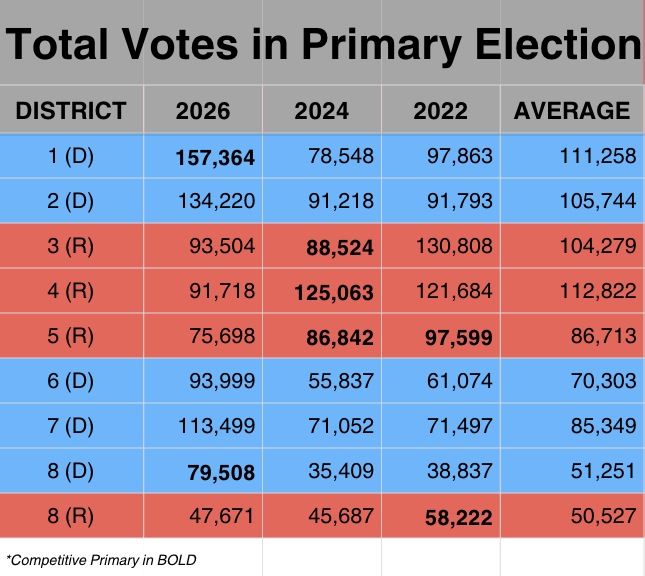
Colorado has become a solid blue state in the last decade, which makes the Primary Election the true decider for statewide office. In 2026, Democrats will almost certainly win all four statewide offices (Governor, Attorney General, State Treasurer, and Secretary of State). If Sen. Michael Bennet doesn’t seek re-election in 2028, a Democrat will assuredly succeed him as well. Based on turnout in recent Primary Elections, candidates from two congressional districts would start any statewide campaign with a big advantage: CO-02 and CO-07.
If you remove competitive Primary races from the list above, CO-02 (Boulder/Larimer Counties) and CO-07 (Jefferson County) stand out in terms of average voter turnout. This is intuitive in that both districts include heavily-populated counties. Both districts have also shared parts of Jefferson County, which has long been the most important swing county in Colorado.
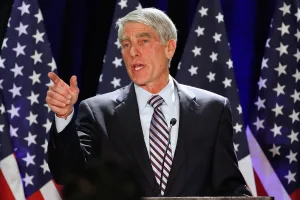
Former Sen. Mark Udall (D-Boulder)
Overall, Democratic voters in CO-02 consistently return their ballots at the highest rate of any blue district. Given that base of support, it makes sense that the last three Democrats to move from Congress to statewide office (Polis, Udall, and former Sen. Tim Wirth) all hailed from various iterations of the second congressional district. The same logic applies for a Republican hailing from CO-04 — such as Gardner — which offers an even bigger advantage now that the district includes the always-expanding Douglas County. If Rep. Lauren Boebert tried to move up in 2028, she would be the odds-on favorite in a Republican Primary.
By comparison, a Democrat running statewide from CO-06 or CO-08 would have a bigger hill to climb in a Primary Election — as would a Republican hailing from CO-05 or CO-08. Both Democrats and Republicans would also have trouble running from CO-08 because it’s a newer district that has yet to see a two-term Representative. It’s harder to compare CO-01 to any other congressional district simply because Denver normally has more competitive Primary races up and down the ballot that influence overall turnout, but it’s a moot point for 2028 given that Melat Kiros will be in her first term in Congress.
For 2028 and beyond, Reps. Joe Neguse and Brittany Pettersen would start any statewide Primary race with a clear numerical advantage; by the same metric, this is less encouraging for Rep. Jason Crow. In a statewide Republican Primary, Boebert or Rep. Jeff Hurd (R-Grand Junction) would theoretically have a head start in a race to be the eventual General Election loser.

 July 08, 2026 11:27 AM UTC

Comments