Ten years ago, it would have seemed ridiculous to think that Donald Trump could become President of the United States. After Trump’s first term in the White House ended with an insurrection at the U.S. Capitol, it was fair to assume that Trump would not be able to maintain his grip on the Republican Party, let alone find a path to re-election as president.
Yet here we are.
Time (and polling) has demonstrated again and again that Republicans will always move the goalposts for Dear Leader Trump rather than risk the electoral wrath of Trump’s blindly-loyal MAGA base. Congressional Republicans will sometimes speak up (or sign letters) in opposition to a particular Trump policy, but in the end they always do what Trump wants….until now.
On Thursday, Congressional Republicans at last decided they wouldn’t re-draw another line Trump had crossed. The President had given Congressional Republicans a deadline of June 1 to use the reconciliation process to bypass Democrats and approve a new funding package for the Department of Homeland Security, but an internal revolt forced both chambers to punt and recess until June.
As The New York Times explains:
Through revenge primary campaigns, bullying social media posts and the threat that he can command the G.O.P. base to go after anyone at any time, Mr. Trump has brought lawmakers in his party under his control like no president in modern history. A single critical word against Mr. Trump or his agenda could result in a full-scale retribution campaign to force a disloyal Republican from office.
But this week, in a rarity in G.O.P. politics, Mr. Trump’s taunts, bullying and threats have backfired, at least for now. Senate Republicans, after the president targeted two of their own, stood up to Mr. Trump on two of his biggest priorities: money for his White House ballroom, and a $1.8 billion fund to reward Trump supporters who claim political persecution by Democrats, such as the rioters who attacked the Capitol on Jan. 6, 2021.
“So the nation’s top law enforcement official is asking for a slush fund to pay people who assault cops?” said Senator Mitch McConnell, Republican of Kentucky. “Utterly stupid, morally wrong — take your pick.”
Then, in another sign that the party was pushing back on Mr. Trump, House Republicans canceled a vote on a resolution to halt the war in Iran, after it became clear they did not have enough votes to defeat it.
It wasn’t just one thing that changed this week, but a confluence of events that might have finally broken the Trump spell:
The week began with a new batch of absolutely brutal polling numbers for Trump and Republicans. Trump’s 37% approval rating in a New York Times/Siena survey marked a new low for the President — in either term in office. Trump’s approval has plummeted largely on angst about the economy; 64% of voters disapprove of how Trump is handling the economy and 69% give the President a thumbs-down on the cost of living. The Times/Siena poll also showed Democrats with a double-digit advantage in the “Generic Congressional Ballot,” moving polling averages into the same territory as 2018, when Democrats won 41 seats in the House to retake majority control. These numbers were a flashing red light that Republicans would be following Trump over an electoral cliff in November and increased fears in Congress about backing a $1 billion request for a new White House ballroom that Americans absolutely do not want.
Monday also brought a rash of headlines about a $1.8 billion “slush fund” that the Department of Justice was creating to hand over taxpayer money to Trump’s right-wing allies — including Jan. 6 insurrectionists. Senate Republicans were incensed about the proposal and grilled Acting Attorney General Todd Blanche for two hours on Thursday. As The New York Times reports:
They questioned its legal basis, whom it would pay and how the process would work. And they made it clear they wanted no part of the plan, the product of a deal struck between Mr. Trump’s lawyers and his own administration to use money that Congress does not control to pay off purported victims of government mistreatment, potentially including some of the rioters who violently assaulted their workplace during the Jan. 6, 2021, riot.
By the end, Republicans were so livid that party leaders scrapped planned votes on the party’s top priority — a $72 billion immigration crackdown measure it had planned to muscle through before Memorial Day — punting action for fear of having to cast votes on the fund…
…Inside the room, according to people familiar with the session, Mr. Blanche came under withering questioning and criticism from the majority of Republicans about the fund. They were incredulous that they were just learning about it, and deeply dissatisfied with the acting attorney general’s answers to queries about how it would work. [Pols emphasis]
Several Republicans spoke up to express worry that the fund would be used to provide money to people who had attacked police officers during the Jan. 6 assault on the Capitol and were later pardoned by Mr. Trump. They noted a lack of criteria for any payouts, including a specific prohibition against paying anyone who had been involved in violent actions.
Colorado Sen. John Hickenlooper added to Republican concerns with a smart amendment to prohibit any money from the Trump slush fund from going to former Mesa County Clerk and Recorder Tina Peters. As The Colorado Sun reports:
Hickenlooper plans to introduce his amendment whenever the bill to fund immigration enforcement is taken up. The amendment targets anyone convicted of crimes related to state or federal election interference, impersonation, identity theft, official misconduct, violation of duty in elections and failure to comply with the requirements of the secretary of state, according to his office.
It’s possible, if not likely, Hickenlooper’s amendment fails, but it will force Republican senators to go on the record about the payments. [Pols emphasis]
Fox 21 News has more on Hickenlooper’s amendment:
Senate Republicans absolutely did not want to vote on anything related to the Trump slush fund, so they closed up shop and went home for the rest of the month instead. Trump responded on Friday by doing what he does best: doubling-down on a terrible idea.
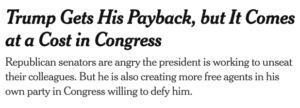
Trump has been on a revenge tour in Republican Primaries this spring, punishing elected officials he deems to be insufficiently loyal on both the local level (in states such as Indiana) and in federal races (such as Rep. Thomas Massie in Kentucky). But in the closed ranks of the U.S. Senate, Trump’s targeting appears to have backfired where he legislative agenda is concerned. As The New York Times reports in a separate story:
Republican senators, boiling mad over President Trump’s intervention in G.O.P. primaries that has cost one incumbent his seat and left another hanging by a thread, say Mr. Trump has chosen personal revenge over governing.
Six months out from a midterm election in which their majority is at stake, Senate Republicans face a difficult legislative path with a rising number of restless lame-duck senators and a growing sense that the president cares much less about accomplishments that could boost them in November than about protecting himself and settling his political scores.
It comes as Republicans already face a grim political environment made worse by Mr. Trump’s decisions to pursue a war in Iran that has driven up gas prices and impose tariffs that have led to higher costs for companies and consumers — all while continuing to demand loyalty from lawmakers whose political survival may depend on distancing themselves from him.
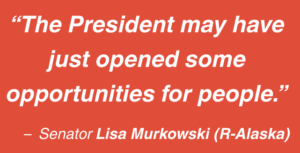
“I’d say the mood is pretty sour,” Senator Lisa Murkowski, Republican of Alaska, said as she digested Mr. Trump’s late-stage decision to snub Senator John Cornyn, the veteran Texas Republican and former member of the party leadership who faces a challenging primary on Tuesday, and endorse his opponent. [Pols emphasis]
Republican Senators are dismayed that Louisiana Sen. Bill Cassidy lost a Republican Primary on Tuesday to a Trump-endorsed opponent. Cassidy voted to convict Trump on impeachment charges in 2021, but he stood by Trump after the President was re-elected in 2024, even backing Robert F. Kennedy Jr. as HHS Secretary despite his many reservations about the nomination.
It was Trump’s endorsement of Ken Paxton in Texas, however, that really irked Senate Republicans. Trump’s backing of Paxton probably dooms the re-election hopes of longtime Republican Sen. John Cornyn, a very popular member of the GOP caucus. From The Hill newspaper:
Republican senators exuded pain for Cornyn, who served as Senate Republican whip during Trump’s first term and is deeply respected by his Senate GOP colleagues
“I’m really sad, I’m sad personally for John Cornyn and I hope he’s successful in his election regardless, and I’m sad for the institution,” said one GOP senator who requested anonymity to talk about the internal conference feelings.
“There’s no senator that works harder to make things happen around here, works harder to take care of his colleagues,” the GOP lawmaker lamented.
The fate of Cassidy and Cornyn showed Republicans (who should already know better) that loyalty to Trump is a one-way street. Backing Trump’s agenda is perilous enough given his historically-low approval ratings; knowing that Trump could turn against you regardless doesn’t give Republicans much reason to take the legislative bullet for the President. Back to the Times:
Mr. Trump could carry the day in checking names off his enemies list only to see his victory backfire when it comes to getting his way on Capitol Hill.
“It goes back to the old ‘be careful what you wish for,’” [North Carolina Republican Sen. Thom] Tillis said.
He predicted that those no longer encumbered by the need to placate the president could alter their voting patterns.
“I think there will be fewer political calculations going into people’s decision-making process,” he said. “Look, we want to support the president every time it is good policy and good politics and never when it is either bad policy or bad politics or both.”
There’s probably an equal chance that Senate Republicans return to Washington D.C. in June and promptly fold their cards once again. But for the first time in Trump’s second term, there’s at least reason to hope that a Republican majority in Congress might finally decide to do its job.
Subscribe to our monthly newsletter to stay in the loop with regular updates!
Comments