U.S. Senate See Full Big Line

(D) J. Hickenlooper*

(D) Julie Gonzales

(R) Mark Baisley

80%

20%↓

10%

(D) Phil Weiser (D) Michael Bennet (R) Victor Marx
50% 50% 20%↑
Att. General See Full Big Line

(D) Jena Griswold

(D) M. Dougherty

(D) Hetal Doshi

40%

30%

30%

Sec. of State See Full Big Line
(D) J. Danielson

(D) A. Gonzalez

(R) James Wiley
50%↓

40%↑

10%
State Treasurer See Full Big Line

(D) Jeff Bridges

(R) Kevin Grantham

80%↑

20%↓

CO-01 (Denver) See Full Big Line

(D) Diana DeGette*

(D) Milat Kiros

(D) Wanda James

70%

20%

10%↓

CO-02 (Boulder-ish) See Full Big Line

(D) Joe Neguse*

(R) Somebody

90%

2%

CO-03 (West & Southern CO) See Full Big Line

(R) Jeff Hurd*

(D) Dwayne Romero

(D) Alex Kelloff

(R) Ron Hanks

50%↓

35%↑

30%↓

20%

CO-04 (Northeast-ish Colorado) See Full Big Line

(R) Lauren Boebert*

(D) E. Laubacher

80%

20%

CO-05 (Colorado Springs) See Full Big Line

(R) Jeff Crank*

(D) Jessica Killin

53%↓

48%↑

CO-06 (Aurora) See Full Big Line

(D) Jason Crow*

(R) Mel Tewahade

90%

2%

CO-07 (Jefferson County) See Full Big Line

(D) B. Pettersen*

(R) Somebody

90%

2%

CO-08 (Northern Colo.) See Full Big Line

(R) Gabe Evans*

(D) Shannon Bird

(D) Manny Rutinel

45%↓

30%↑

30%↑

State Senate Majority See Full Big Line

DEMOCRATS

REPUBLICANS

80%

20%

State House Majority See Full Big Line

DEMOCRATS

REPUBLICANS

95%

5%

[wpdreams_ajaxsearchlite]
June 04, 2026 11:13 AM UTC

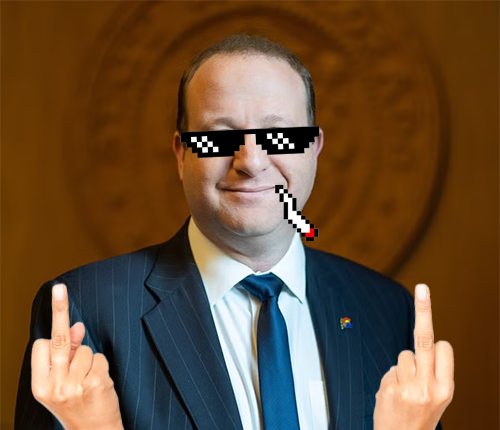
Gov. Polis Goes Out With Big Fat Middle Finger

One of the ways to measure the level of cooperation between the governor’s office and the state legislature in any state with single-party control is the number of bills vetoed at the end of the legislative session. Few to occasionally no vetoed bills is a sign of good communication through the process of producing legislation, ensuring the final product is something the governor can actually sign into law.

But as the Colorado Sun’s Jesse Paul and Taylor Dolven report, that bidirectional line of communication broke down this year in Colorado on a noteworthy number of bills:

Gov. Jared Polis vetoed three bills Wednesday, including one that would have prohibited credit card companies from imposing swipe fees on sales taxes starting in 2028.

With the new round of vetoes — including measures helping firefighters who get cancer and letting people sue federal immigration agents for constitutional violations — the term-limited governor has now rejected 12 bills passed by the legislature this year, eclipsing the personal record he set in 2025.

The veto carnage kicked off last week with the fully anticipated veto of the Worker Protection Act, legislation that would have reformed the state’s unique anti-union laws requiring two elections to organize a workplace. The anger over this veto was overshadowed to some degree by Gov. Jared Polis’ commutation of convicted felon ex-clerk Tina Peters the week before that, but the decision to pass this high-profile bill a second time and force Polis to veto it in his final term in office was deliberate on the part of its supporters. It’s worth noting that despite the bill’s popularity among Democrats, neither Democratic candidate running to succeed Polis has committed to signing it.

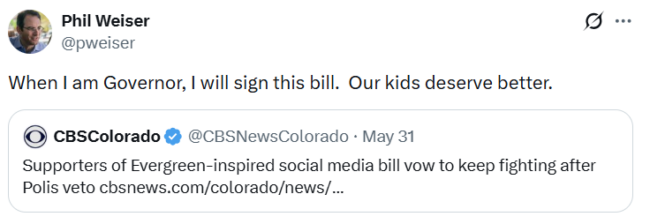
That’s not the case with at least some other vetoes, which included legislation passed in response to the Evergreen High School shooting to require social media companies to respond in a more timely manner to search warrants:

Then this week, as Colorado Public Radio reports, several more high-profile bills that had received significant press coverage during the session met their doom:

Gov. Jared Polis on Tuesday vetoed several bills backed by progressive Democrats, the latest round of vetoes during his final year as governor. The axed proposals addressed surveillance pricing, arbitration reform and plastic waste from restaurant takeout.

One of the vetoed bills, HB26-1210, would have prevented corporations from using surveillance data, or personal information scraped from users’ online activity, to set individual prices and wages for their customers and workers. The bill was unveiled with fanfare last January as part of Democrats’ signature affordability platform. [Pols emphasis]

Photo by Colorado Sun’s Jesse Paul

The “surveillance pricing” bill in particular had attracted a great deal of attention as the practice of microtargeting consumers proliferates, and the bill is sure to be back next year in some form for the next governor to consider. Likewise with another marquee bill announced at the beginning of the session with fanfare, Senate Bill 26-005, allowing Coloradans to sue immigration agents for rights violations–from the Colorado Sun’s story today:

Polis wrote in his veto letter that he found “the legal risks … outweigh the potential benefits.” He worried that if he signed the bill into law and it was struck down by a judge, “it could weaken current protections for vulnerable community members.”

…State Sen. Mike Weissman, D-Aurora, a sponsor of the bill, called the veto a “travesty.”

“This is a great disservice to people in our state, and I’m afraid it’s a green light to the Trump administration to come in and commit abuses in Colorado,” Weissman said.

Other vetoed measures include a bill eliminating “swipe fees” on sales tax that credit card companies spent millions of dollars flooding the airwaves with wildly false claims to undermine, needlessly in our view since in the end there was only one person they needed to convince. Another bill reforming the shady arbitration process that you’ve signed up for countless times whether you know it or not was too big a lift for Polis to countenance in his final term in office.

Our purpose today is not to evaluate the pros and cons of these individual bills, but to consider the larger political ramifications of Gov. Polis’ final legislation for himself and Colorado Democrats. Although he has presided over an ambitiously progressive eight years in office overall with a long list of reforms to his credit, Polis has never been a clean ideological fit for orthodox liberal Democrats, regularly offending their sensibilities with lip service to tax cuts and ill-advised love for RFK Jr.’s health care quackery. The frustrations he has left in his wake with the Democratic base are now political opportunities for his successors, and the intense criticism Polis has drawn from the Tina Peters commutation followed by this spate of vetoes has made him more politically useful as a foil than an ally. Whoever wins the primary, don’t expect to see Polis campaigning with them in the fall.

But as angry as progressive Democrats are at Polis today, and we do not dispute their right to that anger, there’s a possibility that Polis is right where he wants to be. It’s the theory that these peaks and valleys level out into some kind of political “Goldilocks zone.”

We are not endorsing this theory. It’s not where we would want to be. But for those of you looking for Gov. Polis’ desired upshot, there it is.

Comments

Recent Comments


Posts about Donald Trump

Posts about Rep. Gabe Evans

Posts about Rep. Lauren Boebert

Posts about the Colorado House

Posts about the Colorado Senate


170 readers online now

Newsletter

Subscribe to our monthly newsletter to stay in the loop with regular updates!