(Welcome to the Post-Roe world — Promoted by Colorado Pols)
Originally posted at the Colorado Times Recorder
On Friday, the Fifth Circuit Court of Appeals ordered the Food and Drug Administration to temporarily reimpose in-person requirements for medication abortion. This banned the use of telehealth appointments for the purposes of medication abortion, and the mailing of one of the drugs used in medication abortion, mifepristone. Today, conservative Supreme Court Justice Samuel Alito, acting as Circuit Justice, issued an administrative stay of the Fifth Circuit’s ruling.
“Once again, abortion patients and providers are facing the chaos, confusion and fear that anti-abortion policymakers and courts are inflicting on them,” said Kelly Baden, vice president for public policy at the Guttmacher Institute, a pro-abortion think tank, in a Monday news release. “The Supreme Court’s administrative stay provides critical short-term relief for patients and providers across the country. Blocking the baseless in-person dispensing requirement for mifepristone from going into effect for a week may help to offset some disruptions to care following the Fifth Circuit ruling last week — but the underlying threat to access remains just as dire as it was before.”
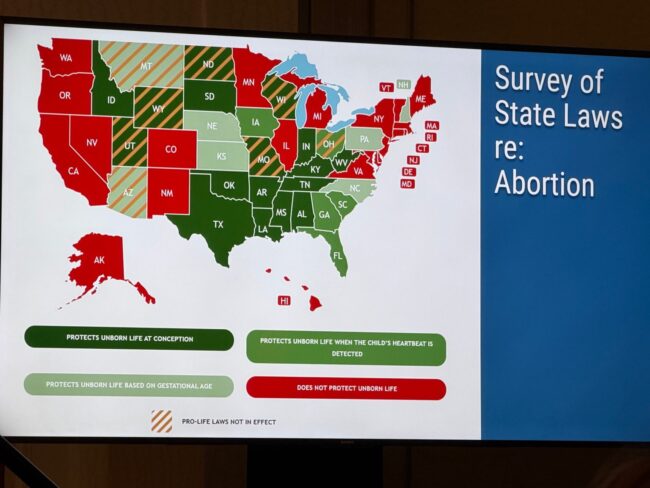
While the 2022 Dobbs decision, which overturned Roe v. Wade, ostensibly returned the regulation of abortion to individual states, Monday’s decision reveals the anti-abortion strategy targeting nationwide access.
“This is a devastating ruling based on politics, not science, for patients seeking health care in Colorado and across the country,” said Karen Middleton, president and CEO of Cobalt, a pro-abortion nonprofit, in a May 1 news release. “Colorado is not Louisiana and here should not pay the price for Louisiana’s abortion ban. Abortion access is guaranteed in Colorado state laws and in our Constitution.”
The Food and Drug Administration permanently ended the requirement for in-person visits for medication abortion in December 2021, after temporarily suspending the practice during the COVID pandemic, but then reinstating it following the Supreme Court’s March 2021 FDA v. American College of Obstetricians and Gynecologists decision. Eighteen states currently have laws requiring in-person visits for medication abortion, but anti-abortion activists are pushing for a nationwide ban on medication abortion.
In January, during a $500 a plate breakfast at Washington D.C.’s Capitol Hill Club, March for Life Action donors heard from 22 Republican U.S. Representatives, many of whom spoke about efforts to restrict the mailing of mifepristone. Days later, during this year’s Nation Pro-Life Summit in D.C., Alliance Defending Freedom lawyer Caleb Dalton expressed consternation over the ability to mail abortion medication across state lines, and shield laws — like Colorado’s — that protect providers and patients.

“The shield laws have been passed in many states, and they are literally designed to protect prescribers that are prescribing these drugs across borders,” said Dalton. “They’re drug traffickers and they’re violating the law in the state that they’re sending the drug to, but the states that they live in — for example California and New York — there’s doctors in those states who have violated the law and they’re supposed to be extradited for violating the laws, but in in California and New York, both, the governors have said, ‘We will not extradite this criminal, this criminal drug trafficker in our state, because of their shield laws.’ They passed these laws saying, ‘We will not help you enforce your law. We will actively keep you from enforcing your pro-life laws.’ The two things that are really in many ways undermining the pro-life laws that states have been passing are the FDA’s removal of the in-person dispensing requirement [for mifepristone] and then the shield laws that even prohibit pro-life states from prosecuting and enforcing their laws against these doctors that are shipping these drugs, trafficking these drugs into their states.”
Baden argues that there is no medical requirement for in-person visits for medication abortion. “This move runs counter to decades of scientific evidence from the United States and around the world that overwhelmingly affirms that mifepristone is safe and effective whether provided in person or via telehealth,” she said in a May 1 news release. “Data from the Guttmacher Institute show that medication abortion accounts for roughly two out of every three abortions nationwide, while the Society of Family Planning finds that one in four abortions are provided via telehealth.”
Despite efforts to ban and restrict abortion, the practice is electorally popular, and Republicans in swing districts, like Rep. Gave Evans (R-CO), are balking at an outright ban. In March, Evans, who has previously explained his own position on abortion thusly: “If the circumstances wouldn’t warrant killing a born person, the unborn also should not be killed,” nevertheless told news outlet NOTUS that mifepristone has “viable medical uses.” When NOTUS asked for clarification on whether that meant he opposed a bill to ban mifepristone at the federal level, Evans said, “I have to read it, I haven’t seen the policies, but I’m always cautious of issues like that.”
Since the Dobbs decision, anti-abortion activists have grown increasingly frustrated with Republicans. “They’re doing nothing to address it,” said national anti-abortion activist Abby Johnson during an April 29 appearance on the Jeff and Bill Show. “In fact, these chemical abortion pills were made accessible through the Biden administration and twice the Trump administration has had the opportunity to rein them back in and to say, ‘We are not going to allow this to continue in our country,’ And twice he has said, ‘We are not going to do anything to stop the distribution of these pills.’ Also, it was Trump’s FDA who allowed the generic distribution of these RU-486 pills, these chemical abortion pills. He green-lighted that through! The Trump administration has done nothing but expand the access to these chemical-abortion pills, which are significantly more dangerous than surgical abortion. So, absolutely, the Trump administration is setting up women for dangerous abortions.”
The Supreme Court’s stay on in-person requirements for mifepristone will expire, absent a further order from Alito or the Court, at 5 p.m. on May 11.
Subscribe to our monthly newsletter to stay in the loop with regular updates!
Comments