
The final hours of Joe Biden’s presidency are ticking away, and with the once-unthinkable return to power of Donald Trump after his stunning Electoral College and popular vote victory last November–a third consecutive election without the support of Colorado voters–fast approaching, the anticipation/dread over next Monday is growing across the state and nation. Local Republicans who failed in large part to take advantage of last November’s “red wave” are excited to witness the new administration’s promised deportation crackdown that Trump has labeled “Operation Aurora” after the wildly exaggerated election-year tales of Colorado’s largest suburban city “fallen” to migrant gangs, banking on Trump’s promises to expand fossil fuel production even beyond the Biden administration’s record levels, and quietly hoping that Trump’s promised trade wars do not disrupt their own revenue streams.
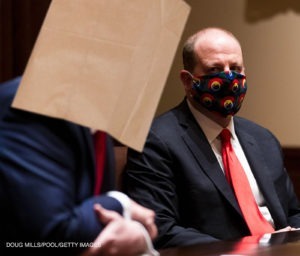
Colorado Democrats, undefeated at the polls but nonetheless awaiting the hostile new administration with total albeit narrow control in Washington, are necessarily walking a more nuanced line. In last week’s State of the State address, Gov. Jared Polis tried to address the delicate balance blue states need to strike between constructive engagement with the new administration where possible, while defending Colorado values incompatible with Trump’s agenda. Colorado Public Radio’s Bente Birkeland reported:
“My principle is always: I will work with anyone and everyone when it’s good for Colorado, and I will oppose anyone and everyone, and do everything in my power to protect Colorado when it hurts our people and state,” he said.
In a nod to a fight that could get new life with Trump’s return to office, Polis declared early on that Colorado is the “rightful home of Space Command.” Officials in Alabama are hopeful the president-elect will return to his earlier decision to relocate the Command from Colorado Springs to their state…
Polis said he would push back on incoming President Trump’s proposal for broad-based taxes on imported goods that would “raise the costs of everything, from groceries to housing to energy and so much more.”
The governor also spent time on immigration. While he said immigrants who follow the law and contribute to society should have a chance to stay in this country and pursue the American Dream, Polis also emphasized that he wants to see a crackdown on those who commit crimes.
Gov. Polis was heavily criticized in November after he spoke out in (qualified) favor of Robert F. Kennedy, Jr.’s highly controversial nomination to lead the Department of Health and Human Services, which remains in doubt even as some of Trump’s other sketchy nominees are plowing through the confirmation process. After the State of the State, Polis was further criticized on the left for conceding too much of the framing of the immigration debate to Trump:
“It’s very disappointing when Democrats are repeating those harmful talking points from Republicans around strengthening the border and that migrants are criminals,” said Rep. Elizabeth Velasco of Glenwood Springs. She immigrated to the U.S. from Mexico as a teenager.
Rep. Elizabeth Velasco is correct, and Gov. Polis himself has agreed, that immigrants statistically commit crimes at a lower rate than the native-born population. There’s very little public sympathy at this point for immigrants who have committed crimes, but much more for immigrants who have lived here for generations and contributed to their local communities–this illustrated by Rep. Gabe Evans’ recent dodge about deporting “gangsters not grandmas.” The tension between Polis and Rep. Velasco is illustrative of the fine line Democrats must walk on the issue–at least unless or until Trump takes an action sufficiently egregious to render these internal disagreements moot. The most likely scenario is that Trump will very quickly make a liar of Rep. Evans, while uniting Democrats against catastrophic overreach.
Although Trump is the first Republican to win the popular vote since George W. Bush’s second term victory in 2004, two polls this week show Trump’s net favorability to be negative, even as a small majority of those polled approve of his handling of the transition of power–a stark contrast to the violence and bad faith of Trump’s reluctant handoff to Biden in January of 2021. Ernest Luning at the Colorado Springs Gazette’s political blog quoted newly elected Rep. Jeff Crank singing the praises of outgoing Vice President Kamala Harris’ for peaceably certifying Trump’s victory:
“I was really struck by the transfer of power on Jan. 6, how well that went and how smooth it went,” Crank said. “And to see Kamala Harris up there certifying an election for her opponent, I think, spoke volumes about the greatness of our country.”
History will not record the same for Donald Trump, but Crank left that part conspicuously unsaid. Once a sworn enemy of Trump, Jeff Crank is a barometer for the weakness of the resistance to Trump within the Republican Party. At this moment, it couldn’t be weaker. And although Democrats generally held the line in Colorado, Trump’s nationwide victory and the narrow Republican trifecta obligate Democrats like Gov. Polis at least initially to profess openness to “common ground,” delineate what is not negotiable, and wait for Trump to make the first move. It’s arguable that the more rapidly Trump is able to execute the wide-ranging threats he made on the campaign trail, the shorter Trump’s “honeymoon” will be, and the sooner Democrats can switch to an oppositional footing for the 2026 midterms.
In the short term, we must take the bitter pill that voters outside Colorado have prescribed. Because that’s how democracy works.
Subscribe to our monthly newsletter to stay in the loop with regular updates!
Comments