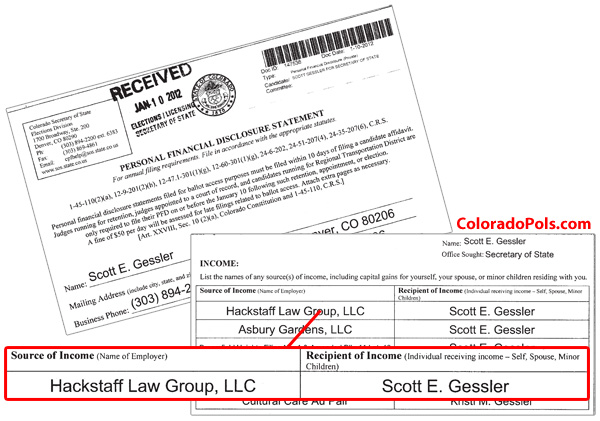
Last year at this time, Colorado’s then-newly elected Secretary of State Scott Gessler was just beginning to recover from a major scandal that hobbled his first weeks in office. Gessler had announced in mid-January of 2011 his intention to continue working for his old elections-specialty law firm, the Hackstaff Law Group (formerly Hackstaff Gessler).
After a massive outcry from Democrats and editorial boards around the state over the conflict of interest potential this represented, and an opinion from Attorney General John Suthers that hasn’t been disclosed, Gessler publicly backed off–and announced that he would teach college classes on the side to supplement his income instead. Since then, Gessler has certainly not been a stranger to controversy, but we hadn’t heard anything more about Gessler continuing a relationship with his old law firm while serving as Secretary of State. Which is a relief, as Hackstaff is one of the most politically connected law firms in the state, and it’s very difficult to see how he could have any ongoing relationship there without inviting scandal.
But once Gessler called it off, there was nothing to talk about either way. Until we saw this:

The excerpt above is from Gessler’s 2011 personal financial disclosure statement. The top-listed item under Gessler’s list of external personal income is money paid to him, an unknown amount and for an unknown purpose but sometime within the 2011 calendar year, by the very same Hackstaff Law Group he was going to moonlight for! After the ruckus caused by Gessler’s attempt do do side work for his old firm, it should be clear why this annual disclosure is mandatory from incumbent officeholders: so the public can see if there is a problem.
And it would be a problem if Gessler was still working for Hackstaff, especially after swearing the idea off last January–you know, if it was determined that Gessler wasn’t being truthful when he announced that he was calling off the “moonlighting.” Wouldn’t that be a bit of a problem?
We’re told that there have been some inquiries about this disclosure report with Gessler already. His office replies that the undisclosed amount of money paid to Gessler from Hackstaff Law Group in 2011 was a “buyout” of his interest in the law firm, but Gessler has reportedly turned down requests for additional documentation which would substantiate that claim. Under current law, Gessler is only required to disclose what you see above–no description, not even a total amount paid. Until we see the report in January of 2013 showing what Gessler earned this year, we’ll have no way of knowing if the claim of a “one-time” buyout payment is true.
And the fact is, these are not the only possibilities, even if Gessler is telling the truth about being bought out. How many former clients of Gessler’s may have paid bills in 2011, or awarded monies, etc. with Gessler then entitled to his cut? Were any of those cases in fact wrapped up after Gessler became Secretary of State? Might the possibility of a larger (or for that matter, smaller) residual payout from those clients have affected how they were handled in the Secretary of State’s office? What were the terms of Gessler’s “buyout” from Hackstaff Law Group? What provision exists, if any, for Gessler going back to work there when he leaves office?
Wouldn’t you like to know the answer to these questions? And isn’t a little more than idle curiousity, since this is the only way to verify if what Gessler said a year ago was true?
Because here is evidence it may not be, and you’re being asked to take Gessler’s word. Again.
Subscribe to our monthly newsletter to stay in the loop with regular updates!
Comments