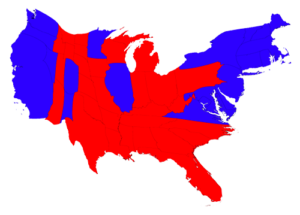
As the Colorado Independent reports:
The Secretary of State on Thursday certified that petitioners opposed to Colorado’s participation in the National Popular Vote Interstate Compact have collected enough signatures to place the matter on the November 2020 ballot.
This is a direct challenge to a bill passed earlier this year and signed into law by Democratic Gov. Jared Polis. The bill provoked a significant party-line fight at the Capitol, during which Democrats — who control the state House and Senate — expended much more political capital than they’d planned for. Republicans seeking to recall Polis and various Democratic lawmakers have alleged the bill is a key example of overreach during the past session.
According to the Secretary of State, Colorado hasn’t seen a state law challenged on the ballot since 1932, when voters overturned a tax on margarine.
That the ballot measure challenging this year’s National Popular Vote Interstate Compact law adopted by Colorado received enough signatures to make the 2020 ballot should come as a surprise to no one. In marked contrast to the recall petition drives underway showing little sign of success, backers of the NPV repeal initiative excitedly kept the press informed about their progress and turned in well over the required number.
Since the campaign to repeal the NPV Compact in Colorado got started last spring, we’ve been frank about the likelihood that its solidly Republican proponents would succeed in their petition drive, and be better served politically to organize around this effort than with recall campaigns against legislators in a few small districts. Since then, however, the debate over NPV has become cluttered with external factors like the recent federal court ruling in favor of so-called “faithless electors.” At the same time, the national NPV push appears to have stalled with several states having defeated their attempts to join the compact. As of this writing it’s very unlikely that the NPV Compact would be in effect for the 2020 elections, and even if it were it may not be enforceable against the wishes of Colorado electors.

And as we’ve said before, if NPV remains a partisan question in a state about to reject President Donald Trump on the same ballot, the repeal measure’s prospects are dim no matter how many Republican signatures they received.
To all of that uncertainty, here’s another twist–a column in Politico published Wednesday just ahead of the NPV question in Colorado making the ballot, by Republicans arguing that the National Popular Vote Compact is necessary for that party in the long term as well:
In the wake of the 2016 election, when Democrats lost the presidential election but won the popular vote for the second time in 20 years, it’s easy to understand why momentum to abolish the Electoral College once again gathered on the left. It’s not so easy to understand, though, why Republicans have become so committed against the idea of a national popular vote in response. [Pols emphasis]
The Denver Post recently reported that Republican Sen. Cory Gardner actually donated $50,000 to an effort to withdraw Colorado via a referendum from the National Popular Vote Interstate Compact. The compact is an agreement that state legislatures have voted to join that would pool the electoral votes from among the participating states. Once the 270-vote threshold has been reached between those participating states, they would award all of those votes to whoever wins the popular vote across all 50 states and the District of Columbia. Fifteen reliably blue states, plus the District of Columbia, have joined the compact since 2006, but it has not been as popular among Republicans—perhaps because of some kind of partisan loyalty to the Electoral College.
That loyalty is misguided, though. From a practical standpoint, moving to a national popular vote may well be the best way, and perhaps the only way, for Republicans to have a reasonable chance of winning the White House in 2020 and beyond. That’s because, despite President Donald Trump’s widely unexpected 2016 electoral victory, there is no red state advantage in the Electoral College. And things are going to look much, much worse for the GOP’s chances with the Electoral College if red Texas, along with the battleground state of Florida, move to purple or blue in the coming years.
This column makes a convincing argument that with large states like Texas and Florida steadily moving leftward, the still-large bloc of GOP voters in those states could save a Republican presidential candidate in a nationwide popular vote–voters whose voices are completely lost in today’s 50%+1 winner-take-all system. Which, we should add, has been the status quo for Republican voters in Colorado too in the last several presidential elections.
Like the panic over “faithless electors,” there’s a simple resolution: just make every voter’s vote equal.
Subscribe to our monthly newsletter to stay in the loop with regular updates!
Comments