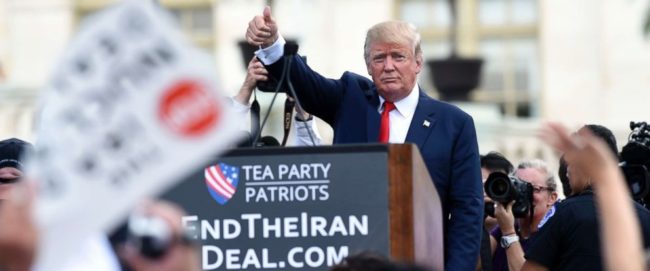
UPDATE: Via the Denver Post, Sen. Cory Gardner defends Trump’s pullout from the Iran nuclear weapons deal while most of the world expresses outrage:
“I think the Iran deal was flawed from the beginning,” said Gardner in a brief interview just off from the Senate floor. “The fact is the Iran deal guaranteed a nuclear future for Iran — a patient pathway to a nuclear bomb.”
But Sen. Michael Bennet says the decision makes a nuclear Iran more likely, not less:
“Since taking office, President Trump has produced no strategy to counter Iran’s malevolent activities across the Middle East, all of which would be more dangerous if backed by a nuclear weapon,” Bennet said. “U.S. intelligence has assessed Iran is in compliance with the (agreement), and the president has offered no alternative path forward to prevent Iran from obtaining nuclear capabilities.”
Who’s right? Hopefully we don’t have to find out the hard way.
—–

President Trump has announced his decision to withdraw from a multi-national agreement with Iran over the country’s ongoing flirtation with nuclear weapons. From the Washington Post:
The United States “will withdraw” from the international nuclear deal with Iran and will reinstate economic sanctions against Tehran, President Trump announced Tuesday.
Trump’s decision, announced at the White House, follows the failure of last-ditch efforts by Britain, France and Germany to convince him that his concerns about “flaws” in the accord could be addressed without violating its terms or ending it altogether…
…The action makes good on Trump’s campaign pledge to undo an accord negotiated under his predecessor, President Barack Obama. Obama considered the agreement his signature foreign policy accomplishment, calling it the best way to head off the near-term threat of a nuclear armed Iran and a potential opening toward better relations with Tehran after more than three decades of enmity.
David E. Sanger of the New York Times attempts to explain the logic behind Trump’s decision:
For President Trump and two of the allies he values most — Israel and Saudi Arabia — the problem of the Iranian nuclear accord was not, primarily, about nuclear weapons. It was that the deal legitimized and normalized the clerical Iranian government, reopening it to the world economy with oil revenue that financed its adventures in Syria and Iraq, and support of terror groups…
…Mr. Trump and his Middle East allies are betting they can cut Iran’s economic lifeline and thus “break the regime” by dismantling the deal, as one senior European official described the effort. In theory, America’s withdrawal could free Iran to produce as much nuclear material as it wants — what it was doing five years ago, when the world feared it was headed toward a bomb.
But Mr. Trump’s team dismisses that risk: Tehran doesn’t have the economic strength to confront the United States, Israel and the Saudis. And Iran knows that any move toward “breakout” to produce a weapon would only provide Israel and the United States with a rationale for taking military action.
It is a brutally realpolitik approach that America’s allies in Europe have warned is a historic mistake, one that could lead to confrontation, and perhaps to war.
We’ll likely have more on this story as it progresses.
Subscribe to our monthly newsletter to stay in the loop with regular updates!
Comments