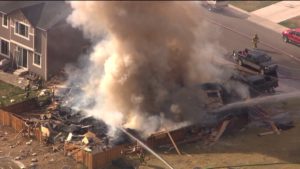
As the Colorado Statesman’s John Tomasic reports, the conclusion last week that an abandoned oil and gas well was responsible for a massive explosion that destroyed a recently-built home in Firestone, killing two people, hasn’t persuaded Firestone’s representative in the Colorado General Assembly, Republican Rep. Lori Saine, that any legislative action is needed:
State Rep. Lori Saine, a Republican who represents constituents rocked by a recent fatal oil and gas industry-related home explosion in Firestone, strongly opposes a bill introduced Friday morning that would require the drilling industry to make available well flowline mapping data to regulators and the public…
Saine called a the bill a “knee-jerk reaction.” She said the minority Republican caucus in the House opposes the bill and she suspects Senate Republicans would also oppose it.
House Bill 1372 was introduced Friday morning and assigned to the House State Affairs committee, where it will be heard Friday afternoon. The legislative session ends Wednesday.
The sponsors, gas patch Democratic Reps. Mike Foote from Lafayette and Steve Lebsock from Thornton, are acting in response to resident concerns in the wake of the April 17 house explosion. Two men were incinerated in the blast while working on a water heater in a basement filled with unrefined odorless gas from an abandoned and uncapped oil and gas well flowline.
Hold everything, says Rep. Saine! There’s a process for this!
Oil and gas politics at the Capitol has long been a charged partisan business. Republicans consistently stand as a bloc against regulation.
“I see this [bill] as a spiking of the political football,” said Saine. “We already have a process in place… We have [line-]abandonment procedures in place They’re pressure testing the lines. I would just say let it work without adding another layer of complexity and confusion. Let the process happen…”
Unfortunately, as the Denver Post has been reporting ever since the explosion April 17th and in fact long before, both the process and the resources for ensuring public safety around oil and gas infrastructure are woefully inadequate:
Long before a pipeline leaked volatile gas into a Firestone home that exploded, Colorado’s overseers of the oil and gas industry were warned such pipelines posed major risks.
For years, they’ve known leaking underground pipes carrying oil, gas and processing waste regularly contaminate soil and water and potentially threaten thousands of people around the state, records show…[i]t wasn’t until last year that the state began any program to monitor the underground pipes connecting wells to tanks and other equipment in the field.
Just three state officials are tasked with ensuring the integrity and safety of thousands of miles of pipelines in Colorado connected to about 53,000 active wells and associated with an additional 36,500 inactive wells. [Pols emphasis] The Colorado Oil and Gas Conservation Commission, which regulates the industry, didn’t deploy those officials until 2016, leaving the vast majority of oil and gas pipelines still uninspected. Regulators say they don’t know where all the pipelines are located. And they leave it up to local jurisdictions to decide whether developers can build homes over them.
Yes, Gov. John Hickenlooper has ordered emergency pressure testing of all flowlines within 1,000 feet of most development. But it’s painfully obvious in the wake of this tragedy that the inspection program in place for this infrastructure is insufficient to protect public safety. Requiring energy companies to map out their lines and give that data to these beleaguered inspectors–not to mention the public–should be a no-brainer.
And yet here we have the representative of the dead and injured from this tragedy, which we now know was caused by exactly the unmapped infrastructure this legislation wants to see documented to protect the public from future tragedies, saying it’s a “knee-jerk reaction.”
Folks, with any other issue–and we’ll even go so far as to say in most other states–Rep. Lori Saine’s indifference in the face of tragedy in her own district would be political suicide. The fact that Rep. Saine can declare a basic and preliminary attempt to address this tragedy a “knee-jerk reaction” without a massive backlash shows how powerful the oil and gas industry is in this state–and how, with a few exceptions like the Denver Post’s excellent recent reporting, our local press is too servile to the energy industry to hold politicians like Rep. Saine accountable.
If this is not an outrage, what is?
Subscribe to our monthly newsletter to stay in the loop with regular updates!
Comments