The passage last week of the Republican budget bill they insist on calling the “One Big Beautiful Bill Act” while public opinion polls say it should be called something more profane has created a huge electoral liability for that party going into the 2026 midterms. The question is not whether but how much damage Republicans inflicted upon themselves, with pre-OBBB forecasts already showing Republicans vulnerable to the loss of dozens of House seats. As Politico’sElena Schneiderreports, Democrats are getting ready to unleash hell on swingable Republican districts over this vote, and looking ambitiously at the 2026 map:
The bill that passed Thursday has already triggered a spike in candidate interest deep into Trump territory, House Majority PAC said. Separately, Democrats are digging into a round of candidate recruitment targeting a half-dozen House districts Trump won by high single or double digits, according to a person directly familiar with the Democratic Congressional Campaign Committee’s plan and granted anonymity to describe private conversations. They’re recruiting Democrats to challenge Reps. Ann Wagner of Missouri, Maria Elvira Salazar of Florida, Andy Ogles of Tennessee, Kevin Kiley of California, Nick LaLota of New York and Jeff Crank of Colorado.
“There’s almost nothing about this bill that I’m going [to] have a hard time explaining to the district,” said Rep. Jared Golden (D-Maine), who represents a district Trump won by 9 points. “This is a giant tax giveaway to wealthy people. Everyone fucking knows it.”
In 2024, now-Rep. Jeff Crankeasily defeated youthful challenger River Gassen. Democrats historically hit a ceiling around 40% in this district against its former longtime GOP Rep. Doug Lamborn, so if Democrats see a wave in 2026 big enough to put this seat in danger they will already be well on the way to a historic election night. After Rep. Gabe Evans, who represents Colorado’s most competitive congressional district and is universally considered the most vulnerable Republican in the state if not the whole country next year, the next most endangered Republican after the passage of this unpopular budget in Colorado is Rep. Jeff Hurd of Grand Junction. Defending the seat after Lauren Boebert fled the district for safer Eastern Plains pastures, Hurd won the race for Republicans by a better margin than Boebert’s 2022 squeaker, but not by quite enough to cover the Cook PVI estimate for the district. Meaning that, like Boebert, Hurd underperformed.
Freshman GOP Reps. Jeff Hurd and Gabe Evans
And in Hurd’s case, it’s not just the vote he cast to pass the Senate’s even harsher budget plan, but what he said before his vote that screws him with voters in his district sensitive to the cuts in the bill. A week before his vote to pass the Senate budget bill unchanged, Hurd joined several other Republicans in a letter warning they would not support the Senate’s Medicaid cuts. At that time, Hurd sounded unequivocal about standing firm against the Senate’s even steeper cuts, even though he had already crushed the hopes of constituents with his first vote to pass the House version:
Protecting Medicaid is essential for the vulnerable communities we were elected to represent. Therefore, we cannot support a final bill that threatens access to coverage or jeopardizes the stability of our hospitals and providers. [Pols emphasis]
After the Senate bill passed, Hurd said again that it would require “significant changes” in order to pass back out of the House:
Hurd, in a statement shared through his spokesperson on Tuesday, said the bill “is going to require significant changes in order to pass.”
“I look forward to working with leadership and my colleagues to pass a bill consistent with the promises we made on the campaign trail,” Hurd said.
But in the end, none of that mattered. Hurd voted to pass the bill he said he would not vote to pass without the “significant changes” he demanded and were never made. As readers know, Evans also sent his own “CYA” letter asking for the Senate to undo renewable energy tax credit cuts he had voted for in the House version. Instead, the Senate made the renewable energy cuts even worse–and Evans voted for them anyway.
But as far as we know, Evans never threatened to withhold support for the final bill. That was Jeff Hurd.
Gabe Evans only needed a small mistake to end his career at one term, and his unswerving support for this bill despite the evident harm certainly qualifies. Jeff Hurd needed a bigger mistake, and his abandoned pledge to stand up against the bill could supply the extra outrage needed to put a challenger over the top against Hurd in the midterms.
In both cases, though both men took somewhat different paths to ruin, their second greatest enemy is themselves.
The greatest enemy, though they can never admit it, is the man whose coattails they rode to Congress.

 July 07, 2025 02:31 PM UTC
 The
The 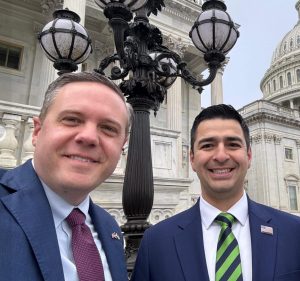
Comments