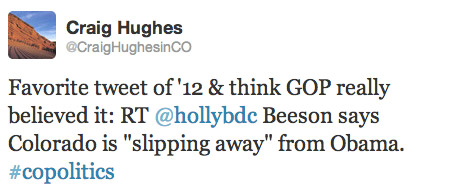
Our friend Craig Hughes of RBI Strategies Tweeted not long after the election:
Well, as The New Republic’s Noam Scheiber reports today, Hughes was more right than anybody knew–that is, about what Republicans, around the country but particularly here in Colorado, believed would be the outcome going into an election they were about to lose.
It’s no secret that the Romney campaign believed it was headed for victory on Election Day. A handful of outlets have reported that Team Romney’s internal polling showed North Carolina, Florida, and Virginia moving safely into his column and that it put him ahead in a few other swing states. When combined with Ohio, where the internal polling had him close, Romney was on track to secure all the electoral votes he needed to win the White House. The confidence in these numbers was such that Romney even passed on writing a concession speech, at least before the crotchety assignment-desk known as “reality” finally weighed in.
Less well-known, however, are the details of the polls that led Romney to believe he was so close to the presidency. Which other swing states did Romney believe he was leading in, and by how much? What did they tell him about where to spend his final hours of campaigning? Why was his team so sanguine about its own polling, even though it often parted company with the publicly available data? In an exclusive to The New Republic, a Romney aide has provided the campaign’s final internal polling numbers for six key states…
The numbers include internal polls conducted on Saturday, November 3, and Sunday, November 4, for Wisconsin, Pennsylvania, Minnesota, Iowa, Colorado, and New Hampshire. According to Newhouse, the campaign polled daily, then combined the results into two-day averages.
In the polling data provided to TNR by Mitt Romney’s chief internal pollster Neil Newhouse, Romney has a 2.5 point lead on President Barack Obama in Colorado over the weekend before Election Day. As you know, the President won Colorado by almost 5.5 points. The range of explanations offered by Newhouse in this story vary from Latino voters (which while significant, don’t fully cover the spread), over-reliance on self-identified “highly likely voters,” and the perils of polling on a Sunday. Each one of these, the story goes, unintentionally helped contribute to the false sense of optimism projected by the GOP going into Election Day.
This story again answers the question of whether the Romney campaign was convinced it was going to win, or whether there was a more complicated process of spin for the base that the higher levels of the campaign knew wasn’t true. Right to the very top, this was a campaign that did believe victory was imminent, and was genuinely surprised when it failed to materialize.
What this story doesn’t seem to adequately capture, beyond the raw numbers of how wrong they were, is the depth of the bubble–with the exception of Gallup and a few clearly GOP-skewed pollsters, Obama’s win in Colorado was accurately forecast in several pre-election polls.
It’s also worth noting, as Hughes did, that longtime local GOP operative Rich Beeson was Romney’s political director. Beeson’s willing participation in the groupthink and flawed assumptions that led the Romney campaign to believe Colorado was in their column shows the extent of the break with a reality they should have seen coming at them like a Mack truck.
Answer: a perhaps unprecedented extent.
Subscribe to our monthly newsletter to stay in the loop with regular updates!
Comments