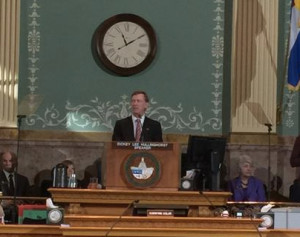
As the Colorado Independent's Tessa Cheek reports:
Governor John Hickenlooper used his fifth State of the State speech today to paint his legislature, where Republicans control the Senate and Democrats control the House, with a Colorado-ness that reaches beyond party priorities. He touted the new first-ever statewide water plan, quoting Thomas Hornsby Ferril, whose poetry is engraved in the Capitol and that emphasizes common interest: “Here is a land where life is written in water.”
“Representatives of urban areas recognized that locally sourced dairy and food is vital to all of Colorado; while the agricultural areas realized that they could not simply allow urban areas to dry up,” Hickenlooper said of the water plan, noting it involved “the largest civic engagement process in state history.”
Lawmakers and leaders should come together, Hickenlooper suggested, to apply similarly high standards of public input and cooperation to tackle tough questions surrounding topics like oil and gas development and government funding under the Taxpayers Bill of Rights (TABOR)…
The Denver Post's John Frank on Gov. John Hickenlooper's measured comments on the controversial so-called Taxpayer's Bill of Rights (TABOR):
Hickenlooper capped his speech by addressing the state's budget situation — which he labeled a "financial thicket" in his inaugural address Tuesday. It's a reference to the possibility of refunds under the state's Taxpayer's Bill of Rights, despite underfunded state programs.
"There is a legitimate debate of whether government should be a bit bigger or a bit smaller," the governor said, according to prepared remarks. "But that misses the point. Regardless of size, government must work."
But he stopped short of asking for an overhaul of TABOR and avoided taking a direct stance on how to address the issue."Some people want to get rid of TABOR, some want to get rid of Amendment 23, others want to get rid of Gallagher. There is no shortage of thorns in this fiscal thicket," he said. "And while we will continue to strategically prune, our state budget can only endure so much cutting. "
Referencing the oil and gas industry, Hickenlooper emphasized the number of environmental protections he has added through collaboration with the industry during his first term, then said he looks forward to seeing the recommendations that a task force examining the role of local government in regulating the industry will deliver later this session. But he did not give any parameters as to what kind of increased regulations he may be willing to back in the Legislature.
On the issue of local control of oil and gas drilling, an issue that caused intense infighting among Democrats last year, Hickenlooper didn't offer much in the way of specifics–but the language that he used to describe those proposals, and the competing interests of surface and subsurface property owners, is unlikely to make conservationists very happy. From the speech:
As part of a compromise to keep economically-devastating initiatives off the ballot, [Pols emphasis] we have worked with the Keystone Center and brought long-polarized interests to the same table…
I look forward to the recommendations of this task force, and pledge to work with you and other stakeholders in developing our energy resources, protecting property rights and our natural environment and public health.
The insistence that increasing local control over oil and gas drilling, in particular the setback and "environmental bill of rights" initiatives put forward during last year's debate, would be "economically devastating" broadcasts our Democratic governor's bias on the issue. There is a legitimate conflict between the rights of surface landowners and mineral rights holders needing resolution, but Hickenlooper still appears firmly on the side of mineral rights owners against local communities based on his comments today.
We wonder how politically tenable that position will be for Hickenlooper throughout his second term, as more research on the effects of "fracking" near residential neighborhoods comes out, and the plummeting price of energy caused by OPEC's price war on the frackers eats away at the already-overblown estimates of the economic impact of the industry in Colorado. Might the same changing economics that led Hickenlooper to endorse President Barack Obama's threatened veto of the Keystone XL pipeline soften Hick's hard line against communities worried about fracking in their boundaries?
That's one of the biggest of many questions awaiting Hickenlooper in his "legacy term."
Subscribe to our monthly newsletter to stay in the loop with regular updates!
Comments