President Trump said last week that the United States will be “running” Venezuela for an indeterminate period of time following the forcible removal of Venezuelan President Nicolás Maduro.
Let’s set aside, for a moment, the question of HOW this is actually going to work in practice; it is clear that nobody in the Trump administration has the foggiest idea how this might happen, or whose job(s) it will be to oversee a country 3,000 miles to the south. As The Washington Post reported on Sunday, “the reality of how Washington will administer that country in the weeks and months ahead appears uncertain and stubbornly complex.”
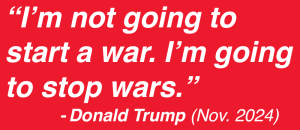
But for Republicans already facing stiff electoral headwinds in 2026, the question about how America might “run” Venezuela is of less importance than why we would even attempt such a task. Trump’s new obsession with trying to become President of the Western Hemisphere is sharply at odds with the messaging that got him elected to a second term in 2024.
As The New York Times reports, Trump’s MAGA base — which was already unhappy — is not at all on board with this change in priorities:
President Trump seized control of the Republican Party on an anti-interventionist “America First” platform that has cleaved the G.O.P. from its Bush-era foreign policy that led to years of messy foreign entanglements.
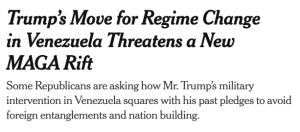
Now Mr. Trump’s decision to send the military into Venezuela to remove its president, and his vague claim that the United States would go on to “run” the country, have threatened to open a new rift within the political movement he has built over the past decade. A handful of Republicans are asking how it squares with his campaign-trail promises to not engage in nation-building or begin new foreign wars.
Mr. Trump and members of his administration have offered differing explanations of what would happen in Venezuela now that the United States has captured its leader, Nicolás Maduro, and brought him back to New York to face criminal charges. After Mr. Trump said that Americans would “run” the country, Secretary of State Marco Rubio tiptoed back from that position on the Sunday morning news shows, and noted that American troops were no longer on the ground there.
“The lack of framing of the message on a potential occupation has the base bewildered, if not angry,” Stephen K. Bannon, the pro-Trump podcaster, said in an interview. “While President Trump makes the case for hemispheric defense, Rubio confuses with talk of removing Hamas and Hezbollah.”
The Associated Press reported on a similar disconnect:
While most Republicans lined up behind the president in the immediate aftermath of the stunning U.S. mission to capture Venezuelan leader Nicolás Maduro and bring him to New York to face criminal charges, there were signs of unease across the spectrum within the party. In particular, Trump’s comments about the U.S. positioning itself to “run” Venezuela have raised concerns that he is abandoning the “America First” philosophy that has long distinguished him from more traditional Republicans and helped fuel his political rise.
“This is the same Washington playbook that we are so sick and tired of that doesn’t serve the American people, but actually serves the big corporations, the banks and the oil executives,” said Rep. Marjorie Taylor Greene of Georgia, a former Trump ally who is resigning on Monday, in an interview with NBC’s “Meet the Press” on Sunday…
…Rep. Brian Fitzpatrick of Pennsylvania, a moderate who is one of the most vulnerable Republicans in the November midterms, said in a statement that “the only country that the United States of America should be ‘running’ is the United States of America.” [Pols emphasis]
Polling data also shows that Americans are not at all pleased that Trump is focused on taking over other countries rather than dealing with domestic problems such as rising prices and health care costs. From a separate story via The Associated Press:
About one-quarter of U.S. adults listed foreign policy topics — such as the Russia-Ukraine conflict, Israel or general involvement overseas — as something they wanted the government to prioritize in 2026, according to an open-ended AP-NORC question that asked respondents to share up to five issues they wanted the government to work on in the coming year. That was down from the prior two years, when roughly one-third of Americans considered foreign issues an important focus. Almost no one specifically named Venezuela. [Pols emphasis]
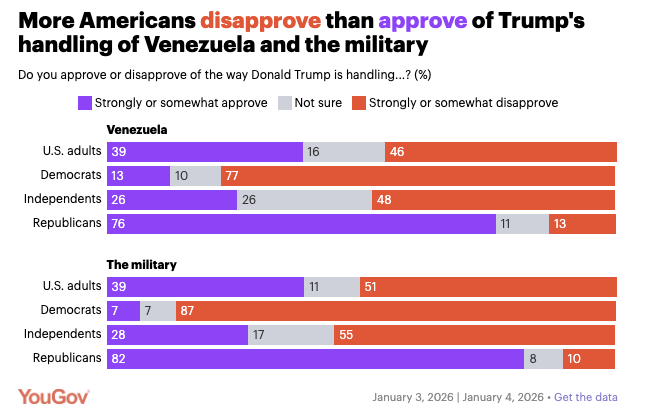
As YouGov noted in late December, “There is scant American support for military intervention in Venezuela.” Those numbers aren’t much better in the wake of Maduro’s capture:

When Americans go to the polls in 10 months, they are first and foremost going to be concerned about the economy and rising health care costs. It’s going to be awfully difficult for Republicans to stake any claim to dealing with these issues when the Trump administration is adopting a policy of “America Second.”
Republicans were unlikely to win over a majority of Independent voters in 2026. If they can’t keep their own base together, we could be looking at a massive blue wave.
Subscribe to our monthly newsletter to stay in the loop with regular updates!
Comments