U.S. Senate See Full Big Line

(D) J. Hickenlooper*

(D) Julie Gonzales

(R) Janak Joshi

80%

40%

20%

(D) Michael Bennet

(D) Phil Weiser
55%

50%↑
Att. General See Full Big Line

(D) Jena Griswold

(D) M. Dougherty

(D) Hetal Doshi

50%

40%↓

30%

Sec. of State See Full Big Line
(D) J. Danielson

(D) A. Gonzalez
50%↑

20%↓
State Treasurer See Full Big Line

(D) Jeff Bridges

(D) Brianna Titone

(R) Kevin Grantham

50%↑

40%↓

30%

CO-01 (Denver) See Full Big Line

(D) Diana DeGette*

(D) Wanda James

(D) Milat Kiros

80%

20%

10%↓

CO-02 (Boulder-ish) See Full Big Line

(D) Joe Neguse*

(R) Somebody

90%

2%

CO-03 (West & Southern CO) See Full Big Line

(R) Jeff Hurd*

(D) Alex Kelloff

(R) H. Scheppelman

60%↓

40%↓

30%↑

CO-04 (Northeast-ish Colorado) See Full Big Line

(R) Lauren Boebert*

(D) E. Laubacher

(D) Trisha Calvarese

90%

30%↑

20%

CO-05 (Colorado Springs) See Full Big Line

(R) Jeff Crank*

(D) Jessica Killin

55%↓

45%↑

CO-06 (Aurora) See Full Big Line

(D) Jason Crow*

(R) Somebody

90%

2%

CO-07 (Jefferson County) See Full Big Line

(D) B. Pettersen*

(R) Somebody

90%

2%

CO-08 (Northern Colo.) See Full Big Line

(R) Gabe Evans*

(D) Shannon Bird

(D) Manny Rutinel

45%↓

30%

30%

State Senate Majority See Full Big Line

DEMOCRATS

REPUBLICANS

80%

20%

State House Majority See Full Big Line

DEMOCRATS

REPUBLICANS

95%

5%

Generic selectors
Exact matches only
Search in title
Search in content
Post Type Selectors
November 03, 2025 02:40 PM UTC

Updated Generic Congressional Ballot is Big News for Democrats

  •  
  • by: Colorado Pols

There’s no avoiding polling data in politics. Not all data is the same, however, and some is more accurately predictive than others.
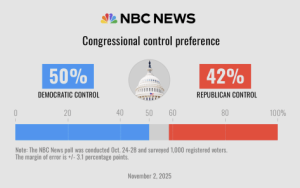
One question that has been asked regularly for decades is much more indicative of election outcomes than others: The Generic Congressional Ballot. The GCB asks respondents, If the election for U.S. House of Representatives were tomorrow, would you vote for the Democratic candidate or the Republican candidate?

Whichever political party leads the GCB tends to perform better in the next election (though the exact numbers don’t line up because many congressional races don’t have competitive General Elections). Ahead of the last mid-term election, for example, the GCB showed a two- to five-point Republican advantage in pre-election polls. Republicans ended up gaining 9 seats in the House and flipping control of the chamber.

In 2024, Democrats and Republicans went back and forth atop the GCB; Republicans ended up losing two seats overall but maintained a slim 5-seat majority.

Perhaps the best example is from 2018, the last time we had a mid-term election with President Trump in the White House. Democrats averaged an 8-point advantage in the GCB that cycle and flipped an astounding 41 seats to make Nancy Pelosi the Speaker of the House.

In November 2017, Democrats held an 8-point advantage over Republicans on the GCB. Those numbers are eerily similar to November 2025. As NBC News reports:

One year before the 2026 midterm elections, Democrats lead Republicans in the fight for Congress by 8 points, 50%-42%, the largest lead for either party on the congressional ballot in the NBC News poll since the 2018 midterms. Democrats had a negligible 1-point edge, 48%-47%, in the March survey…

Democrats’ lead on the congressional ballot is among the larger advantages they have enjoyed in any public polling in 2025. [Pols emphasis]

Moreover, according to a CNN poll conducted by SSRS, Democrats hold a massive advantage in voter enthusiasm:

Looking ahead to next year’s midterms, Democrats appear to have a very early advantage: 47% of registered voters say they’d vote for the Democrat in their district if the election were held today, while 42% prefer the Republican. More say they’ve ruled out supporting a Republican (42%) than say the same about a Democrat (35%). And 41% say they would be sending a message that they oppose Trump with their vote, nearly double the 21% who say their vote would be a message of support for the president. Independents break in Democrats’ favor on the generic ballot (44% to 31% for Republicans, with 19% saying they wouldn’t pick either right now).

Registered voters who are Democrats or Democratic-leaning independents are far more likely than Republican-aligned voters to say they are extremely motivated to vote next year (67% compared with 46%). Those Democratic-aligned voters who consider the state of democracy to be a top concern are perhaps the most fired up within the party: 82% in that group say they are deeply motivated to vote, compared with 57 % among Democratic-aligned voters who call the economy their top concern.

CNN’s poll results suggest that the Democratic Party’s ongoing internal image troubles may not necessarily translate into defections at the ballot box. Democratic-aligned voters remain far less fond of their own party (65% have a favorable view of the Democratic Party) than Republican-aligned voters (80% have a favorable view of the GOP), but even those Democratic-aligned voters with a negative view of the party are almost universally behind the Democratic candidate in their district (93%) and broadly motivated to vote (71% say they are extremely motivated).

All told, Democrats hold a 12-point advantage among those voters who say they are extremely or very motivated to turn out next year. [Pols emphasis]

Democrats probably won’t win 41 seats in the House next year, but they only need a net gain of a half-dozen seats in order to regain the majority. The party out of power in the House historically gains an average of 26 seats in the next election.

Comments

Recent Comments


Posts about

Donald Trump
SEE MORE

Posts about

Rep. Lauren Boebert
SEE MORE

Posts about

Rep. Gabe Evans
SEE MORE

Posts about

Colorado House
SEE MORE

Posts about

Colorado Senate
SEE MORE

84 readers online now

Newsletter

Subscribe to our monthly newsletter to stay in the loop with regular updates!