As Nick Coltrain reports for The Denver Post, Donald Trump’s 2024 campaign promises to lower inflation and the cost of goods have been ignored. Instead, Colorado and the rest of the country on the brink of a recession:
Colorado state government faces a continuing dim fiscal picture heading into next year as a slowing economy, rising costs and the rollout of tariffs weigh on forecasters, according to projections released Monday.
The new forecasts preview what was already expected to be a need for another round of budget cuts. They also project a gap in state tax refunds due to a drop in tax revenue and a relatively high risk of a recession over the next year. [Pols emphasis]
State economists with the legislative branch expect lawmakers will begin about $840 million in the hole when they start drafting the 2026-27 fiscal year’s budget if they absorb projections for spending on Medicaid, higher education, salary increases for state employees and other rising costs. That gap between projected revenue and costs would come despite an expectation that the general fund will grow by 7.4%, or $1.3 billion, according to nonpartisan legislative staff, as rising costs continue to outpace tax collections.
“Years of thoughtful bipartisan budgeting puts us on solid financial footing, but with the devastating impacts of H.R. 1 (the recent federal tax bill), along with tariffs continuing to create uncertainty and raise prices for Colorado families, more tough budget decisions are most certainly ahead,” Sen. Jeff Bridges, a Greenwood Village Democrat and the chair of the Joint Budget Committee, said in a statement.

The combination of Trump’s big beautiful bullshit budget bill; economic uncertainty from Trump’s senseless tariff wars; and general buffonery from the Trump administration and Congressional Republicans has also all but eliminated any potential TABOR refunds in coming years. As Coltrain continues:
Colorado’s tax code is closely tied to federal tax law, making the state particularly sensitive to changes there. The federal cuts dropped Colorado below the tax cap set by the Taxpayer’s Bill of Rights, or TABOR, for the current fiscal year, eliminating expected state refunds when residents file their taxes in 2027.
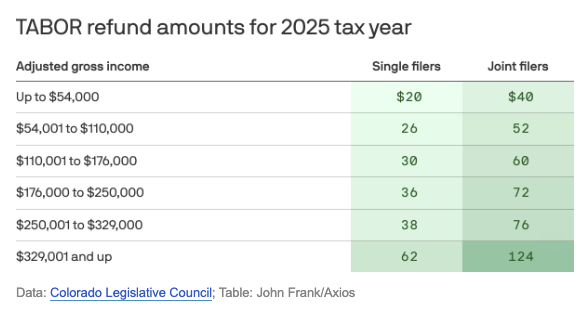
Refunds for the upcoming 2026 tax-filing season are projected at $20 for low-income Coloradans and up to $30 for Coloradans making between $110,000 and $176,000 in income. The highest-income Coloradans can expect $62 refunds. [Pols emphasis]
The following chart from Axios Denver lays out the damage for this year:

For the first time in SIX YEARS, Coloradans will likely receive NO TABOR REFUND in 2027 because of a projected 1.1% decline in revenue, according to an economic forecast presented on Monday by the nonpartisan Legislative Council Staff.
According to a press release Monday from the office of Gov. Jared Polis, there is no mystery as to what is driving this nosedive:
“Today’s forecast again shows that the President’s reckless tariff taxes are increasing costs on consumers, sabotaging our economy, tightening the job market, and driving up inflation. [Pols emphasis] While Colorado is fairing better than the rest of the country with lower unemployment and stronger growth, hardworking families are being cornered to grapple with higher costs, forcing them to make hard personal budget decisions at the dining room table. This forecast is clear, Coloradans are paying the cost for Trump’s tariffs and Republicans’ Washington politics,” said Governor Polis.
Revenue is expected to drop below the TABOR cap in FY26 due to the impacts of H.R.1, with a return above the TABOR cap later in the forecast period. However, based on current projections low revenue growth will eliminate the Family Affordability and Earned Income Tax Credits in Tax Year 2026, but these credits are expected to return in Tax Year 20
27. Opportunity Now Tax Credits funded through HB24-1365 will be cut in half for Tax Year 2026.
The Trumpcession is not isolated to Colorado, of course. Business leaders across the world are growing increasingly worried about the impact of Trump’s reckless firings across the government, as CNN explains:
The nation’s top economic statistician was fired. Central bank independence is being undermined. The federal government is buying chunks of private companies and demanding cuts of revenue streams. Presidential power to lob tariffs has been wielded in unprecedented fashion. And federal regulators are threatening media companies over late-night comics…
…Business leaders are “quite alarmed” in private about the state of democracy in the United States, according to Jeffrey Sonnenfeld, the Yale professor known as the “CEO Whisperer” due to his extensive rolodex in the business community.
“We’ve had a serious erosion of the foundations of democracy,” Sonnenfeld, founder and president of the Yale Chief Executive Leadership Institute, told CNN.
Research shows that democracies tend to thrive financially.
“Democracy is just good for the economy. And autocracy is bad for the economy,” Williamson said. “Autocrats are just not good at managing economies. Policymaking tends to be erratic as democratic institutions decline.” [Pols emphasis]
You can count JPMorgan CEO Jamie Diamond among those concerned business leaders, particularly given a new announcement from Trump regarding immigration. Via Newsweek:
Jamie Dimon, CEO of financial services and banking giant JPMorgan, has highlighted a number of potential risks facing the U.S. economy.
In a series of interviews on Tuesday, Dimon raised concerns about President Donald Trump’s recent policy change on H-1B visas, said that inflation could prove a drawn-out challenge for the Federal Reserve and warned that the country’s mounting deficit—a bugbear of many economists—is an unsustainable issue requiring the urgent attention of policymakers…
…On Tuesday, Dimon said that Friday’s announcement of a $100,000 fee for H-1B visa applications was a shock that could impede the flow of foreign-born talent into the U.S. In an interview with the Times of India, Dimon said the news “came out of the blue,” and that JPMorgan would be “engaging with stakeholders and policymakers” over the matter. [Pols emphasis]
As we have noted before, you can lump much of these problems into the the economic uncertainty basket created by Trump over the last nine months.
Roughly 57% of Americans now disapprove of Trump’s handling of the economy — an all-time low for Trump. Americans are not confused about why the economy is in a bad place. There were no outside forces driving the economy downward. President Trump created this looming recession out of thin air.
None of this needed to happen.
Subscribe to our monthly newsletter to stay in the loop with regular updates!
Comments