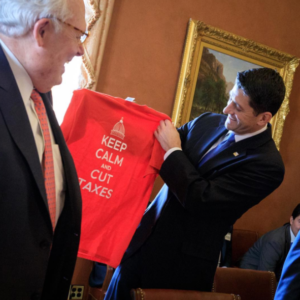
UPDATE (11:45 am): Republicans in the House of Representatives have passed their version of The Tax Turducken. From the Washington Post:
The House passed its version of the Republican tax overhaul Thursday, notching a key win for President Trump and House Speaker Paul D. Ryan (R-Wis.). But obstacles remain in the Senate, which is refining its own version of the legislation amid objections from key GOP senators.
The bill passed with 227 votes in favor and 205 against. 13 Republicans voted against the bill. No Democrats voted for it.
—–

Congressional Republicans are working feverishly (or thereabouts) to pass a massive tax cut for the wealthy before the end of the year, and the House may hold a floor vote as soon as today. There is a lot of information floating around about the House and Senate tax proposals, and it’s a lot to digest (take this list of differences between the House and Senate versions of tax reform, for example). Thankfully, we’re here to, uh, reconstitute that information in a more accessible format.
Here’s what you need to know about the “tax reform” proposals currently getting greased up in Washington D.C.
Let’s go right to the Washington Post with today’s big headline:
The tax bill Senate Republicans are championing would give large tax cuts to millionaires while raising taxes on American families earning $10,000 to $75,000 over the next decade, according to a report released Thursday by the Joint Committee on Taxation, Congress’ official nonpartisan analysts.
President Trump and Republican lawmakers have been heralding their bill as a win for hard-working Americans, but the JCT report casts doubt on that claim. Tax hikes for households earning $10,000 to $30,000 would start in 2021 and grow sharply from there. By the year 2027, Americans earning $30,000 to $75,000 a year would also be forced to pay more in taxes even though people earning over $100,000 continue to get substantial tax cuts. [Pols emphasis]
Gah!
Republicans are trying to fund massive tax cuts for the wealthy and corporations by increasing taxes for everyone else. This is not just some ginned-up liberal talking point. Much like Congressional Republican attempts at repealing Obamacare in the first half of the year, one analysis after another is showing that the GOP tax plan will harm infinitely more people than it could possibly help. The talking points write themselves for Democrats.
Republicans are cramming as much crap as they can into one massive tax bill, including the big news Wednesday that the legislation will include a provision to roll back the individual mandate in Obamacare. This provision would effectively end healthcare coverage for some 13 million Americans.
Both the House and Senate versions of the legislation already include “Personhood” language, a bizarre attempt to establish some sort of legislative foothold for the anti-choice crowd that has absolutely nothing to do with, you know, taxes. The provisions that are related to taxes, meanwhile, can largely be characterized as handouts to specific lobbying groups.
Many Congressional Republicans been quiet for weeks on publicly endorsing or refuting aspects of the tax reform proposals. That changed on Wednesday, when Wisconsin Republican Sen. Ron Johnson announced his opposition to the current versions of both the House and Senate tax plans.
Republican Governors, meanwhile, are worried that an unartful Congressional tax reform plan will only increase the strength of a potential blue wave in 2018. Florida Republican Gov. Rick Scott, a potential U.S. Senate candidate, recently expressed his concern that Congress will fail to make any meaningful changes because they are putting all of their eggs in the same proverbial basket. As CNN reports:
Scott was also critical of how Congress is handling tax reform, saying lawmakers should “quit having a grand bargain” and “do what you can get done today.”
“These ideas that you’ve got to have this gigantic change never happens. These grand bargains never happen,” Scott said.
The math doesn’t lie for Republicans: It’s not possible to make permanent tax cuts for corporations and rich people and regular Americans while not completely exploding the national debt, so Republicans will just worry about corporations and rich people for now.
Congress is not allowed to enact legislation that would add to the federal deficit after 10 years, so Republicans have crafted a way around this problem: They’ll just turn off most of the tax cuts for non-rich people in a few years. As Politico explains:
Senate Republicans are on the defensive after proposing to only offer temporary tax cuts to millions of Americans as part of a revised plan to overhaul the tax code.
While they want to make a host of business tax cuts permanent, they would make reductions in tax rates, expansions of the standard deduction and child tax credit, and other provisions expire after 2025.
As Sen. Lindsey Graham (R-South Carolina) told Politico about the individual tax cut provisions: “I’d like to make them permanent, but we’ll just come back at them again [later].”
In other words, middle class Americans can get bent while the GOP tax cut for the wealthy adds $1.5 TRILLION to the federal deficit in the next decade. Neat!
Check out some of these numbers from the Institute on Taxation and Economic Policy regarding how the Republican tax proposals will (not) benefit Coloradans:
♦ Roughly 18% of Colorado families, most of them middle-class families, will ultimately see their taxes increase as a result of the legislation.
♦ About 75% of the tax cuts will go to the top 20% of Coloradans (46% of the total will benefit just the wealthiest 1% of Coloradans).
♦ The number of households in Colorado that will benefit from repealing the estate tax is about 70. That’s 70 total – not a percentage.
♦ At least 235,000 Coloradans would lose health insurance coverage by 2025 if the GOP tax plan passes.
Results from a new poll out Wednesday from Quinnipiac University follow the same trend as their predecessors in recent weeks. Voters now disapprove of the GOP tax plan by a greater than 2-to-1 margin:
American voters disapprove 52 – 25 percent of the Republican tax plan. Republican voters approve 60 – 15 percent, with 26 percent undecided. All other party, gender, education, age and racial groups disapprove. [Pols emphasis]
Perhaps most troubling for Congressional Republicans is the fact that Americans aren’t accepting the GOP narrative of middle class tax relief:
The wealthy would mainly benefit from this tax plan, 61 percent of American voters say, while 24 percent say the middle class will mainly benefit and 6 percent say low-income people would mainly benefit.
American voters say 59 – 33 percent that the Republican tax plan favors the rich at the expense of the middle class.
Only 16 percent of American voters say the Republican tax plan will reduce their taxes, while 35 percent of voters say it will increase their taxes and 36 percent say it won’t have much impact on their taxes.
Said Tim Malloy, assistant director of the Quinnipiac University Poll:
“The sentiment from voters: The GOP tax plan is a great idea, if you are rich. Otherwise, you’re out of luck.”
And there you have it.
Subscribe to our monthly newsletter to stay in the loop with regular updates!
Comments