As the Longmont Times-Call’s John Fryar reports, a bill making its way through the Democratic-controlled House on its way to its all-but-certain death in the Colorado Senate–and probably vetoed by Democratic Gov. John Hickenlooper in the unlikely event it did not die in the Senate–serves as another head-scratching teachable moment in the politics of energy development in Colorado:
State Rep. Mike Foote’s proposal to require that any future oil and gas wells be located at least 1,000 feet away from schools’ and child care centers’ property lines is headed for debate by the full Colorado House of Representatives after clearing a committee vote on Thursday night…
Current Colorado Oil and Gas Conservation Commission regulations specify that oil and gas wells must be located at least 1,000 feet away from a school building.
Foote’s bill would expand that setback by requiring that wells and related oil and gas facilities be no closer than 1,000 feet to the school’s or child care center’s property line — an additional distance he and supporters of the proposed law say would protect people on playgrounds and athletic fields as well as the students and teachers inside modular classroom buildings on school campuses.
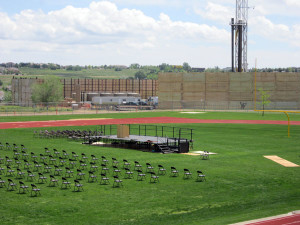
For the overwhelming majority of Coloradans not in the employ of the energy industry or one of its various supporting businesses, the idea that oil and gas drilling operations can occur so close to any part of a school campus is fairly surprising. The situation illustrated vividly in Greeley of a large drill site immediately adjacent to the local high school’s football field (above) isn’t part of most suburban Coloradans’ family experience yet, but it could be in their future. Keeping drilling operations a minimum distance from the property line of a school ensures that students can use the entire property safely. From any reasonable point of view, this should be a no-brainer. In fact, most non-“energy literate” Coloradans are surprised to learn it’s not already the case.
But like we said, the bill is almost certain to die, moving through the House on party lines:
Foote said in a Friday interview that more than 70 people testified in support of his bill on Thursday night and about 15 — opponents who he said were primarily lobbyists and representatives of the oil and gas industry — spoke against it.
“It’s really too bad that the industry locked down on such a reasonable proposal,” Foote said. [Pols emphasis]
In the GOP-controlled Colorado Senate, it’s more or less axiomatic that if the Colorado Oil and Gas Association opposes a bill, the bill dies. This has been the case for as long as Republicans have been in control of the Senate, and the seamless transition of former Senate President Bill Cadman to his new lobbyist government affairs position at Whiting Petroleum surprised absolutely no one. And yes, the Democratic governor of our state has himself proven to be highly accommodating to energy development, to the point of significantly dividing the local Democratic coalition on the issue.
The point we’re making here is that at eventually, this conflict is going to result in a groundswell backlash in Colorado politics–and potentially some realignment among local officials based on their stand either with the energy industry or residential communities. The confrontation between voters concerned about oil and gas development in their neighborhoods and the energy industry’s powerful political establishment was delayed by the passage of Amendment 71 last year, which cracked down hard on citizen initiative power. But Amendment 71 certainly didn’t allay citizen anger over this issue–and more likely will help redirect that energy into other electoral battles like local governments and the state legislature.
We believe that in the long run, the rights of residential communities on the surface must inevitably win out over the right to extract minerals from below the surface via heavy industry. The inevitability of that is as certain as the continued urbanization of the Front Range. The rights of residential communities to be safe and control land use within their boundaries, at some level, have to come first.
And in reality, the people who disagree with that are almost always paid to.
Subscribe to our monthly newsletter to stay in the loop with regular updates!
Comments