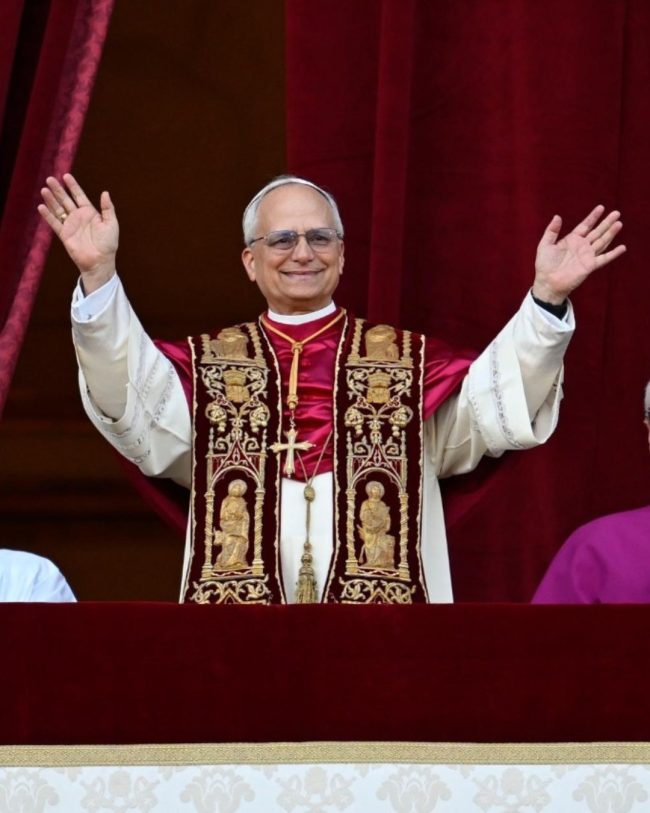
The Washington Post reports on the global news dominating the day today, the election in Vatican City of the first American Pope, Robert Prevost, now Pope Leo the 14th. Pope Leo replaces the recently deceased Pope Francis, whose political engagement on behalf of the poor, migrants, prisoners, and others at the bottom of the social strata endeared him to liberal Catholics while running afoul of conservative church members like Vice President J.D. Vance:
“He’s right out of Francis’s playbook,” said Kathleen Sprows Cummings, a professor of history at the University of Notre Dame who focuses on U.S. Catholics. “He ticks off all the boxes of a future pope: a pastoral heart, managerial experience and global vision.”
Francis turned to Prevost on repeated occasions. In 2022, he had him preside over a revolutionary reform: adding three women to the voting bloc that decides which bishop nominations go forward to the pope. Yet his successor is considered more middle of the road, pragmatic as well as cautious.
As The Hill’s Elizabeth Crisp reports, like his predecessor, Pope Leo has a history of challenging President Donald Trump on a variety of salient political issues:
Cardinal Robert Prevost, who became the first American pope Thursday, frequently used social media to subtly push back on the Trump administration and its policies, a review of his posts on the social media platform X shows.
Prevost, now known as Pope Leo XIV, shared columns that disputed Vice President Vance’s interpretation of Christian “ordo amoris,” ranking order of love, in February; linked to an article that lambasted Trump’s “anti-immigrant rhetoric” as dangerous in 2015; and reposted messages against the death penalty, migrant deportations and Congress’s inaction on gun laws after deadly shootings.
Pope Leo XIV called out Vice President J.D. Vance in a social media post just weeks ago bluntly calling him “wrong”—and bashed Donald Trump in a retweet less than a month ago.
Posting on his X profile as Cardinal Robert Prevost, he criticized Vance for an interview he gave about Christianity on Fox News.
“JD Vance is wrong,” he said. “Jesus doesn’t ask us to rank our love for others.”
All of which is generating hope among progressive Catholics that the new pope will continue the conciliatory ministry of his predecessor, and perhaps revitalize the American Catholic Church which has been in decline for years after sexual abuse scandals and the general disaffection with religiosity in modern life have greatly reduced its influence. Here in Colorado, we have a relatively activist conservative Catholic Archbishop of Denver, Samuel Aquila, who has waged high-profile political campaigns against abortion and LGBT rights along with equally energetic but less public-facing work to kill legislation that would allow victims of sexual abuse in childhood to sue institutions that covered for their abusers. On the latter issue, Pope Francis was much more conciliatory than Bishop Aquila.
Will the new American pope pay more attention to the often-conflicted politics of his American bishops?
An early sign might be how much–or little–we hear from the Archbishop of Denver on wedge issues in the future.
Subscribe to our monthly newsletter to stay in the loop with regular updates!
Comments