CNN’s Kevin Liptak reports on the aftermath of President Joe Biden’s whirlwind tour of Eastern Europe over the weekend, which included as we discussed yesterday a side trip to Kyiv to visit Ukraine’s President Volodymyr Zelensky–and reaffirm the United States’ commitment to helping Ukraine defend itself from Russian aggression that began almost exactly one year ago:
The 72 hours Biden spent on the ground in Ukraine and Poland have been among the most momentous of his presidency, [Pols emphasis] the culmination both of careful, highly secretive planning by White House aides and the president’s singular, decades-held view of America’s role in the world…
“President Putin chose this war,” he declared. “Every day the war continues is his choice. He could end the war with a word.”
A few hours earlier and several hundred miles away, Putin was delivering his own important speech to political and military elite, offering a dramatically different narrative of the war as he accused the West of turning Ukraine into a global confrontation.
The differences between the two speeches were stark, both in content and character. Biden was introduced in Warsaw to a pulsing pop anthem; Putin seemed to put some members of his audience to sleep with his hour-and-45-minute address. On Wednesday, Biden said it was a “big mistake” for Putin to announce that he was suspending his country’s participation in the New START nuclear arms reduction treaty.
The war in Ukraine was never supposed to last as long as it has, and the denial of a quick victory by Ukraine’s stout defense of their country has forced Russia into a devastating war of attrition accompanied by punishing economic sanctions and diplomatic isolation from most of the rest of the world. Western material support for Ukraine in the form of superior weapons and training has made the difference in frustrating the designs of the increasingly erratic Russian President Vladimir Putin.
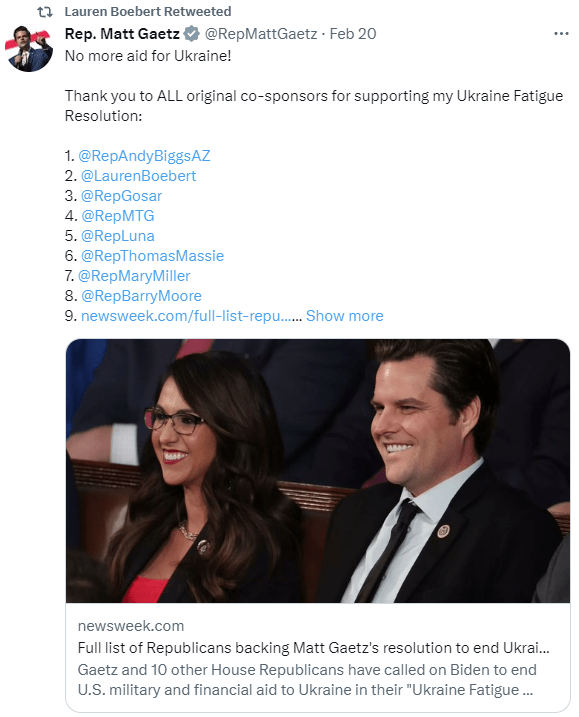
All told it’s a bleak situation for Russia, who badly miscalculated both their own military capabilities and the resolve of the West to defend the independence of free nations on former Soviet territory. One of the only bright spots left for Putin’s Russia as the war in Ukraine enters its second year? A small faction of Republicans in the United States Congress who claim without evidence their objective is to Make America Great Again:


Much like the small number of Republicans who also happened to be led by Reps. Matt Gaetz of Florida and Lauren Boebert of Florida Colorado turned the vote for Kevin McCarthy as Speaker of the House into an agonizing spectacle of party disunity, Gaetz and Boebert are the face of the 11-member “Ukraine Fatigue” caucus, which is a brand lifted straight from the Russian web brigades. The stand against McCarthy that dwindled down to only Boebert and Gaetz versus the entire exasperated rest of the Republican caucus proved the extent to which their pointless contrarianism could do real damage to their own supposed friends.
Now, they’re giving aid and comfort to what everybody but these 11 members considers to be the enemy:
CNN says they haven’t heard an air siren for days in Ukraine, until Joe Biden showed up.
Russia had agreed to a ceasefire while Joe was in Kyiv.
That air raid siren sounding was nothing but propaganda for Joe’s “tough guy” campaign.
It didn’t work.
— Lauren Boebert (@laurenboebert) February 21, 2023
Sputnik News couldn’t have said it better, except for the small issue that they’ve been kicked off of most Western media networks for being state-owned Russian propaganda mills! If you still want to hear the Russian perspective on the news it’s very easy to find, of course. Whether by common interest or other established channels, Boebert has been repeating Russian talking points since the war in Ukraine began. Given the tiny faction of representatives pushing the idea of “Ukraine Fatigue” in Congress, in effect seeking to punish Ukraine for not losing fast enough, Boebert’s constituents have a right to ask why she’s a part of this fight at all, so far removed from the issues affecting her district–and more importantly, what the endgame is.
There used to be consequences for failing to “leave politics at the water’s edge.” More often than not, especially during the Cold War, it was Republicans who enforced them.
Subscribe to our monthly newsletter to stay in the loop with regular updates!
Comments