The bill formerly known as the “Colorado Option” passed out of the House Health and Insurance Committee on a party-line vote on Tuesday. House Bill 1232 now heads to the House Appropriations Committee; it is expected to move along with little trouble to a floor vote and then to the State Senate.
There has been a bit of confusion about what the current format of the bill does and does not accomplish, due in part to complicated policy, protracted negotiations, and multiple versions of bills over several legislative sessions. Here are some questions and answers to help in that regard:
Q: So, what does this bill actually do and why should I care?
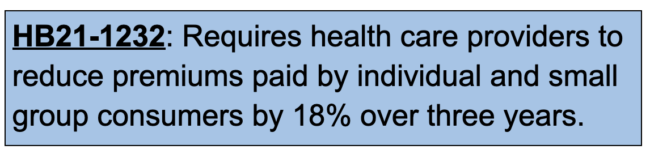
A: This is a big deal. While a lot has been written and said about HB21-1232, the impact on Coloradans is fairly straightforward: Health care costs for individuals and small groups will fall by 18% over the next three years. This is a significant savings for Coloradans and should make it easier for more people to get health care coverage.

Q: Did Democrats cave into demands to drop a public option?
A: Sort of…
Creating a quasi-governmental nonprofit entity to oversee a competitive health care plan was one of the “sticks” outlined by lawmakers to hold the healthcare industry to its promise to reduce the cost of premiums by 20% (now 18%). The “public option” dropped in and out of the conversation between last year and the introduction of HB21-1232, and while it got a lot of attention, our understanding is that this was never the end goal here; the point was always to cut the cost of health care for Coloradans, and that will still happen under the current version of the legislation with a “standardized plan” option.
You could perhaps make an argument that Democrats could have pushed the bill through both legislative chambers as it was originally written, but sponsors ultimately felt that they could achieve their overall goal with a revised version.
Q: Why was this bill being marketed as the “Colorado Option”?
A: Presenting this bill as a “Colorado Option” might not have been the best idea because it raised expectations for many supporters on the left that the end goal was a “public option” of some sort. On the other hand, the threat of a “public option” probably did play a significant role in convincing the healthcare industry to seek out a deal.
Q: Without the threat of a “public option,” what will prevent the healthcare industry from reneging on promises to cut the costs of premiums?
A: The bill instead creates an insurance consumer ombudsman office that requires public hearings on health care access and affordability and puts the regulation of the state’s standardized insurance plan under the insurance commissioner. Companies that fail to meet the required 18% reductions would likely face significant fines from the state.
Colorado Newsline explains more of the details here:
The amended bill, like the original bill, will require private insurers to offer three tiers of a standardized individual plan and small-group plan on Connect for Health Colorado, the state’s health exchange. Such plans make it easier for consumers to compare provider networks, premiums, copays and deductibles when choosing an insurance plan to purchase. Under HB-1232, the standardized plans would all have to include certain mandatory health care services.
Q: Are Republican lawmakers on board with this deal? What did Democrats get out of the discussion?
A: Most of the opposition from the healthcare industry has been removed. Republicans who oppose HB21-1232 are still going to shake their fists, but they’re now isolated on their own little island.
As part of the deal, most industry groups — representing hospitals, doctors, insurance companies, etc. — shifted their position on the legislation from “Opposed” to “Neutral.” House Minority Leader Hugh McKean said a few weeks ago that this would be the “hill we die on,” and there’s no indication that the GOP has changed its mind. This will be a fairly pointless death, however, since negotiations between Democrats and industry groups made Republican opposition largely irrelevant.
Q: How does this bill compare with the health care overhaul initially planned for the 2020 legislative session?
A: There’s no “public option” here, but the outcome is undeniably better. The 2020 version of this legislation would have cut premiums by 10% over two years and applied only to the individual market. The version likely to become law this year will have dramatic effects on how people and businesses can afford health care, which will make a big difference in a lot of lives.
Subscribe to our monthly newsletter to stay in the loop with regular updates!
Comments