U.S. Senate See Full Big Line

(D) J. Hickenlooper*

(D) Julie Gonzales

(R) Janak Joshi

80%

40%

20%

(D) Michael Bennet

(D) Phil Weiser
55%

50%↑
Att. General See Full Big Line

(D) Jena Griswold

(D) M. Dougherty

(D) Hetal Doshi

50%

40%↓

30%

Sec. of State See Full Big Line
(D) J. Danielson

(D) A. Gonzalez
50%↑

20%↓
State Treasurer See Full Big Line

(D) Jeff Bridges

(D) Brianna Titone

(R) Kevin Grantham

50%↑

40%↓

30%

CO-01 (Denver) See Full Big Line

(D) Diana DeGette*

(D) Wanda James

(D) Milat Kiros

80%

20%

10%↓

CO-02 (Boulder-ish) See Full Big Line

(D) Joe Neguse*

(R) Somebody

90%

2%

CO-03 (West & Southern CO) See Full Big Line

(R) Jeff Hurd*

(D) Alex Kelloff

(R) H. Scheppelman

60%↓

40%↓

30%↑

CO-04 (Northeast-ish Colorado) See Full Big Line

(R) Lauren Boebert*

(D) E. Laubacher

(D) Trisha Calvarese

90%

30%↑

20%

CO-05 (Colorado Springs) See Full Big Line

(R) Jeff Crank*

(D) Jessica Killin

55%↓

45%↑

CO-06 (Aurora) See Full Big Line

(D) Jason Crow*

(R) Somebody

90%

2%

CO-07 (Jefferson County) See Full Big Line

(D) B. Pettersen*

(R) Somebody

90%

2%

CO-08 (Northern Colo.) See Full Big Line

(R) Gabe Evans*

(D) Shannon Bird

(D) Manny Rutinel

45%↓

30%

30%

State Senate Majority See Full Big Line

DEMOCRATS

REPUBLICANS

80%

20%

State House Majority See Full Big Line

DEMOCRATS

REPUBLICANS

95%

5%

Generic selectors
Exact matches only
Search in title
Search in content
Post Type Selectors
September 21, 2016 11:39 AM UTC

A Fresh Dose of Bogus "Obamascare"

  •  
  • by: Colorado Pols

THURSDAY UPDATE: A commenter correctly notes below that while the nationwide rate of policyholders who receive tax credits to help cover insurance premiums is 85%, Colorado itself has a somewhat lower percentage of individual insured who get tax credits–61.9%, attributable to higher personal incomes in the state.

It’s certainly a big enough difference to merit clarifying, though the fact remains that the large premium hikes reported without any distinction as to who is affected are incorrect. We’re still talking about 7.7% of Colorado’s population, of whom a large percentage receive tax credits to reduce and even reverse the impact.

—–

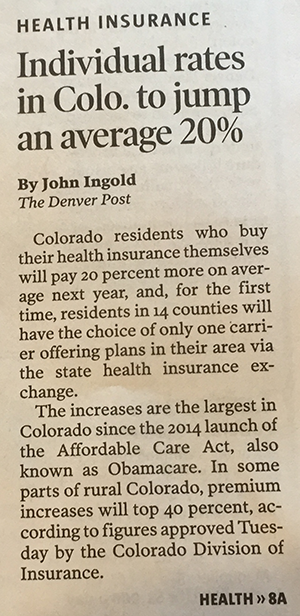
Nothing but Obamascare on the Denver Post's front page today.
Nothing but Obamascare on the Denver Post’s front page.

Headlines across the state are blaring an alarming message today about large increases in health insurance premiums for Colorado proposed for next year–and as we’ve seen repeatedly now after premium hikes became political with the passage of the Affordable Care Act, a.k.a “Obamacare,” factual reporting is taking a back seat to sensationalism.

AP via CBS4 is a good example:

Coloradans shopping for health insurance will see double-digit rate hikes next year, a result of insurers leaving the market and cutting plans.

The lack of any qualifiers in that sentence is enough to grab the attention of…well, everyone who pays for health insurance in Colorado–individuals, businesses, everybody. And it shouldn’t be necessary to remind our readers that the political opponents of Obamacare have no interest in clarifying. Today’s Denver Post story from reporter John Ingold, titled “Individual rates in Colo. to jump an average 20%,” does little to clear up the confusion:

The finalized numbers confirm the worries that began in June when the steep increases were first proposed. In a speech on the floor of the U.S. Senate on Tuesday, Colorado Sen. Cory Gardner, a Republican, blamed the increases on President Barack Obama’s signature health care law, which led to the creation of the exchanges.

“The people of Colorado can’t afford Obamacare,” Gardner said. “Obamacare can’t keep its promises.”

Marguerite Salazar, Colorado’s insurance commissioner, said the increases are the result of rising health care costs overall. The increases for people who buy their plans on the state’s Obamacare exchange and those who buy insurance off of it will be roughly the same. [Pols emphasis]

That last statement, like the lede in the AP wire story most people are reading today, is extremely misleading with context. Without a expert’s understanding of the subject of health insurance, these news reports could easily lead ordinary citizens to believe that the cost of all health insurance in Colorado is dramatically spiking.

But turning to the Grand Junction Sentinel’s Charles Ashby, we finally see a story that doesn’t try to sensationalize first and explain later:

Health insurance premiums on Colorado’s individual market for 2017 will be about 20 percent higher than those from this year, but not everyone will have to pay so much. [Pols emphasis]

Wait, what? Didn’t you just read from the Associated Press that “Coloradans shopping for health insurance will see double-digit rate hikes next year?” As Ashby reports to his small media market, that’s not the whole story. Not even close:

That large increase applies only to individuals who get their insurance through the state’s health care exchange — known as Connect For Health Colorado — who don’t qualify for federal tax credits, according to the Colorado Division of Insurance. [Pols emphasis]

Those who are qualified for credits and continue to have the same or cheaper plan as this year could see an average decrease in rates of about 11 percent to 29 percent, while others on the exchange can minimize their increase to about 13 percent by switching to a lower cost plan, the division said.

Meanwhile, the average person on employer-sponsored plans, which make up about 51 percent of all insured Coloradans, all will see an increase of about 2.1 percent, said Marguerite Salazar, Colorado’s insurance commissioner.

In truth, the “average 20% increase” only applies to individual plans sold via the state’s insurance exchange–less than 8% of Colorado’s population according to the Colorado Health Foundation. What’s more, 85% 62% (see above) of individual policyholders through the insurance exchange receive federal tax credits to ease the burden–so much so that most of them will in fact see a decrease, not an increase, in their premiums. For the majority of Coloradans who get their insurance through their employer, that 2.1% increase you see buried in these stories–even though it applies to vastly more people–is considerably less alarming.

So with all of this in mind, what the hell is (almost) every media outlet in the state doing misinforming the public like this? This kind of grossly misleading sensationalism in journalism is never okay–and just weeks from a major election, it’s a serious problem.

Obamacare’s enemies have flooded the debate with preposterous lies from the moment the law was introduced in Congress. This is another opportunity to ask our friends in the fourth estate to please stop helping them.

Comments

Recent Comments


Posts about

Donald Trump
SEE MORE

Posts about

Rep. Lauren Boebert
SEE MORE

Posts about

Rep. Gabe Evans
SEE MORE

Posts about

Colorado House
SEE MORE

Posts about

Colorado Senate
SEE MORE

61 readers online now

Newsletter

Subscribe to our monthly newsletter to stay in the loop with regular updates!