Excellent story today from the Durango Herald's Joe Hanel on the introduction of the comprehensive election modernization bill from Democrats, set to be introduced this week in the Colorado Senate:
Even before it has been introduced, the bill has touched off a partisan fight.
But La Plata County Clerk Tiffany Lee Parker, a Republican, supports the bill and says it’s not a partisan issue.
“To me, this is really bipartisan. This makes sense. This is not Republican versus Democrat,” Parker said. [Pols emphasis]
La Plata County's Republican Clerk Tiffany Parker is not alone in supporting this bill from the right as a practical measure to make it easier to vote in Colorado. As Hanel reports, much of the bill was initiated by the Colorado County Clerks Association, and much of the bill is very much uncontroversial–with the exception of legislative Republicans and Colorado Secretary of State Scott Gessler.
The divide between Gessler and the county clerks, who have never enjoyed particularly good relations, seems wider now than ever before as this bill comes up for debate. As we noted yesterday, Gessler is upset that he was not consulted though the county clerks were–in the Colorado Statesman story we cited:
“How the hell can they rewrite the state election code in such as way that it excludes half of the entire legislature, the people who have expertise from a secretary of state’s standpoint?” he asked. “These people are just crazy. They have no interest in creating a good system. They are interested in shoving through an agenda.”
The truth is, Secretary of State Gessler has not been considered an honest player in Colorado's election system for quite a while–and this is a feeling held by county clerks on both sides of the aisle. It's important to remember that in the last two years, Gessler has done more to menace Colorado elections than constructively work to improve them. At some point, unproductive viewpoints just don't help the process, and they get excluded.
The biggest bone of contention in the bill, by far, is the provision allowing voters to register all the way through Election Day. In much the same manner as the recent gun safety legislation debate, Republicans insist that this would have disastrous consequences–instead of "banning gun ownership," the story this time, as Hanel continues:
Same-day registration opens the door to voter fraud, said Colorado Republican Committee Chairman Ryan Call.
“This is nothing more than a partisan power-grab by Democrats, taken at the expense of integrity in our elections,” Call said in a news release. “The last thing Coloradans want is the legitimacy of our elections cast into doubt because of the serious potential for voter fraud.”
And much like the gun debate, your next reasonable question is, "what's your evidence for that?"

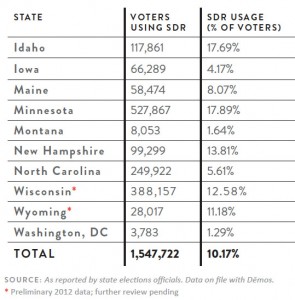
This is probably where the rational argument will end, because as with the gun debate, there is no evidence to support the charge being made. Colorado is not the first state to propose allowing registration up through Election Day, just as we weren't the first state to limit magazines or require background checks. Eleven other states and the District of Columbia, including our neighbors Wyoming, Idaho, and Montana all have this law on the books.
And folks, did you hear about voter fraud scandals in Wyoming last year? Uh, no.
However, in Wyoming in 2012, according to preliminary data (see chart right) some 28,000 voters–11% of the vote in that state–used Election Day registration. And that's on the low side compared to a number of other states.
Is GOP Chairman Ryan Call alleging these were fraudulent votes in Wyoming last year? Or for that matter, any of these states? Half a million votes in Minnesota? That would be one hell of a scandal, wouldn't it?
Bottom line: the principal argument against the most "controversial" provision in this bill, that allowing registration to vote up through Election Day would have "serious potential for voter fraud," is not backed up by the facts–proven now that it has been successfully implemented in other states. What this bill will do, based on experience in other states, is significantly increase voter turnout.
When you cut through the bluster from opponents with these facts, you begin to understand that increasing voter turnout, this goal you would think every American would hold sacrosanct, is what they really oppose.
We have to believe that if reporters ask honest questions, this is going to become painfully obvious.
Subscribe to our monthly newsletter to stay in the loop with regular updates!
Comments