Roughly 10 percent of Colorado households DO NOT currently have access to high-speed internet services. Fortunately, help is on the way.
According to a press release from the office of Gov. Jared Polis, Colorado will soon be on the receiving end of more than $826 million dollars (and 41 cents) in federal money that will be used to build out high-speed internet infrastructure in parts of Colorado where people are still listening to that awful dial-up modem sound:
Today, Colorado U.S. Senators Michael Bennet and John Hickenlooper and Colorado Governor Jared Polis welcomed the announcement from the National Telecommunications and Information Administration (NTIA) that Colorado was awarded $826,522,650.41 from the Bipartisan Infrastructure Law’s Broadband Equity, Access, and Deployment (BEAD) program. The BEAD program is the largest broadband investment in American history, and provides funding to build essential infrastructure and connect communities to high-speed internet. The program is based on Bennet’s bipartisan BRIDGE Act, which was incorporated into the Bipartisan Infrastructure Law…
…The BEAD program provides $42.45 billion to expand high-speed internet access by funding planning, infrastructure deployment, and adoption programs in all 50 states and territories. The program prioritizes unserved and underserved locations that have no or very slow internet access. In Colorado, 10 percent of locations are unserved or underserved, and 190,850 households lack access to the internet. For the most up-to-date information, please visit the Colorado Broadband Mapping Hub.
The BEAD program is based on the bipartisan BRIDGE Act that Bennet introduced in June 2021 to provide $40 billion in flexible broadband funding to states, Tribal governments, U.S. territories, and the District of Columbia to ensure all Americans have access to affordable high-speed internet.
Because we’re talking about a program created through legislation in Congress, there are a lot of acronyms — NTIA, BRIDGE, BEAD — to wade through in order to understand how and why this funding is coming to Colorado. But the short version, and really the only part you need to know, is this: You can thank the Infrastructure, Investment, and Jobs Act signed into law by President Biden in November 2021.

According to an issue brief from Pew Charitable Trusts:
Among many other provisions, the law established the Broadband Equity, Access, and Deployment (BEAD) Program, the federal government’s most ambitious investment in high-speed, affordable internet to date. BEAD dedicates more than $42 billion to construct broadband networks, establish subsidies to offset the cost of internet service for lower-income households, and create programs to provide end users with the devices and training they need to use the new and upgraded networks. The BEAD Program also marks the first time the federal government is providing grants to states specifically for these purposes.

The Infrastructure, Investment, and Jobs Act was supported by all Democratic members of Colorado’s Congressional delegation (remember, these votes took place in 2021; current Reps. Brittany Pettersen and Yadira Caraveo were not in Congress at the time). All three Republicans in Colorado’s delegation — Reps. Lauren Boebert, Ken Buck, and Doug Lamborn — voted NO on the Infrastructure Act.
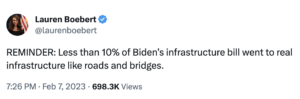
Boebert regularly voiced strong opposition to the Infrastructure Act, despite later trying to get federal funding for a bridge project in Glenwood Springs. It’s important to acknowledge all of this, since Boebert has a nasty habit of later trying to take credit for things that she opposed in Congress. Boebert’s penchant for pretending to deliver federal pork to her constituents in CO-03 even recently drew the public ire of the normally mild-mannered Sen. John Hickenlooper.
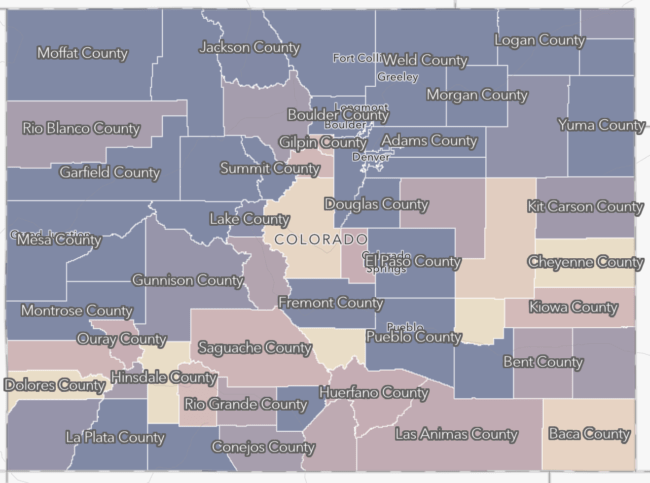
The odds are pretty good that Boebert will soon be pretending that she somehow helped bring the internet tubes to her aggravated constituents. She did nothing of the sort, though she probably SHOULD have supported the bill (along with her Republican colleagues Buck and Lamborn). As you can see from the map below, the parts of Colorado most in need of high-speed internet access also tend to be represented by the very same Republicans who make little to no effort to bring federal money for important projects back to Colorado.

Boebert, Buck, and Lamborn should instead have to explain to Coloradans why they stood in the way of needed infrastructure improvements — including high-speed internet access (although, to be fair, it’s not at all clear that Lamborn even knows about the internet). In the meantime, Coloradans can be thankful that elected Democrats continue to work on their behalf regardless.
Subscribe to our monthly newsletter to stay in the loop with regular updates!
Comments