
If you were paying attention to Colorado politics over the weekend, you might have noticed a lot of people running around like they were on fire.
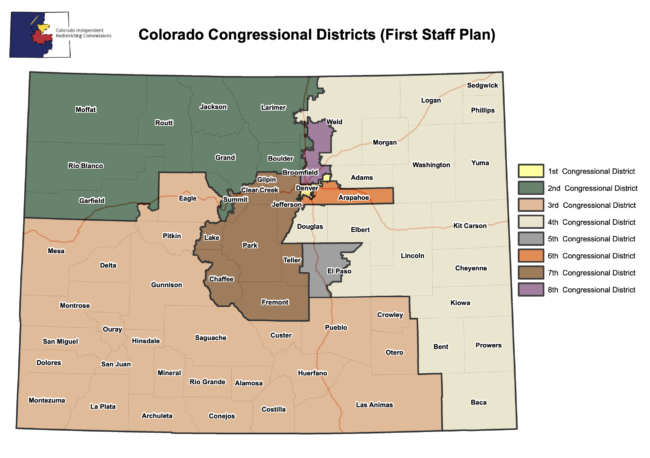
On Friday, Colorado’s Independent Congressional Redistricting Commission released a new proposed map of Colorado’s eight Congressional districts (officially called “First Staff Plan”). As Thy Vo and Sandra Fish report for The Colorado Sun today, there is much wringing of hands and discussions of viewpoints considering some pretty significant new district lines being proposed:
The dozen members of Colorado’s Independent Congressional Redistricting Commission questioned nonpartisan staff Monday about the latest draft map of the state’s U.S. House districts as they prepare to hear from the public about the plan this week.
The map, introduced Friday based on 2020 census data and which has thrown Colorado’s political world into a tizzy, is markedly different from an initial proposal based on 2019 population estimates.
Before we go any further, we should point out that the map introduced on Friday is not necessarily the map that will determine Congressional boundaries for 2022. The Redistricting Commission will hold four public hearings this week for comment on the First Staff Plan (FSP) Map, which can be confirmed with a ‘YES’ vote from 8 of the 12 Commission members. If this map is NOT approved, the nonpartisan redistricting staff can present as many as two additional proposals before the Sept. 28 deadline to finalize redistricting boundaries.
But if the “FSP Map” ends up being close to a final version of what we can expect for the next decade, then there is plenty to talk about. Here’s what that map looks like (CLICK HERE for a bigger version):

The biggest news is that the FSP Map basically draws Rep. Joe Neguse (D-Boulderish) and Rep. Lauren “Q*Bert” Boebert (R-ifle) into the same Congressional district (known here as CO-02). Much of Neguse’s former district gets split up into CO-04 and CO-08, while Boebert’s current district (CO-03) moves a little south from her residence in Rifle, Colorado. Neguse’s campaign took quick note of the new potential matchup:
So, if the redistricting map released tonight holds, looks like I may be running for re-election against . . . Lauren Boebert.
Join our team today ⬇️⬇️⬇️https://t.co/TIjQZdYNDo
— Joe Neguse (@JoeNeguse) September 3, 2021
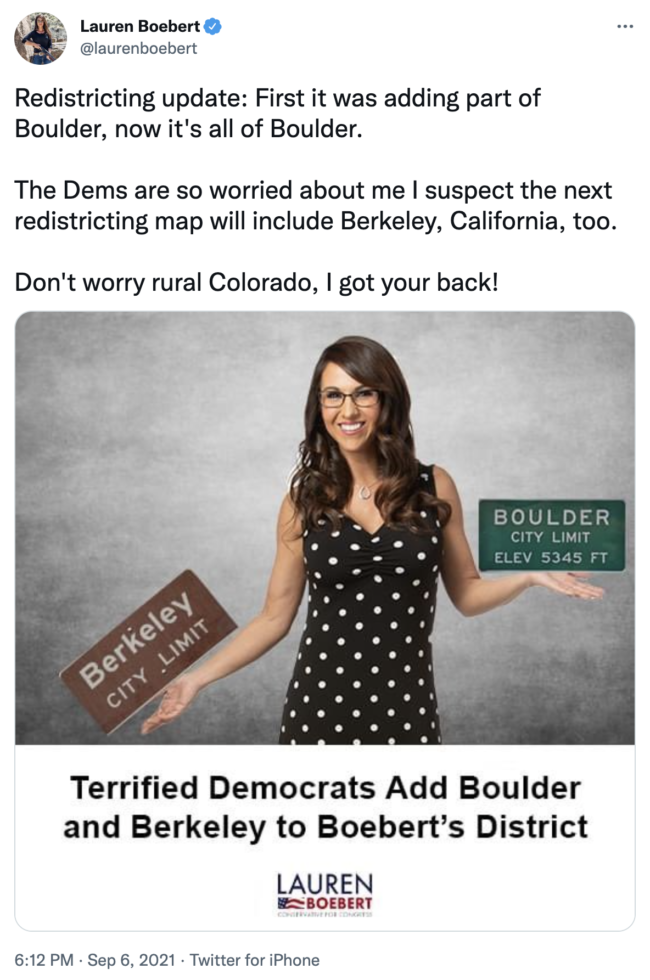
Lauren Boebert, meanwhile, was less enthusiastic about the proposed changes. At roughly the same time on Friday that the Redistricting Commission staff were presenting the new proposed map to the Redistricting Commissioners, Boebert was Tweeting out a completely false accusation against the Commission Staff:

Despite what Boebert says, Democrats did not draw this new map. Furthermore, the nonpartisan staff that are responsible for creating the new map is under specific instructions to NOT consider incumbent residency in their proposals.
This is a good time to remind you that Members of Congress DO NOT need to actually live within the boundaries of the district they represent. The chances are probably pretty good that Boebert would just run in CO-03 instead of challenging Neguse in a district with a slight Democratic lean in terms of registered voters. Congressman Ken Buck (R-Greeley) would have a similar dilemma, since he resides in what would now be called CO-08 — outside of the boundaries of the more familiar CO-04.
State Republican Party Chairperson Kristi Burton Brown (a former staffer on Boebert’s 2020 Congressional campaign) also went after the nonpartisan redistricting staff. From The Colorado Sun:
Brown on Sunday emailed members of the party to urge them to comment on the new map.
“Unfortunately, the commissioners chose to put the interests of the urban Front Range first by diluting the voice of rural Colorado and completely changed the map from the first preliminary Congressional maps,” she wrote. [Pols emphasis]
Of course, the majority of Coloradans just so happen to live along the Front Range. It’s not a conspiracy; it’s just math.
As FiveThirtyEight notes in an examination of the new map proposal, three of the districts would have a Republican lean; three would tilt toward Democrats; and two districts would be toss-up battles:
While the map has two highly competitive seats and assuages the concerns of Hispanic interest groups by making the 8th District 34 percent Hispanic by voting-age population, it has also drawn some criticism for unifying southern Colorado and northern Colorado into one district each (the old congressional map was more oriented in an east-west direction)…
…The map is also unlikely to satisfy Democrats who feel that they deserve more than three safe seats in a state that is trending in their direction.
It’s anyone’s guess as to how the FSP Map might be changed before final approval, but the numbers don’t allow for unlimited options. Combining southern Colorado and northern Colorado, for example, might be tough to avoid simply because there aren’t any big population centers in either area. It’s also tough to create too many competitive seats in a state where Democrats have trounced Republicans in the last two elections, with statewide top-ticket candidates winning by an average margin of 10 points.
Additional proposed maps from the redistricting staff could be presented on Sept. 15 and (if necessary) Sept. 23, but any final decisions are going to be unpopular with somebody. As Redistricting Commissioner Bill Leone, a Republican from Westminster, told The Colorado Sun, “We’re learning every map has some strengths and some weaknesses, there are trade offs with every map.”
Subscribe to our monthly newsletter to stay in the loop with regular updates!
Comments