

 August 08, 2016 10:49 AM UTC

Aerial view of VA Replacement Hospital 10/2015 – 50% completed after 11 years and $1 Billion
The “old” VA hospital on 10th and Clermont, where Joe has gone for 25 years and where they know him well, no longer has an emergency room for psychiatric triage, and they only have 20 beds in their psychiatric wing. So the VA farms “psych emergency” patients out to several area hospitals. Where he’ll end up, nobody knows.
Wherever the ambulance takes him, the new hospital won’t have his medical history. They won’t know what meds he’s supposed to be taking or how long he’s taken them. They won’t know what works and doesn’t work with this particular disabled veteran. So they will trank him up and warehouse him for a few days or a week, and then send him back home. This is how the VA treats those with “mental health injuries” while awaiting opening of the shiny new VA hospital.
What Joe needs, says his case manager, the social worker, and his doctors, is a residential treatment center that specializes in long term psychiatric needs of veterans. The VA had plans for such a facility, as part of the new and improved Denver VA Medical Center. The Veterans Administration has been designing and building a new “Replacement Hospital” for 12 years. The cost of this facility has gone from $328 million to its current 1.73 billion price tag – and that may not be the final cost, and doesn’t include the psychiatric rehabilitation wing that Joe needs, nor will it have room to accommodate the outpatient caseload expected when it is slated to finally be completed 1/23/2018.
Psychiatric Needs of Veterans
Aging vets like Joe are not even the largest population needing a psychiatric rehabilitation facility, or at least consistent, reliable, veteran-specific mental health care now. According to the National Veterans Foundation, citing the RAND Center for Military Health Policy Research,
20% of the vets who served in either Iraq or Afghanistan suffer from either major depression or post-traumatic stress disorder. 19.5% of vets in these two categories have experienced a traumatic brain injury. These three service related disorders alone have an enormous impact on the demand for veteran mental health treatment.
Roughly half of those who need treatment for these conditions seek it, but only slightly more than half who receive treatment get minimally adequate care.
As the United States continues to expand wars in the Middle East and across the globe, more and more young veterans are surviving injuries that would have been fatal in earlier wars – and they are surviving with traumatic brain injuries, missing limbs, PTSD and other “mental health injuries” that result in unprecedented, and shameful, rates of suicide among young veterans. Twenty two veterans, on average, take their own lives every day.

Medevac Airlift from Iraq to Germany, 2007 – Wikimedia Commons
So there is an urgent and growing need for a psychiatric rehabilitation center, to help veterans recover from PTSD, TBI, depression, substance abuse, and other “mental health injuries”.
Yet Denver’s residential psychiatric center has been postponed yet again, due to a 12 year dysfunctional cluster**** of poor management and miscommunication between the VA, its main contractor, Kiewit-Turner, and Congress, including Representative Mike Coffman.
History of the “Biggest Construction Failure”
The United States is not known for taking care of its veterans. Since the earliest days of our country, before the VA existed, politicians have publicly praised soldiers as heroes, while neglecting or outright stealing from these “heroes” after the wars are over. Yet Denver’s VA Medical Center Replacement Hospital seems to have set a new bar for bureaucratic incompetence, poor communication, mismanagement, and coverups of the same.
In 2004, the VA began to plan for a “shared facility” to be built for $328 million on Fitzimmons land, in conjunction with the University of Colorado Medical Center. The first major design disagreement was about whether or not to have a shared or a stand-alone facility – most of the Congressional delegation, including Coffman, Degette, and Perlmutter, wanted a shared facility, as it would be cheaper, but were persuaded to the stand-alone option, as veterans have specialized needs.
Then, the VA entered into a bizarre new contracting process with contractor Kiewit-Turner. This process, called Integrated Design and Construction, or IDC, gives the contractor a blank check, as far as I can tell. Between the contractor’s changes, and the medical center’s requests, there were more than 1400 expensive design changes. Judy Guy, the project coordinator, explained in court that the budget was not her responsibility, and nobody told her to stop asking for things. So it wasn’t too surprising that the $328 million price tag soon became $604 million in 2011, then $800 million, and now $1.73 billion in 2016.
The detailed history of the VA hospital debacle can be followed in the Sources links below. For those interested, I recommend the Post’s Matthews, Andrews, and Migoya special project: Anatomy of a Calamity, or the 2014 GAO Audit.
Mike Coffman – Mixed Record on Veteran’s Issues
The VA Replacement hospital was in trouble long before Mike Coffman inherited it in his redrawn House District 6 in 2012. At that point, the new hospital had been in the design process for eight years, and had doubled in cost. However, the issues with the VA project and military hospitals in general had long been familiar to Coffman – elected to the House in 2008, he began serving on the Armed Services Committee, starting when the 112th Congress was seated in 2011. He was a member of the ASC’s subcommittee on Military Personnel, which had jurisdiction over military health care, and held hearings about it. Coffman is still a member of this subcommittee. However, there is no record of Coffman attending the 2009 hearing on the VA hospital construction.
So, in 2011, when the VA made an impossible-to-keep agreement with Kiewit-Turner to build the hospital for $604 million, Mike Coffman was on a committee with jurisdiction over military health care, and could have at least questioned the feasibility of that contract. However, Coffman did not begin speaking out about the issue until 2013. Democrat Ed Perlmutter, in whose district the hospital was until the 2012 redistricting , was very outspoken, and is “universally hailed” as the driving force behind the project, and with restarting the stalled project. But Coffman was silent.
Scolding, Showboating, Partisan Posturing
Then, in 2013, Mike Coffman became the Chair of the Oversight and Investigations Subcommittee of the Veteran’s Affairs Committee, where he had responsibility to “conduct hearings, site visits, and investigations nationwide.” The new VA hospital was in his redrawn district – and his district was much more Democratic than it had been before. Mike Coffman began speaking out about the hospital, holding hearings, sponsoring legislation.
However, most of Coffman’s public statements were over-the-top partisan posturing, meant to bolster his reputation as a tough-talking Marine rather than to bring people together to complete a desperately needed hospital project. His policy proposals seem to be furthering a Republican anti-union, anti government agenda more than helping veterans, as well. For example:
- He has sponsored legislation calling for all VA employee bonuses to be frozen – not just those of the officials responsible for the mess.
- He has accused specific officials of corruption, and called for criminal investigations.
- He co-sponsored HR1994, which ends due process for all VA employees
- He has called for the resignation of VA Chief Shinsecki, and that of hospital director Lynette Roth, and for firing two VA directors.
- And, although Coffman says that he is not for privatization of the VA, he did support funding of the $10 billion “Choice Card” boondoggle, which is not well understood nor utilized by veterans, but which leaves the door open for privatization. (As a Colorado State legislator, Coffman sponsored HB92-1001 to privatize government services)
- Coffman sponsored an amendment to the 2011 DoD budget to study the effects of cutting tuition assistance to veterans and their families. Ultimately, tuition benefits were cut by 25%.
- Coffman’s vote for the 2013 government shutdown hurt veterans and their families; benefits were cut or delayed, government employees were furloughed, and many never recovered.
- Coffman voted against increased VA funding in 2009 and 2011. This impacted care for thousands of veterans worldwide.
These are just some of the reasons Representative Coffman only has a grade of “C” from the Iraq and Afghanistan Veterans of America (IAVA) , the largest, youngest, most diverse and most modern veteran’s organization in the US. (For comparison, Udall & Bennet have B’s). IAVA has some policy recommendations for veteran mental health care, and specify that vets should have consistent and reliable access to care – not exactly the situation in the Denver region now.
Coffman’s Achievements for Veterans
Mike Coffman has done some good things that actually help veterans and their families.
- He sponsored the Fairness for Veterans Act to promote better access to mental health services, including for PTSD.
- He has co-sponsored bipartisan legislation, the Helping Families in Mental Health Crisis Act. HR2646 which would coordinate the patchwork of mental health agencies, and hopefully, make it easier to get help. However, if Coffman were to be successful in defunding Obamacare, which he has voted to do at least 46 times, HR2646 would not help anyone.
- His legislation to reform the VA contracting process and to put the Army Corps of Engineers in charge of finishing the hospital construction is a positive step – I’d have to agree with Coffman that the VA has shown that it sucks at the hospital building business, and that they should stick to taking care of veterans.
However, putting the Army Corp of Engineers (USACE) in charge hasn’t necessarily solved the problem, nor will it guarantee an early 2018 completion date for the hospital –
But Col. John Henderson, commander of the Corps’ Omaha, Nebraska, district — which includes Denver — said it’s too soon to know whether the builders can finish for less than the nearly $1.7 billion contract cost because some other expenses are rising.
“It would be creating a false expectation,” Henderson said while leading Republican U.S. Rep. Mike Coffman and others on a tour of the suburban Aurora site. Coffman’s district includes the hospital.
USACE itself is not free of controversies – think Katrina levees, wetlands management, construction of the Dakota pipeline from North Dakota oilfields to markets in Chicago.
Mike Coffman should take credit for the modest gains he has made, and stop trying to undermine veteran’s benefits and bust government employee unions. He should stop trying to score partisan points by beating up on VA employees.
When the Replacement Medical Center is finished, hopefully in 2018, it will be a beautiful showplace of a facility, no doubt – energy efficient, with an energy center which monitors use and solar panels, with daylighting from the long concourse, which will also allow people in wheelchairs to easily access the different buildings. But it didn’t need to take 14 years. And it will still not have a long term psychiatric rehabilitation facility that would help people like Joe R. He, like the young Gulf War veterans with traumatic brain injuries requiring extensive rehabilitation, will have to keep on waiting.
Sources:
History of VA Hospital Construction Project:”Anatomy of a Calamity” Denver Post Special
Rep. Coffman’s Public Statements about VA Hospital Construction
VA hospital project site with virtual tour: http://www.denvervahospital.com/
Iraq and Afghanistan Veterans of America (IAVA) Survey of Post 9-11 veterans
Timeline:
2004: Process of evaluating and planning for a new VA hospital begins.
7/2008 Perlmutter and Salazar receive the planning documents for a stand-alone hospital.
1/2009 Mike Coffman takes office as representative for CD6.
1/2011 Mike Coffman begins serving on the Armed Services Committee: Subcommittee: Military Personnel: Responsibility: Military Health Care
11/2011 Kiewit Turner and the VA agree in writing to build the new hospital for $604 million.
2/2014 Coffman introduces legislation to put Army Corps of Engineers in charge to resolve contract disputes and get the project moving.
1/2015 Government Accountability Office (GAO) report issued on VA hospital cost overruns. See screenshot from page 3 here.
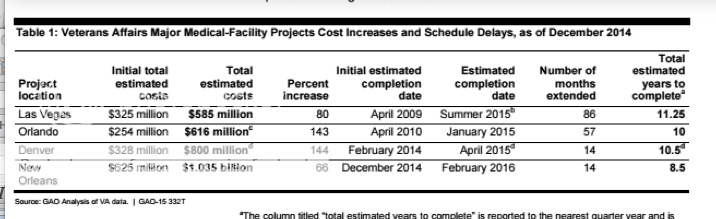
GAO Comparisons of VA Hospital time and money overruns
3/2015 Coffman introduces H.R. 1681: VA Construction, Accountability, and Reform Act to put Army Corps of Engineers in charge of finishing VA hospital, “take the VA out of the hospital building business”.
4/2015 Coffman visits site, has press conference, accuses VA of corruption
5/2015 Marshall Zelinger, 7 News report on whistleblower allegations of waste and fraud
5/2015 Aurora Sentinel (Biz): details of contract disputes and litigation between contractor Kiewit – Turner, VA, and Coffman’s appt of emergency manager from Army Corps of Engineers
5/2015 Stopgap construction bill passed to fund project for three months. Revised cost of project: $900 million
6/2015 – 9/2015 Coffman’s $150 million, 3 month extension of construction funding passes House
10/2015 Army Corps of Engineers awards final construction contract for $570M to Kiewit Turner. Price tag to finish the facility is now at $1.67 Billion
2/2016 Kiewit Turner and USACE met for progress reports. 60% completed.
2/2016 US Army Corps of Engineers, Omaha District receives “excellence in contracting” award for getting Kiewit Turner to commit to a contract
4/2016 Coffman letter to Inspector General calling for criminal investigations around the VA hospital delays and cost overruns.
5/2016 VA says that the psychiatric rehabilitation center was not included in the design, and will necessitate an extra building.
6/2016 Coffman statement: VA Sloan Gibson won’t release GAI report, but Army Corps of Engineers is in charge now, so overruns and construction are all on track, says Coffman. 75% completed. Cost $1.73 billion, not including residential psych facility.
6/2016 Military Times article details Army Corps Manager’s cost cutting measures on design
Updated 7/2016 VA Deputy Secretary Sloan Gibson says VA hospital now “70% complete”
7/2016 Slideshow and overview of project, Aurora Sentinel Biz Journal
*a psuedonym – but “Joe R” is a real person – my ex-husband, a 100% disabled Vietnam vet. I wrote to Coffman’s office with questions for this article, and also specific questions regarding “Joe R”‘s care – I have not yet heard back on any of my questions.
Comments