We interrupt our normal coverage of Colorado politics to notify our readers of something of…well, at least some importance, brought to our attention about a conservative blog that has been operating in our state for several years. Colorado Peak Politics has received occasional press attention as a source of Republican-leaning opinion and blog scuttlebutt, and has more or less replaced a hodge podge of GOP-leaning blog properties that have come and gone through the election cycles. Face the State, the People's Press Collective, and others you may have heard of previously occupied a niche now pretty much the exclusive domain of Peak Politics.
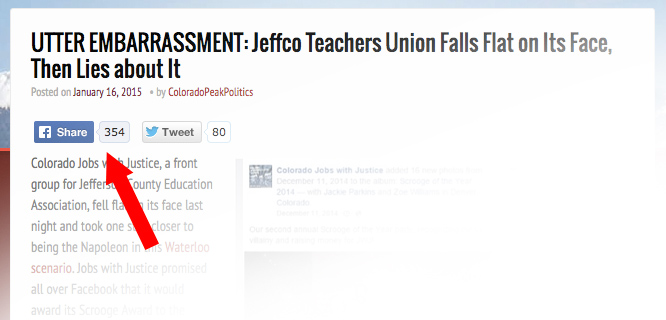
Peak Politics represents itself as highly influential, frequently comparing its influence to that of this blog, and sometimes even suggesting that they have "surpassed" us as the leading blog in Colorado politics. Now, we have no interest in getting into some kind of pissing match with other blogs, so we haven't seen any reason to engage these claims. But we'll admit that we have been impressed by some of the visible statistics for social media sharing on Peak Politics. For example, they recently posted an item about the Jefferson County school board drama that looks like it had a lot of Facebook shares.
For a blog focused on Colorado politics, from our experience this would be a pretty solid indicator of social media "virality." Extrapolating the number of people who would have viewed all of these supposed shared instances, that number certainly indicates a respectable total readership for this blog post.
The only problem is, that number is fake.
We were directed this past weekend to a Facebook developer resource tool. This tool returns a simple text response via the Facebook "Application Program Interface" (API) to queries about any given URL on the web. Facebook, as you can expect, keeps very good track of the number of times a web page is shared within their system. In your browser address window, you can enter https://graph.facebook.com/?id=, then paste any URL on the web into the space after ?id=. Facebook will return a text page with the number of Facebook shares and comments to this URL.
Following this procedure for the URL for the above Colorado Peak Politics post reveals that it has been shared a total of 61 times on Facebook–about 17% of the number publicly indicated on their website. To be as generous as we can, we'll admit that the correct count of 61 isn't horrible either–but it is a small fraction of the total number they claim.
Once we started running other Colorado Peak Politics blog posts through this Facebook API checker, we found what appears to be systematic inflation of their indicated number of Facebook shares. A post yesterday attacking local Democratic consultant Laura Chapin shows 67 Facebook shares as of this writing. The Facebook API says it has only been shared four times. Another post about Gov. John Hickenlooper's State of the State address claims 24 Facebook shares, Facebook itself says there were exactly two. To varying degrees that we haven't found a pattern to explain, basically every single blog post on Colorado Peak Politics has been misrepresented in this way.
Sources tell us that what they are doing may not be technically complicated. Because they are using a third-party "share button" application, it may be as simple as the share buttons recording clicks for "shares" that are never completed through the API for Facebook–or Twitter, presumably, since the Tweet counts for their pages show similar signs of inflation. The best theory we have been given, in short, is that somebody associated with Colorado Peak Politics is clicking on the share buttons for their posts repeatedly to inflate their displayed count. No matter what the excuse is, we have been assured that the share count returned by Facebook directly via this query is correct.
Bottom line: in over a decade of operation, we've been able to interact constructively with local conservative blogs, middle-road blogs, and liberal blogs alike. We consider an influential and diverse blogosphere to be a critical piece of the total range of news and opinion available to voters and citizens.
But being dishonest about that influence doesn't help anyone. So let's please cut that out.
Subscribe to our monthly newsletter to stay in the loop with regular updates!
Comments