As the Colorado Independent's John Tomasic reports, food for thought as the debate over "fracking" near Colorado's populated areas goes on:
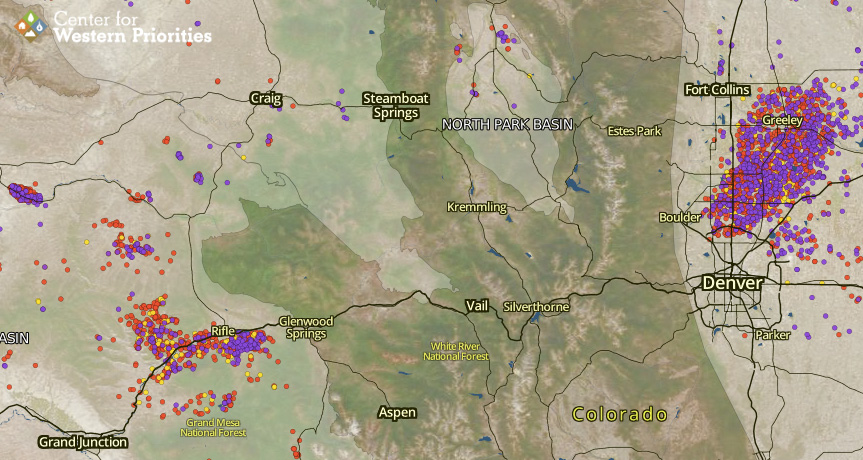
The energy and environment research Center for Western Priorities this week released a map of oil-industry spills that have occurred in Colorado over the past 13 years. It’s a colorful map but it’s not very pretty.
The map is built on information compiled by the state’s Oil and Gas Conservation Commission and it’s dotted with 4,900 Colorado spill sites, which the group says amount to tens of millions of gallons of oil, drilling fluid and other toxic waste. The main sites of the spills come in the four corners of a square that runs between Grand Junction, Durango, Trinidad and Greeley. The vast majority of the spills come in the northern front range, in an area extending southwest from Greeley between Fort Collins, Boulder, Broomfield, Longmont and Lafayette. Those are the five cities that have drawn lawsuits from the industry and the state for voting over the last two years in support of municipal bans and moratoriums on hydraulic fracturing — the extraction technique where drillers blast millions of gallons of mixed sand, water and chemicals deep into underground rock formations to crack open fissures and release oil and gas.
At its related “Colorado Toxic Release Tracker,” the Center for Western Priorities reports that, since the beginning of the year, drillers reported 156 spills in the state. They reported 44 spills in March. So far, 6 percent of spills this year were reported to have contaminated water. Eighty-four spills occurred within 1,000 feet of surface water. Forty-two spills have occurred less than 50 feet from groundwater.
Looking casually at this sobering interactive map, it becomes really obvious why two of the northern Front Range's "L-Towns"–Lafayette and Longmont, along with Boulder, Broomfield and Fort Collins–have banned or passed moratoria on fracking within their boundaries. Fracking causes more problems than just surface spills, and spills aren't always directly related to the fracking process, but this map vividly illustrates the dirty, accident-prone industrial process going on every day in Colorado–in many cases just across the street or field from neighborhoods.
If you look at this report and still can't understand why local communities are tired of state regulators' outright contempt for their concerns, which has led to the "crisis" of ballot measures to give local communities real power to regulate oil and gas drilling, we respectfully submit that you are the one with the problem. Fracking isn't just an environmentally worrisome process of drilling, it's the fact that it brings drilling to places it hasn't been before–with all of drilling's attendant nastiness like surface spills and air pollution.
And as you can see, the industry's track record where they drill now isn't very good.
Subscribe to our monthly newsletter to stay in the loop with regular updates!
Comments