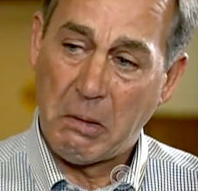
The House has passed a "clean" extension of the debt limit.
Twenty-eight Republicans joined all but two Democrats to approve the extension of the debt limit until March 2015 — without any additional legislative wish list items attached…
…Republicans had wanted to attach some kind of policy provision to the must-pass legislation. Members suggested including measures like approving the Keystone XL pipeline or repealing part of the Affordable Care Act, but leaders were unable to secure enough votes for those add-ons to ensure passage. The White House also insisted it would not pay “ransom” for the extension, a position that Obama successfully held during last year’s government shutdown.
Ultimately, House Speaker John Boehner brought a “clean” debt limit extension for a vote, a move that incensed many conservatives who wanted to extract some kind of concession from the White House.
Prior to the vote, our friends at "The Fix" wrote about the Greek tragedy that has become Speaker Boehner's legacy, suggesting that Boehner "quit" on the debt ceiling bill because he couldn't reach a deal with the many different factions of his Caucus:
House Speaker John Boehner summed up his speakership during a press conference Tuesday morning: “We don’t have 218 votes. When you don’t have 218 votes, you have nothing.”
Boehner was talking specifically about his failed attempts to cobble together a deal that would have allowed the Republican House majority to support an increase in the debt ceiling. Over the past 10 days, he had tried to lure tea party conservatives to vote "yes" by putting approval of the Keystone XL pipeline, elimination of risk corridors in the Affordable Care Act and, finally, restoring the cost of living adjustment for members of the military on the table. Nothing worked. The simple fact is that there was no proposal that Boehner and his leadership team could think up that could overcome the fact that 30-40 Republicans wouldn't vote for any debt ceiling increase.
And so, Boehner gave up. "Let his party give him the debt ceiling he wants," Boehner said of President Obama. (Boehner's work is far from finished, of course. He will still need to deliver at least 17 Republican votes — if all 199 Democrats vote for their clean increase. And that's far from a sure thing.)
We've seen this movie before. From the fiscal cliff to the farm bill to the government shutdown — and at several points in between — the narrative arc just keeps repeating itself: A controversial deadline looms, Boehner and the GOP leadership try like hell to avert it through a series of offers to the tea party wing of the conference, those offers are rejected, and Boehner is left throwing up his hands and cutting a deal with Democrats.
This, as has become clear over the past year or so, is Boehner's fate as Speaker: To lead a group of Republicans who do not want to be led. And, ironically, even in the attempt to lead his conference (that is his job after all), Boehner has become further villainized by outside conservative groups.
In Boehner's defense, it is exceedingly difficult to lead a group of Republicans who not only don't want to be led, but don't know where they want to go anyway. Many conservative groups, such as the Senate Conservatives Fund, are openly calling for Boehner's ouster as Speaker, as though changing the man at the top would have any effect on changing the incompatible dynamics of the Republican caucus.
But after years of open frustration with Tea Party Republicans, perhaps Boehner is charting a new direction as leader — by no longer pretending to hide his cards. At the very least, perhaps Boehner has come to a different conclusion following last fall's government shutdown debacle. If they're not going to let him steer the ship, at least he's going to decide which iceberg to ram.
Subscribe to our monthly newsletter to stay in the loop with regular updates!
Comments