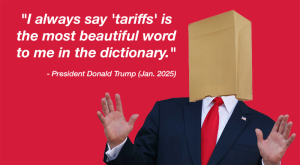
In less than eight months, President Trump has driven a strong American economy right off of a cliff thanks mostly to his unpredictable, nonsensical, and probably illegal tariff policies. Unemployment numbers are at their highest levels in more than four years — in June, the United States saw its first month of job losses since the COVID-19 pandemic — as business owners and farmers hold on for dear life. The housing market is crumbling; food prices are reaching record highs; the cost of gasoline is rising; and health insurance rates are about to increase by the largest percentage in 15 years.
But other than that, Trumponomics has been a YUGE success!
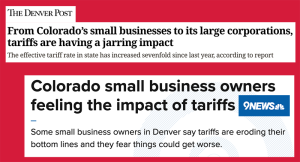
As The Denver Post reported over the weekend, Colorado businesses of all sizes are feeling the pinch:
A Thursday report from the Colorado Office of State Planning and Budgeting says the tariffs have “already increased costs across nearly every sector of Colorado’s economy” and has put fiscal pressure on an already strained state budget.
In addition, the end of a tariff exemption on small shipments is adding extra strain for small-businesses owners and creating uncertainty for consumers, making imported goods more expensive.
On July 14, Gov. Jared Polis signed an executive order requiring specific state agencies to analyze the impacts related to changes in U.S. tariff policy, requiring that the OSPB produce a report “estimating the impact of Colorado’s tariff burden.”
Under current tariffs imposed by the Trump administration as of Aug. 12, the effective tariff rate in Colorado has increased sevenfold since last year, the report said.
When put in a broader historical perspective, the Trump tariffs are even more striking:
In 2024, the estimated effective tariff rate in Colorado was 3%, and it has now increased to 21% following broad-based tariff implementation from the administration on certain nations and products.
The U.S. estimated effective tariff rate has increased from 2.6% in 2024 to 20.7%. The last time they exceeded the current effective levels was in 1910. [Pols emphasis]
As 9News notes, small businesses continue to struggle with increased costs:
Small business owners in Denver say tariffs are eating into their bottom lines and they fear the situation could get worse.
At Silk Road, a shop in Denver’s East Washington Park neighborhood, Karla Akpinar has curated an eclectic mix of items from all over the world. There are ornate ceramics, jewelry and purses.
Her store has been open for around 20 years. She has already survived a recession and a pandemic, but the tariffs have been a different kind of challenge.
“The tariffs have hit us hard,” she said. “We try to absorb it as much as we can because our customers like our prices the way they are, so we’ll just make less money to pay off our debt this Christmas.” [Pols emphasis]
Trump and his lackeys have long argued that companies in foreign countries are carrying the burden of increased costs related to tariffs, but nobody here in reality has seen this scenario actually happen. It is American business owners and American consumers who are paying higher prices on just about everything. In many cases, foreign companies have simply stopped shipping goods to the United States altogether.
Senator John Hickenlooper (D-Denver) heard a litany of tariff concerns from Western Slope business owners at a recent roundtable discussion. As Nathan Deal reports for the Grand Junction Daily Sentinel:
Tariff troubles were one of the major topics at Sen. John Hickenlooper’s roundtable with Grand Valley business owners and community leaders Friday.
The Grand Junction Business Incubator Center (BIC) hosted the roundtable, which included 15 business owners, presidents of local chambers of commerce, and officials from cities and from Mesa County…
…Katie Powell, the president of industrial goods manufacturer Munro Companies, said she understands trade inequities exist and the value of seeking the return of domestic manufacturing, but she sees the Trump administration’s approach as impractical.
“In my distribution business, we sell very foundational products, so everything from fasteners to hoses to things used everywhere. Those prices have increased significantly, so when I hear things like, ‘These tariffs won’t be inflationary,’ that is absurd. That makes no sense to me at all,” Powell said. [Pols emphasis]
Hickenlooper summarized the problem later in comments to the Sentinel:
“We had the strongest economy in the history of the world, but now for the first time in a long time, going all over the state, I’ve heard people reining in and cutting back and saying, ‘We’re going to wait.’ If everybody waits, all of a sudden, you don’t have customers. This is how you have not just recessions but depressions.” [Pols emphasis]
As you can see from new polling data provided by Magellan Strategies, Coloradans are deeply unhappy with Trump in general, but particularly when it comes to his handling of the economy:

The good news — to the extent that there is good news here — is that Coloradans aren’t confused about why the economy is heading toward a Trumpcession (Coloradans are also very unhappy with Trump’s big beautiful bullshit bill).
As the 2026 election draws near, we’ll be very interested to see how long Colorado Republicans continue to pretend that everything is fine.
Subscribe to our monthly newsletter to stay in the loop with regular updates!
Comments