U.S. Senate See Full Big Line

(D) J. Hickenlooper*

(D) Julie Gonzales

(R) Janak Joshi

80%

40%

20%

(D) Michael Bennet

(D) Phil Weiser
55%

50%↑
Att. General See Full Big Line

(D) Jena Griswold

(D) M. Dougherty

(D) Hetal Doshi

50%

40%↓

30%

Sec. of State See Full Big Line
(D) J. Danielson

(D) A. Gonzalez
50%↑

20%↓
State Treasurer See Full Big Line

(D) Jeff Bridges

(D) Brianna Titone

(R) Kevin Grantham

50%↑

40%↓

30%

CO-01 (Denver) See Full Big Line

(D) Diana DeGette*

(D) Wanda James

(D) Milat Kiros

80%

20%

10%↓

CO-02 (Boulder-ish) See Full Big Line

(D) Joe Neguse*

(R) Somebody

90%

2%

CO-03 (West & Southern CO) See Full Big Line

(R) Jeff Hurd*

(D) Alex Kelloff

(R) H. Scheppelman

60%↓

40%↓

30%↑

CO-04 (Northeast-ish Colorado) See Full Big Line

(R) Lauren Boebert*

(D) E. Laubacher

(D) Trisha Calvarese

90%

30%↑

20%

CO-05 (Colorado Springs) See Full Big Line

(R) Jeff Crank*

(D) Jessica Killin

55%↓

45%↑

CO-06 (Aurora) See Full Big Line

(D) Jason Crow*

(R) Somebody

90%

2%

CO-07 (Jefferson County) See Full Big Line

(D) B. Pettersen*

(R) Somebody

90%

2%

CO-08 (Northern Colo.) See Full Big Line

(R) Gabe Evans*

(D) Shannon Bird

(D) Manny Rutinel

45%↓

30%

30%

State Senate Majority See Full Big Line

DEMOCRATS

REPUBLICANS

80%

20%

State House Majority See Full Big Line

DEMOCRATS

REPUBLICANS

95%

5%

Generic selectors
Exact matches only
Search in title
Search in content
Post Type Selectors
August 27, 2025 01:50 PM UTC

Plugging The Big Bad Billion-Dollar Budget Hole Wasn't Easy, Fun, Or Permanent

  •  
  • by: Colorado Pols
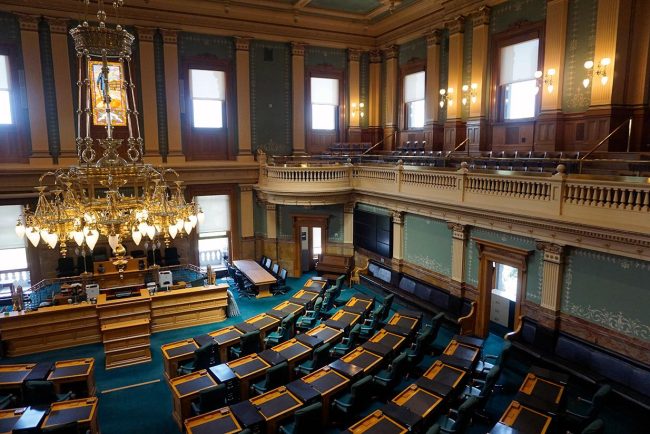
Colorado House chambers.

As Marianne Goodland reports for the Colorado Springs Gazette’s political blog, yesterday Colorado lawmakers wrapped up a special session of the Colorado General Assembly primarily focused on overcoming the usual GOP minority delay tactics, and closing the billion-dollar hole opened in the state’s formerly balanced budget by the passage of the “We’re All Going To Die” federal budget bill signed into law by President Donald Trump on July 4th.

In order to rebalance the state budget until next year, lawmakers relied on a combination of means to increase revenue, while making the politically smart decision to ask the executive branch to do the hardest part, itemizing the necessary spending reductions left over:

Five tax bills passed along party-lines in both chambers, offered by the majority Democrats in the House.

The measures are designed to raise general fund revenue to cover a portion of the shortfall. The fiscal notes said they could raise as much as $253.2 million.

But the rest is now up to Gov. Jared Polis, who will present a spending reduction plan to the Joint Budget Committee on Thursday afternoon that could cover another third of the shortfall.

To be clear, the Gov. Jared Polis already had the authority to make the spending reductions lawmakers deferred to his office to decide upon–the only difference now being that the governor has to report those plans to the Joint Budget Committee this week:

Lawmakers actually didn’t pass any legislation dealing with budget cuts.

Instead, that job now falls to the governor, something that’s already outlined in state law.

Lawmakers tweaked those statutes to require him to present a spending reduction plan to the Joint Budget Committee. That meeting will happen on Thursday.

This arrangement deprives Republicans of the means to hypocritically attack individual Democratic lawmakers over specific budget cuts, which they would otherwise do despite the fact that those cuts were made necessary by the passage of the GOP’s federal budget bill. As the troika of reporters representing the Colorado Capitol News Alliance report, lawmakers pinched off loopholes in the tax code that shouldn’t give the average voter much trouble:

To raise about $45.9 million for this fiscal year, which began July 1, Democrats nixed a tax break for wealthy owners of so-called “pass-through businesses” that would have taken effect in January.

Single filers earning more than $500,000 of profits or joint filers earning more than $1 million will not get the break…

To bring in about $44 million this fiscal year, Democrats passed a bill ending a tax break for insurance companies that have a “regional home office” in Colorado. The incentive is aimed at boosting the insurance workforce, but Democrats say some insurers that claim the credit have actually cut jobs in the state.

Democrats also passed a bill adding Hong Kong, Ireland, Liechtenstein, Netherlands and Singapore to the list of countries that corporations can’t route their revenue through without proving to the state that they aren’t shielding their earnings from taxation. That’s expected to raise about $36 million in the current fiscal year.

Liechtenstein. No longer a Colorado tax haven.

So if you’re parking money in Liechtenstein to shield your cash from Colorado taxes, you might have to pay up. But that’s not going to be a problem for most Coloradans, nor will ending a tax break for insurance companies with no value for consumers. For those of us who are more interested in the government being able to meet its basic obligations than drowning it in the bathtub, the most worrisome change made by lawmakers to balance the books this year is a provision that could cost the state big down the road:

Democrats also passed a bill that will let the state sell up to $125 million in tax credits to large companies, mainly insurance corporations, for as little as 80 cents on the dollar. That’s expected to raise $100 million for the current fiscal year.

The credits will effectively let the companies that buy them prepay their taxes through 2033 at a discount.

Again, the point of this exercise was to minimize the immediate harm and fund as much as possible of the current budget. Lawmakers are aware that future budgets are going to require substantially more cuts in order to cope with the reductions specified in the federal budget bill, but the overriding need at this point was to balance this year’s budget. Everyone understands that selling off future tax obligations to raise short-term cash is not sustainable.

What we’re looking at in the long run is another major revenue crunch not unlike what the state suffered in the early 2000s, which led to bipartisan support for a referendum in 2005 to relax the strict rules of the so-called “Taxpayer’s Bill of Rights” and allow the state to keep more of the revenue it collected as the economy recovered. The hard fiscal choices that lie ahead will once again create the conditions in which a major constitutional reform will be within the scope of mainstream debate.

Only then will we know whether the political will exists to put an end to Colorado’s self-imposed austerity for the long term.

Comments

Recent Comments


Posts about

Donald Trump
SEE MORE

Posts about

Rep. Lauren Boebert
SEE MORE

Posts about

Rep. Gabe Evans
SEE MORE

Posts about

Colorado House
SEE MORE

Posts about

Colorado Senate
SEE MORE

48 readers online now

Newsletter

Subscribe to our monthly newsletter to stay in the loop with regular updates!