U.S. Senate See Full Big Line

(D) J. Hickenlooper*

(D) Julie Gonzales

(R) Janak Joshi

80%

40%

20%

(D) Michael Bennet

(D) Phil Weiser
55%

50%↑
Att. General See Full Big Line

(D) Jena Griswold

(D) M. Dougherty

(D) Hetal Doshi

50%

40%↓

30%

Sec. of State See Full Big Line
(D) J. Danielson

(D) A. Gonzalez
50%↑

20%↓
State Treasurer See Full Big Line

(D) Jeff Bridges

(D) Brianna Titone

(R) Kevin Grantham

50%↑

40%↓

30%

CO-01 (Denver) See Full Big Line

(D) Diana DeGette*

(D) Wanda James

(D) Milat Kiros

80%

20%

10%↓

CO-02 (Boulder-ish) See Full Big Line

(D) Joe Neguse*

(R) Somebody

90%

2%

CO-03 (West & Southern CO) See Full Big Line

(R) Jeff Hurd*

(D) Alex Kelloff

(R) H. Scheppelman

60%↓

40%↓

30%↑

CO-04 (Northeast-ish Colorado) See Full Big Line

(R) Lauren Boebert*

(D) E. Laubacher

(D) Trisha Calvarese

90%

30%↑

20%

CO-05 (Colorado Springs) See Full Big Line

(R) Jeff Crank*

(D) Jessica Killin

55%↓

45%↑

CO-06 (Aurora) See Full Big Line

(D) Jason Crow*

(R) Somebody

90%

2%

CO-07 (Jefferson County) See Full Big Line

(D) B. Pettersen*

(R) Somebody

90%

2%

CO-08 (Northern Colo.) See Full Big Line

(R) Gabe Evans*

(D) Shannon Bird

(D) Manny Rutinel

45%↓

30%

30%

State Senate Majority See Full Big Line

DEMOCRATS

REPUBLICANS

80%

20%

State House Majority See Full Big Line

DEMOCRATS

REPUBLICANS

95%

5%

Generic selectors
Exact matches only
Search in title
Search in content
Post Type Selectors
December 15, 2023 11:27 AM UTC

It's the Economy, Stupid...and It's Pretty Darn Good

  •  
  • by: Colorado Pols

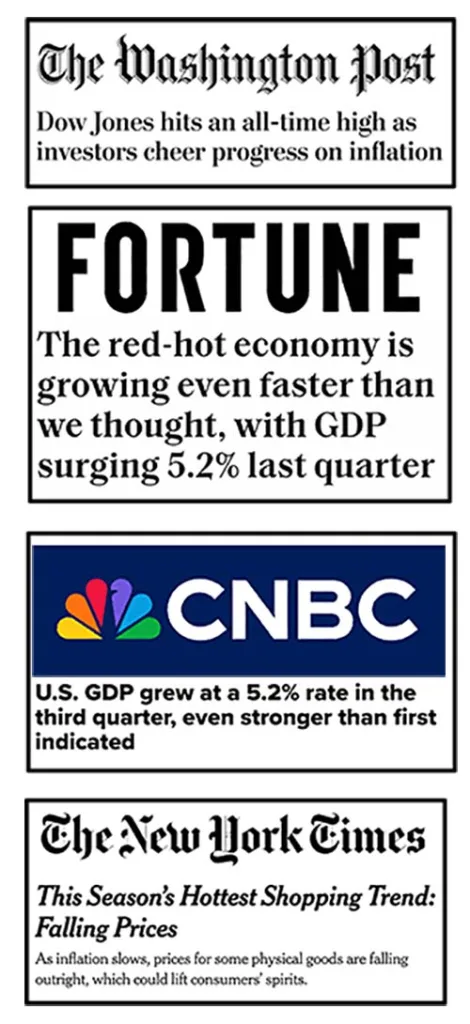
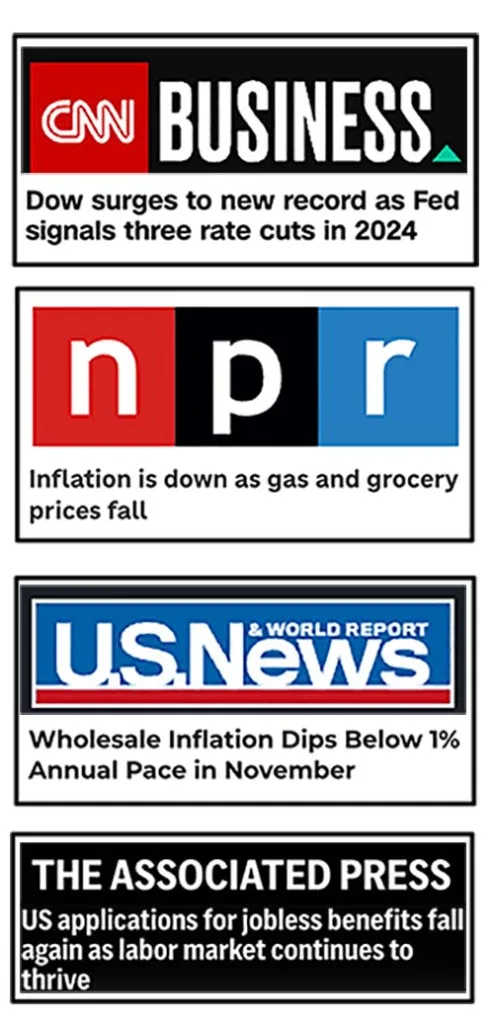
If you haven’t seen the business headlines lately, the U.S. economy is so bad that the stock market hit a record high this week.
Twice.

As Reuters reports:

U.S. stocks ended firmer on Thursday, with the Dow Jones Industrial Average notching its second straight record high close, lifted by optimism that borrowing rates will decrease next year following a dovish pivot by the Federal Reserve…[Pols emphasis]

…The Fed left interest rates unchanged on Wednesday, as expected, with Chair Jerome Powell saying the historic tightening of monetary policy was likely over, as inflation falls faster than expected, and discussions on cuts in borrowing costs were coming “into view.”

As CNBC reported this week, the U.S. economy is so terrible that people are feeling better about it:

Two new surveys released in recent days suggest consumers may be starting to feel more optimistic about inflation.

This could be welcome news for President Joe Biden, whose 2024 reelection campaign is battling a stubborn economic gloom tied directly to high consumer prices.

The New York Federal Reserve’s November consumer survey, released Monday, found that consumers expect inflation will be 3.4% over the coming year. That’s a drop of 0.2 percentage points from what consumers predicted in October, and the lowest expected level of inflation the survey has seen since April 2021. 

A separate survey from the University of Michigan released Thursday recorded an even sharper shift in consumer confidence.

Year-ahead inflation expectation fell by around 30% in a single month, a remarkable turn. [Pols emphasis]

And here’s “Fortune” from late November:

The U.S. economy, the world’s largest, has proved resilient even as the Federal Reserve has raised its benchmark interest rate 11 times since March 2022 to fight the worst bout of inflation in four decades. Those higher interest rates have significantly increased consumer and business borrowing costs. But they have also helped ease inflationary pressures: Consumer prices rose 3.2% last month from 12 months earlier, a marked improvement from the 9.1% year-over-year inflation recorded in June 2022.

The U.S. job market is cooling from the red-hot levels of the past two years. But it’s still healthy by historical standards: Employers are adding an average of 239,000 jobs a month this year. And the unemployment rate has come in below 4% for 21 straight months, the longest such streak since the 1960s. [Pols emphasis]

This bears repeating: Thee unemployment rate in the U.S. hasn’t been this consistently low since the late 1960s.

By just about every statistical benchmark, the U.S. economy is humming along at an incredible pace. Despite the rhetoric you see online or hear at the water cooler, economic news is very, very, very good.

As Nick Hanauer recently wrote for “TIME” magazine, “Bidenomics” is not just a slogan anymore:

Despite record-low unemployment, rising real wages, strong GDP growth, and a rapid fall in the inflation rate to below both global and historical averages, only 36 percent of Americans say they approve of Biden’s handling of the economy. Given such weak approval numbers, “Bidenomics” might at first appear to be an ill-advised slogan for a reelection campaign.

But to dismiss Bidenomics as mere sloganeering is to miss the point: The Biden Revolution is real, and running on Bidenomics is key, not just to winning reelection, but to winning the battle to establish a new consensus over how to manage and build our economy in the decades ahead. 

Like Reaganomics before it, Bidenomics is largely an argument over economic cause and effect. Bidenomics argues that a large and thriving middle class is the primary cause of economic growth. “When the middle class does well, everybody does well,” the President has repeatedly explained. This is the core proposition of Bidenomics: that prosperity grows from the bottom up and the middle out. [Pols emphasis]

Look, another amazing economic number!

The political question, then, is about why Americans keep expressing that they feel like the economy is in bad shape. The Associated Press recently tried to dig into this phenomenon, noting that “Pollsters and economists say there has never been as wide a gap between the underlying health of the economy and public perception.”

The New York Times has also recently examined the odd “bad vibes” around the economy, pointing in part to viral social media posts from people complaining about price increases; like anything else on social media, negative news goes viral faster than its counterpart.

Much of this is because of learned expectations. Consumer prices rose almost imperceptibly for decades, which made significant jumps in recent years stand out more for the average American — price increases feel different now because more people remember when they were much lower. This is sort of the modern equivalent of your grandparents talking about how a gallon of milk used to cost only a quarter; it seems fantastical to imagine out of context, just as it would have seemed absurd 70 years ago to ponder paying more than a dollar for any food item at the grocery store.

From a political messaging perspective, Republicans are well aware that they need to obscure the reality of our current economic success. From the same AP story:

The Republican counter to Biden has been to dismiss the positive economic data and focus on how voters are feeling. As the annual inflation rate has fallen, GOP messaging has focused instead on multi-year increases in consumer prices without necessarily factoring in wage gains. And Republican lawmakers have argued that people should trust their gut on the economy instead of the statistics cited by Biden. [Pols emphasis]

Not an economist

There it is: You gonna trust facts and data, or you gonna listen to what Bubba from West Virginia done said on Tik Tok?

As always, Republicans have no real ideas on economic policy other than to continue arguing that we should give more tax breaks to the rich in case wealthy Americans suddenly decide to pass it on to others. As Dana Milbank writes today for The Washington Post, the Republican-controlled House of Representatives may well go down as the least-productive Congress in history. As in, like, ever.

If you can’t talk about what you are doing, and you don’t want to talk about what your opponents are doing, then the only strategy left is to yell “SQUIRREL!” and/or initiate an impeachment investigation into President Biden for reasons even the most dedicated MAGA follower couldn’t explain for all the money in the world.

President Biden and Democrats will need to be more diligent in 2024 about selling the story (and the data) of America’s continued economic growth. You can help, too: When your drunk uncle starts whining about the economy over the holidays, pull out some of these facts and let ’em fly. Maybe you won’t change his mind, but one of the best ways to fight disinformation is to make sure that actual information gets out into the world.

The results of the 2024 election may well depend on it.

Comments

Recent Comments


Posts about

Donald Trump
SEE MORE

Posts about

Rep. Lauren Boebert
SEE MORE

Posts about

Rep. Gabe Evans
SEE MORE

Posts about

Colorado House
SEE MORE

Posts about

Colorado Senate
SEE MORE

60 readers online now

Newsletter

Subscribe to our monthly newsletter to stay in the loop with regular updates!