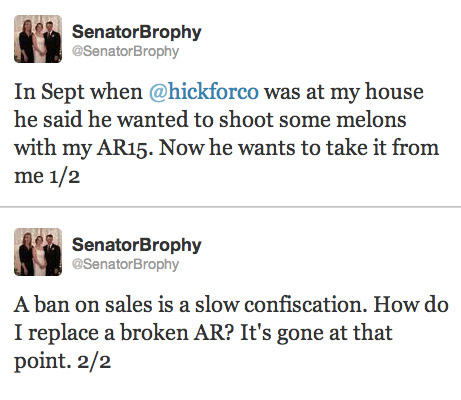
UPDATE: Sen. Greg Brophy’s opposing view noted for the record:

—–
A major story coming out of the 2012 elections last month concerned lavish amounts of money spent by favored Republican message groups–the most frequently-cited example being Karl Rove’s “Super PAC” American Crossroads–with an absolutely horrible “rate of return” on that spending as measured by candidates who actually won. In the case of American Crossroads, the nonpartisan Sunlight Foundation estimated that only about six percent of the hundreds of millions spent by that group was spent in races where the Republican candiate prevailed.
So the question naturally occurred to us this weekend: how did the gun lobby do?
As the Washington Post reported right after the elections:
The Sunlight Foundation ran the numbers and found that after spending nearly $11 million in the general election, the National Rifle Association got a less than one percent return on its investment this cycle. That is, less than one percent of the money went toward the desired result.
The group supported 27 winning candidates, but most of its money was spent targeting winning Democrats (including over $7 million against President Obama) or bolstering losing Republicans (including $1.8 million supporting Mitt Romney and $500,000 backing Indiana Senate candidate Richard Mourdock).
The NRA’s lobbying arm, the NRA Institute for Legislative Action, fared only a bit better – 10 percent of its money went to winning candidates.
Answer: not real well, folks.
There are two ways to look at this situation. The fact that the National Rifle Association was able to bring tremendous assets to bear in races around the country demonstrates what an on-paper formidable organization the gun lobby remains. Certainly, Republicans can’t be expected to perform as poorly in every election as they did in 2012–it just wasn’t a Republican year, in so many respects that have nothing whatsoever to do with guns.
But the NRA’s extremely poor rate of return on its electoral spending in 2012, even lower than Rove’s embarrassingly bad success rate with the millions he controlled at American Crossroads, reveals something nonetheless important: the gun lobby doesn’t have any special powers of persuasion. Guns, as a partisan electoral issue, appear no more persuasive for Republicans than anything else they run on, and in 2012, that meant the issue wasn’t persuasive at all.
In Western states like Colorado, Democrats naturally run on a more deferential platform toward gun rights than their counterparts in, say, New Jersey. This reduces the effectiveness of gun policy as a GOP issue here, and also allows local Democrats to lead on gun policy reforms, when the moment presents itself, with a degree of bipartisan credibility. The simpleminded attacks against “gun grabbing” Democrats don’t work as well here, because our Democrats are less vulnerable to them, and better able to appeal to responsible gun owners.
In key ways, we’d say the much-feared “gun lobby” has an underreported bark/bite imbalance.
Subscribe to our monthly newsletter to stay in the loop with regular updates!
Comments