U.S. Senate See Full Big Line

(D) J. Hickenlooper*

(D) Julie Gonzales

(R) Janak Joshi

80%

40%

20%

(D) Michael Bennet

(D) Phil Weiser
55%

50%↑
Att. General See Full Big Line

(D) Jena Griswold

(D) M. Dougherty

(D) Hetal Doshi

50%

40%↓

30%

Sec. of State See Full Big Line
(D) J. Danielson

(D) A. Gonzalez
50%↑

20%↓
State Treasurer See Full Big Line

(D) Jeff Bridges

(D) Brianna Titone

(R) Kevin Grantham

50%↑

40%↓

30%

CO-01 (Denver) See Full Big Line

(D) Diana DeGette*

(D) Wanda James

(D) Milat Kiros

80%

20%

10%↓

CO-02 (Boulder-ish) See Full Big Line

(D) Joe Neguse*

(R) Somebody

90%

2%

CO-03 (West & Southern CO) See Full Big Line

(R) Jeff Hurd*

(D) Alex Kelloff

(R) H. Scheppelman

60%↓

40%↓

30%↑

CO-04 (Northeast-ish Colorado) See Full Big Line

(R) Lauren Boebert*

(D) E. Laubacher

(D) Trisha Calvarese

90%

30%↑

20%

CO-05 (Colorado Springs) See Full Big Line

(R) Jeff Crank*

(D) Jessica Killin

55%↓

45%↑

CO-06 (Aurora) See Full Big Line

(D) Jason Crow*

(R) Somebody

90%

2%

CO-07 (Jefferson County) See Full Big Line

(D) B. Pettersen*

(R) Somebody

90%

2%

CO-08 (Northern Colo.) See Full Big Line

(R) Gabe Evans*

(D) Shannon Bird

(D) Manny Rutinel

45%↓

30%

30%

State Senate Majority See Full Big Line

DEMOCRATS

REPUBLICANS

80%

20%

State House Majority See Full Big Line

DEMOCRATS

REPUBLICANS

95%

5%

Generic selectors
Exact matches only
Search in title
Search in content
Post Type Selectors
December 10, 2011 10:47 PM UTC

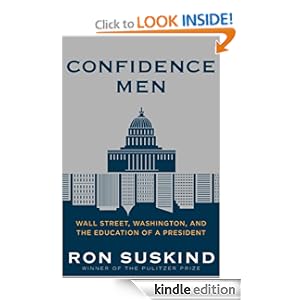
Confidence Men: Wall Street, Washington, and the Education of a President

  •  
  • by: DavidThi808

Wow. This is an incredible book. Hard to put down. It goes through the first couple of years of the Obama administration, primarily discussing how he handled the financial meltdown and stabilization. (We can’t say recovery yet because so far there has been no recovery.)

A lot of what’s in here is the author’s (and other’s) opinion of why people made decisions. But on the specific facts, what people said, what people did, how people were treated – none of that has been disputed by the principals covered. And those facts alone are incredibly damning.

The president turned the economy over to Sumners, Geithner, & Emanuel – three people who helped eviscerate FDR’s financial reform at the end of the Clinton Administration. And then were cheerleaders for Wall St. as it went wild over the last decade. A President who wanted to truly get all views day in and day out would have had one of those three, but then had Volker in one of the roles and third person as chief of staff.

The president also comes across as someone who allowed those three to seal him off in a bubble where they determined what was presented to the President. And then, in many cases, ignored the decision of the President and continued with what they thought was the best policy.

The clear conclusion of the book, although Suskind never explicitly says it, is that President Obama is a poor manager. That’s not terribly surprising, it’s a super difficult job managing the people at that level and Obama didn’t have any experience at this level. (The same is true of Bush where Cheney, Rumsfield, & Co. ran things.)

It’s a sad picture of something we all had such high hopes for. But it is a fascinating read. And it provides a lot of context for the disappointments of the last 2½ years.

Krueger put it to Obama bluntly. The American workforce was on an unsustainable course: overworked, heavily stressed, inadequately insured against rising health costs, and moving more deeply into debt each year.


I’m a professor of civil reengineering at Princeton. And I was up at Yale the other day and they’ve given up teaching civil engineering. There are just two old geezers like me up at Harvard, and once they’re gone that’ll be it. There’s hardly an elite university in the United States that pays attention to civil engineering. What’s the result? We hardly know how to build bridges; they tend to fall down. It’s cost twice as much to build that new bridge across the Potomac as it would have cost if it was built in Europe . . . I assure you, I know . . . and besides our bridges are ugly and theirs are beautiful.’ ”


But that’s what Gensler was now doing with one of country’s most powerful, self-sustaining, play-for-keeps communities: Wall Street. Its ethos and ethics had altered the way people thought about hard work, honesty, self-reliance, and fair practice-what de Tocqueville once called America’s admirable and accessible “bourgeois virtues.” Wall Street had bet against people who believed in those sleepy mores, and year after year, it had won huge.


While Orszag wouldn’t publicly affirm Summers’s critique of the president’s abilities-saying later, “I don’t want to go there”-he wouldn’t disagree, either. He sat in meeting after meeting where the president would cover the same issue, or controversy, or policy dilemma, and “relitigate” it, in the president’s parlance, over and over. Decisions were left unmade; policies drifted without direction. It wasn’t a matter of intellectual framing. The president seemed to grasp the nature of key policy dilemmas, like a journalist, or narrator, or skilled observer. The problem was in guiding the analysis toward what a president is paid, and elected, to do: make tough decisions.


“For Washington to not demand anything when it saved us, even stuff that we know is for our long-term good, was one of the stupidest moves in modern times. I figured Obama understood that-it wasn’t a nuanced point-and that he’d act as we started to pull out of the abyss six months ago. But he didn’t, and I don’t know who to thank. I feel like I should go over and hug Tim. It’s a shame we can’t pay him, ’cause that’s a guy who really earned a big-time bonus.”


“You can’t run a policy based on a misdirection, on a fiction,” she said. “I don’t know what the president is thinking. I don’t see the president. He meets with bankers. He doesn’t meet with me. But if he’s involved in this at all, he’s got to know that his angry words at Wall Street, at their recklessness and dangerous incentives in compensation, about how they do their business in ways utterly divorced from what’s actually good for the economy-that he can’t just say that sort of thing, and then dump money in their laps and be credible. Tim and Larry’s whole plan is just like Argentina in the 1980s. There was this giant hole marked ‘Banks’ and the government just dumped money in that hole, as much as they had, while they lied about it. That’s what Larry thinks: that the U.S. is Argentina!”


“To not see this coming, and not start to act, even back in November, after we got slaughtered in the governors’ races, wasn’t an asleep-at-the-switch issue,” said a close aide to Obama. “It was utter incompetence. This is what political aides get paid for. This is their job.” In January-with two weeks, still, until the day of the special election-the White House called Coakley’s campaign strategist, Dennis Newman, to see what help Washington could offer. He said they were fine. Nothing was done.


yelling, ‘We have no fucking credibility!’ Seeing Democrats and Republicans going at the same unresolved issues, side by side, highlighted that this might have been the only area of actual bipartisanship-the kind of bipartisanship the president was searching endlessly for. But here was our guy getting pilloried.”


This is, of course, the way criminal syndicates rise up. It’s an issue of might. If the government, with its power of law and prosecution, can’t challenge them, they spread, and their influence deepens. The large banks and their companions, unregulated hedge funds, had increasingly taken ownership of the trading enterprise, opened new casinos dealing with the more complex, often shadowy realm of debt, and figured out ways to rig it on their behalf. For the clients and smaller competitors, this hard reality first brought frustration, then, year by year, acquiescence, and finally a kind of furtive participation. If it’s not going to change, then why not be part of it? If they didn’t sign on, their competitor would. The aim for clients is to be large enough, or strategically important enough, that Goldman sees them as valued partners and protects them or, even better, gives them a cut.


One other thing “all the latest reforms” shared was they were all battered, or already buried, because none of them, including his amendment, “have really been supported by the president-not really.”


After an hour of discussion, Krueger asked the undergraduates to introduce themselves and say something about their plans or their goals. About half were economics majors, but the other half were spread across many disciplines-history, philosophy, biology. One after another, they said they planned on going to Wall Street. All of them.

Comments

Recent Comments


Posts about

Donald Trump
SEE MORE

Posts about

Rep. Lauren Boebert
SEE MORE

Posts about

Rep. Gabe Evans
SEE MORE

Posts about

Colorado House
SEE MORE

Posts about

Colorado Senate
SEE MORE

101 readers online now

Newsletter

Subscribe to our monthly newsletter to stay in the loop with regular updates!