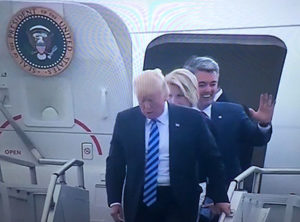
The Washington Post has an interesting story up today about the drag of President Trump on Republicans in 2018 and 2020. The gist of the story, which features Colorado as a prominent example, is that 2018 proved Trump to be helpful to Republicans in states where people already liked Trump, but a real problem everywhere else:
“Trump just overwhelms and takes all of the oxygen out of the room and it’s all focused on him,” said Sen. Jeff Flake (R-Ariz.), [Pols emphasis] a critic of the president who declined to run for reelection…
…Republicans in rural parts of Kentucky, Georgia and Tennessee were newly excited about the election, according to Democratic polling in those races, increasingly favorable toward the president and cheered by the recent confirmation of Supreme Court Justice Brett M. Kavanaugh. In suburban, wealthier parts of the country such as Northern Virginia, the opposite was happening, as moderates recoiled…
…Strategists from both parties say the president, in effect, erected a wall that broke the blue wave, allowing Republicans to hold onto key House seats and defeat Democratic Senate incumbents in conservative Missouri, Indiana and North Dakota. The same strategy, however, empowered Democrats to win decisive victories in formerly Republican suburbs in New Jersey, New York, Pennsylvania, California and the otherwise reliably red state of Texas.
Trump’s late campaigning may have saved Republican candidates in states like Florida, where the GOP narrowly won contests for U.S. Senate and Governor. But Florida is also a state that Trump won in 2016 (albeit narrowly). In states like Colorado, where Trump lost to Democrat Hillary Clinton, the outcome was much different:
“It was very difficult to try to make a case — particularly to suburban, college-educated women who were so upset with the president — to vote for me when they felt there needed to be a greater check on his power,” said Rep. Mike Coffman (R-Colo.), who lost his suburban Denver district by more than 11 points after winning by 8 points in 2016.
Coffman’s experience was certainly not unique. Republican-leaning outfit Magellan Strategies found Trump to be quite the albatross for the the GOP in 2018. From Denver7:
Thirty-four percent of respondents said they were less likely to vote for a Republican candidate in the election because of Trump’s influence, and Trump’s approval rating is far underwater among Colorado’s unaffiliated voters: His approval rating is 31 percent among the group, while 62 percent said they disapproved of the job he is doing as president and 48 percent said they strongly disapproved.
Flaherty said in his analysis those numbers made Trump’s overall approval rating “toxic” and that “it is quite clear that any association with Donald Trump and his policies harmed Republican candidates in most parts of Colorado” in this year’s election.
Colorado Sen. Cory Gardner (R-Yuma), the 2018 chair of the National Republican Senatorial Committee (NRSC) added his “no shit, Sherlock” analysis in a comment to the Washington Post:
“The states where we saw the most success with the rallies were states where he won by 20 points or 30 points or 40 points,” said Gardner.
Colorado, of course, is not one of those states. It is clear that Trump was a mighty albatross for Colorado Republicans in 2018, and with his name on the ballot again in 2020, the impact may be even worse.
Subscribe to our monthly newsletter to stay in the loop with regular updates!
Comments